
GamingNexus’s enthusiastic review calls the FG3 the best wired multipurpose headset the reviewer has used, praising its music playback, console compatibility, detachable ENC microphone and browser-based tuning. FiiO’s first dedicated gaming headset does put an unusually ambitious feature set into the sub-$70 tier: coaxial 50 mm and 16 mm dynamic drivers, a built-in DAC and headphone amplifier, hardware controls, detachable boom mic, virtual surround modes, and profile storage without a Windows utility running in the background.
The catch is that the experience depends substantially on using the USB hardware and spending a few minutes with FiiO Control Web. Independent testing from Tom’s Guide reached a more measured conclusion: the FG3 is comfortable, capable and strong value after adjustment, but its default sound was described as muddy and its plastic construction as a clear cost-saving compromise. A brief audition reported by ecoustics likewise found the sound surprisingly good for the price while noting mild roll-off at both ends of the frequency range.
For Windows gamers, that makes the FG3 less of a blind “best headset” recommendation than a high-value wired headset for people willing to configure it.
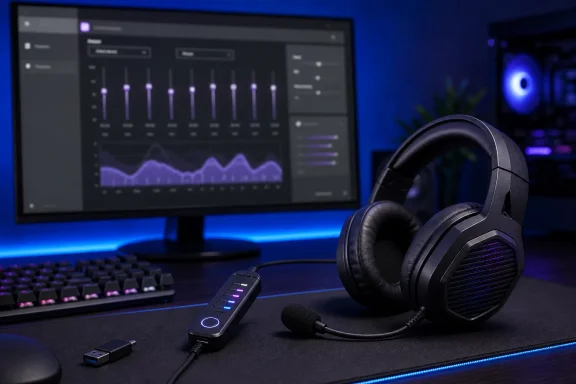 The USB-C inline DAC is the actual product
FiiO sells the FG3 as a cross-platform headset, and that is true in the practical sense: it can connect over USB-C or USB-A with the included adapter, while the headset itself also has a short 3.5 mm lead. FiiO says the USB connection works without drivers on Windows 7, Windows 8, Windows 10 and Windows 11, with UAC 1.0 and UAC 2.0 support intended to broaden compatibility with consoles and mobile devices.
But the analog and USB connections are not equivalent.
On a Windows PC, the USB-C inline controller is the connection to use. It contains the device’s DAC and DSP processing, gives access to the onboard controls, and is where custom profiles are stored. Plugging the headset into a controller or a standard analog audio jack may remain convenient for basic playback, but it bypasses the digital signal chain that FiiO is using to distinguish the FG3 from ordinary low-cost wired headsets.
Tom’s Guide specifically found that connecting through a PlayStation controller’s 3.5 mm jack meant losing access to saved EQ presets and custom profiles held by the DAC. The same practical limitation applies to an analog PC connection: the headphones will work, but the tuned USB configuration will not travel through the headset’s passive 3.5 mm path.
The cable specification also deserves more careful reading than the “1.5 meter cable” shorthand in the GamingNexus review. The headset’s built-in 3.5 mm lead is approximately 0.7 meters, and the USB DAC extension adds roughly 1.5 meters, for a combined USB run in the neighborhood of 2.2 meters. That is generous enough for a desktop setup, but it is still short for a living-room console arrangement unless the player is seated close to the machine or uses a suitable extension solution.
FiiO Control Web avoids an app, not configuration
FiiO’s browser-based control page is the FG3’s most interesting PC feature. Rather than installing a resident Windows application such as Logitech G Hub, Razer Synapse or SteelSeries GG, users connect the headset over USB, open FiiO Control Web in a browser, adjust a 10-band EQ and hardware options, and save their changes to the inline DAC.
That approach has real advantages for users who are tired of peripheral software adding startup tasks, background services and account prompts. A profile saved to the hardware should also make more sense than a PC-only preset when moving between a desktop, laptop and compatible USB-equipped console.
It does not mean the FG3 needs no setup. It means the setup lives in a browser rather than an installed application.
That distinction matters because default tuning has emerged as the dividing line in early reviews. GamingNexus praised the improvement achieved after EQ adjustments and described the result as competitive with more expensive Sennheiser and Nacon headsets. Tom’s Guide independently reported that the FG3 became substantially better after switching away from its default settings, but criticized it for needing that intervention in the first place. Its reviewer found the default game profile lacked impact and reduced high-frequency clarity, while the default music profile sounded muffled and distant.
The evidence supports a practical recommendation: connect the FG3 to a Windows PC over USB before judging it. Test the presets, try a flat profile, and make modest EQ changes before deciding whether the headset’s sound suits your games and music. Buyers looking for a headset that sounds finished the moment it leaves the box should treat the FG3’s web configuration as a requirement, not a bonus.
“7.1 surround” is virtual and mode-specific
The FG3 has two physical driver units in each earcup, but it is not a multichannel speaker system. Its 7.1 feature is virtual surround processing performed by the headset’s onboard DSP.
FiiO’s own documentation narrows the claim further: virtual 7.1 is active only in the Cinema and Action modes. The FPS, MOBA and rhythm-game presets do not include the virtual surround processing. That is an important qualification for PC players who might otherwise assume that selecting the FPS mode automatically activates surround positioning.
There is nothing unusual or inherently deceptive about virtual surround; most gaming-headset surround modes are DSP simulations delivered through stereo earcups. The important point is that it is a processing choice, not a universal characteristic of the headset. Some players will prefer FiiO’s virtualized Cinema or Action profiles for open-world games, films and more dramatic presentation. Others may prefer conventional stereo for competitive shooters, where the game engine’s own headphone mix and cleaner EQ can provide more predictable positional cues.
GamingNexus described the headset as particularly effective in a 7.1 presentation during Assassin’s Creed Black Flag Resynced, with ship sounds and dialogue appearing around the listener. That is a valid use case for a virtualized mode. It should not be read as proof that every game, every platform and every preset will benefit from surround processing.
The dual-driver design has promise, but not a free pass
The FG3’s most distinctive hardware decision is its coaxial driver layout. A 50 mm dynamic driver handles low and midrange frequencies, while a smaller 16 mm driver handles higher frequencies through an electronic crossover. FiiO says placing the two drivers on the same axis helps phase consistency and directional presentation.
That is more unusual than the single 40 mm or 50 mm driver commonly found in budget gaming headsets, and it helps explain why the FG3 has attracted attention from audio-focused reviewers. FiiO also lists up to 192 kHz/24-bit decoding and an 80 mW headphone amplifier in the USB unit, specifications that are meaningful primarily when using the USB connection.
Specifications alone do not settle how a headset sounds. Ecoustics heard respectable overall performance at CanJam London 2026 but noted modest frequency-extreme roll-off. Tom’s Guide liked the performance after tuning but found the default voicing too subdued. Those observations are more useful than treating dual drivers or high-resolution support as an automatic guarantee of superior playback.
The other common point of agreement is physical construction. At roughly 315 grams including the mic, the FG3 is light for an over-ear headset and uses mesh-covered memory-foam pads that reviewers have found comfortable. The tradeoff is a mostly plastic chassis. GamingNexus objected to a somewhat loose fit; Tom’s Guide reported slight creaking from the swiveling earcups and described the construction as flimsy. Neither finding proves a durability problem, but the FG3 is too new for long-term reliability evidence to exist.
A strong Windows value, with clear limits
FiiO has made a smart first move into gaming headsets by putting its audio electronics and browser-controlled EQ where the price competition is fiercest. The FG3 offers Windows users a rare combination at $69.99: no required driver package, hardware-stored tuning, USB audio processing, a detachable noise-reducing microphone and an analog fallback for devices that lack USB support.
The better reading of the early reviews is not that FiiO has somehow made every established $150 headset obsolete. It is that the FG3 can punch far above its price when it is connected over USB and configured properly. Its default tuning, plastic build, wired-only design and short base cable remain material compromises.
For a Windows desktop or laptop gamer who prefers a cable, wants to avoid peripheral software, and does not mind opening a browser to tune an EQ, the FG3 is one of the more credible budget headset launches of 2026. For anyone planning to use it mostly through a controller’s 3.5 mm jack, the purchase makes less sense: that setup leaves much of the headset’s advertised advantage sitting in the inline DAC rather than in the earcups.
