
The shift matters to Windows administrators and service-desk leaders because it changes the operational question. Freddy is no longer being sold only as an assistant that helps an agent read, summarize, or draft a response. Freshworks is now asking customers to let agents retrieve live ticket, configuration, and knowledge data, then take actions in connected systems. That can reduce repetitive work, but it also makes identity controls, approval design, logging, and rollback procedures part of the implementation—not optional cleanup after an AI pilot.
The submitted Markhub24 analysis correctly identifies Freshworks’ core commercial logic: package AI inside products customers already operate rather than make mid-market IT teams buy, build, and integrate a separate AI stack. The company’s product announcements and investor materials support that direction. But the practical story is more constrained than the “service transformation” marketing language suggests: key MCP capabilities remain in early access, availability varies by Freshservice plan, and an autonomous workflow is only as reliable as its permissions, source data, and integration design.
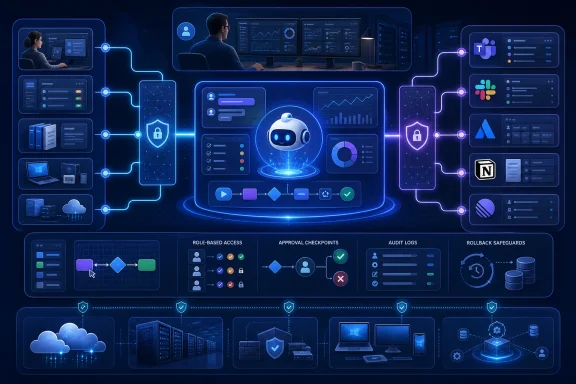 Freddy’s progression from Copilot to service operations
Freshworks introduced Freddy’s generative-AI features in 2023 as self-service, agent-assist, and insight products. Freddy AI Copilot became the human-facing component: it can summarize tickets, suggest responses, surface similar incidents, and help agents work through long request histories. Freddy AI Agent is the self-service and automation component, intended to answer questions or carry out defined work before a human agent handles the ticket.
That separation still matters. A Copilot feature generally improves the productivity of a named technician or support representative. An AI agent can alter the flow of work itself by deflecting tickets, initiating a request process, or interacting with systems outside the service desk. The risk profile changes as soon as the tool moves from recommending an action to performing one.
Freshworks has disclosed meaningful adoption of its paid AI products. In its second-quarter 2025 earnings call, the company said more than 5,000 customers were paying for Copilot and AI Agent products, with annual recurring revenue from those offerings exceeding $20 million. Its 2026 investor materials also continued to present paid AI adoption and attach rates on larger Employee Experience deals as operating metrics, rather than treating Freddy solely as an undifferentiated product feature.
This disclosure discipline is unusual enough to be useful, but it should not be confused with independently measured customer outcomes. Freshworks’ published customer metrics and ticket-deflection figures are vendor-reported. They establish how the company is measuring the product and how it is selling the product; they do not establish that every deployment will produce similar savings, resolution times, or staffing reductions.
The May release makes MCP the consequential feature
The largest technical change in the May 2026 release is the MCP Gateway. Model Context Protocol, or MCP, is a standard for allowing AI applications to obtain structured context and invoke tools. Freshworks describes its gateway as serving two directions.
Inbound MCP is intended to let external AI tools query Freshservice information such as tickets, configuration items, and knowledge content. Freshworks specifically lists tools including Cursor, Claude, and Microsoft Copilot among the environments where that context can be used. Outbound MCP lets Freddy AI Agents act through connected applications, with Freshworks naming Atlassian products, Notion, and Linear as examples.
For IT teams, that should be read as an integration and access-control project, not as a chatbot deployment. A ticket’s contents can include passwords accidentally pasted by users, asset identifiers, internal hostnames, license information, customer data, HR context, and incident details. Making that data useful to an AI client requires a careful decision about which identities may query what, which fields are exposed, how responses are retained, and whether a user can cause the agent to disclose information from a ticket they were never authorized to read.
Freshworks says its MCP connections use role-based access controls and are governed through the platform. That is a necessary baseline, but the announcement does not spell out a universal permission model for every third-party MCP server, every external action, or every customer’s data-retention requirements. Administrators should demand that detail before granting an agent rights that extend beyond read-only knowledge retrieval.
There is another constraint absent from much of the promotional discussion: the MCP Gateway is listed as an Early Access Program. Inbound Freshservice MCP is available to Enterprise-plan customers, while outbound access requires Growth, Pro, or Enterprise plus an active Freddy AI Agent Studio. Freshdesk availability has a separate set of conditions. “Available” therefore does not mean every Freshworks tenant can deploy the same workflow today.
Agent Studio changes who can create automation
Freshworks is positioning Freddy AI Agent Studio as a no-code builder that lets service teams start with prebuilt IT and HR agents or create custom agents using business rules, knowledge sources, workflows, integrations, and APIs. The company says its agents can operate across more than 30 app integrations and can meet users in Microsoft Teams, Slack, and employee portals.
For organizations that have spent years keeping workflow changes behind a small ServiceNow, Power Platform, or ITSM administration team, this is the disruptive element. No-code lowers the time and skill barrier for automation. It can also lower the barrier to creating an over-permissioned, poorly tested process that resets access, updates a record, or opens a downstream request based on ambiguous language.
The right deployment pattern is narrower than Freshworks’ broad “AI workforce” framing. Start with a high-volume, low-impact task whose completion criteria can be tested: password-reset guidance, software-request routing, knowledge lookup, standard onboarding questions, or creation of a draft request for human approval. Keep actions that alter identity, payroll, endpoint management, procurement, production access, or security controls behind explicit approvals until the team has evidence that the agent handles exceptions safely.
A useful initial control set includes:
- The agent should receive its own least-privilege service identity rather than inheriting an administrator’s standing permissions.
- Each workflow should define an owner, a business purpose, approved data sources, an escalation path, and a tested rollback method.
- Teams should log the prompt, retrieved sources, tool calls, final action, and approving identity for every consequential transaction.
- Knowledge sources should be cleaned and access-scoped before they are made available to an agent, because outdated or overly broad content becomes an operational error at machine speed.
- Initial production use should measure incorrect routing, unsupported answers, unauthorized-action attempts, and human rework—not merely ticket deflection.
Device42 and FireHydrant fill gaps around the agent
Freshworks’ broader integration strategy is not limited to language models. The company acquired Device42 in June 2024, adding asset discovery and IT asset-management capabilities, then completed its acquisition of incident-management vendor FireHydrant in January 2026. Freshworks describes FireHydrant as its incident-management and reliability layer inside a wider ServiceOps offering.
That sequence explains why the company is emphasizing “service, asset, and incident” data together. An AI agent that only sees a user’s ticket can offer generic advice. An agent with current configuration, ownership, service dependencies, change history, and incident context can in principle give a more relevant answer or trigger a more appropriate workflow.
Yet joining these systems does not automatically make the data trustworthy. Asset inventories frequently have duplicate records, stale owners, unmanaged devices, incomplete cloud discovery, and unreliable relationships between services and infrastructure. Incident systems carry a different problem: a live incident often contains preliminary conclusions that later prove wrong. Giving an AI agent more context can improve its decisions, but it can also give it more stale or unverified material to repeat with confidence.
Freshworks’ acquisition record gives the company a stronger basis for an integrated ITSM and IT operations pitch against ServiceNow than Freddy alone would provide. The near-term work for customers is less glamorous: establish which system is authoritative for a configuration item, how discrepancies are resolved, and whether the agent is allowed to act when asset and ticket data conflict.
The commercial strategy is clear; the operational proof remains local
Freshworks has steadily converted Freddy from a bundled intelligence layer into a separately monetized product family, including per-seat Copilot pricing and usage-oriented AI Agent pricing. That aligns the company’s revenue model with a market where customers may pay for automated interactions rather than simply for additional human agent seats.
The Markhub24 report also points to Freshworks’ claim that many organizations prefer AI capabilities embedded in familiar service software instead of assembling point solutions. That is plausible, especially for mid-market teams with limited integration capacity. But embedded procurement should not create embedded complacency. The presence of Freddy inside Freshservice does not remove the need to test data boundaries, evaluate third-party connectors, or review every action an agent can initiate.
For Windows and enterprise IT teams, the immediate decision is not whether Freddy AI can summarize a ticket. It is whether the organization can safely define the permissions, data sources, and approval gates required to let an AI agent do more than summarize one. Freshworks has supplied the platform pieces; customers now have to supply the operational discipline.
