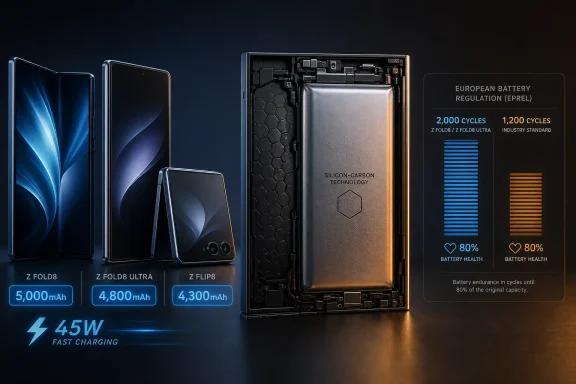
The immediate results are easy to see on the specification sheets. The Galaxy Z Fold8 Ultra has a 5,000mAh typical battery, the Galaxy Z Fold8 moves to 4,800mAh, and the compact Galaxy Z Flip8 carries 4,300mAh. At the same time, Samsung is continuing its campaign for thinner and lighter foldables, including a Fold8 Ultra that measures 4.1mm when open and weighs 215 grams.
Those numbers are significant because battery capacity, device thickness, camera hardware, display size, cooling, structural reinforcement, and hinge durability are constantly competing for the same internal volume. A silicon-carbon battery does not magically solve every engineering constraint, but it gives Samsung another important lever to pull.
The catch is that this technology comes with its own compromises. Silicon can hold far more lithium than conventional graphite, but it swells dramatically as it charges. That creates a long-term durability challenge that materials scientists and battery engineers have spent years trying to control. Samsung’s new foldables may demonstrate the physical benefits of silicon-carbon battery technology immediately, but their battery health after hundreds of charging cycles will require much more time to assess.
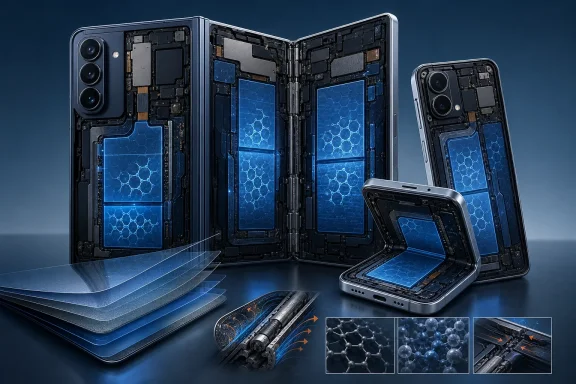 The Big Change: Still Lithium-Ion, But With a Different Anode
The phrase silicon-carbon battery can be misleading. It does not mean Samsung has abandoned lithium-ion chemistry for an exotic replacement, nor does it mean the Galaxy Z Fold8 family uses a solid-state battery.
These are still lithium-ion batteries. The key difference lies in the anode—the electrode that stores lithium during charging. Most consumer electronics batteries have relied heavily on graphite-based anodes because graphite is reliable, well understood, comparatively stable, and suitable for mass production.
Silicon changes the equation because it can store substantially more lithium than graphite. In broad terms, that higher lithium-storage capacity gives battery designers an opportunity to increase the amount of energy stored within a similar physical footprint.
For a conventional slab-style smartphone, that can translate into a larger battery without a major increase in thickness. For a foldable phone, the potential advantage is arguably even greater.
A foldable is not simply a normal smartphone split down the middle. It must accommodate a hinge assembly, multiple display layers, flexible display material, cameras, antennas, vapor chambers or other cooling systems, reinforcement components, speakers, charging hardware, and two battery sections arranged around the hinge. Every millimeter is contested.
That is why silicon-carbon batteries have become attractive to phone makers pursuing thinner devices without accepting smaller batteries.
Why “Silicon-Carbon” Is a More Accurate Name Than “Silicon Battery”
Samsung’s terminology also matters. The anode is not necessarily made of pure silicon, and the exact silicon percentage is not publicly disclosed.
Instead, silicon is integrated into a carbon-based anode structure. Carbon materials can provide electrical pathways and mechanical support while helping mitigate some of silicon’s instability. Manufacturers may use engineered particles, porous structures, coatings, binders, and electrolyte additives to make the silicon component more usable in a commercial battery.
The label silicon-carbon therefore describes a family of designs rather than one standardized formula. Two phones can both advertise silicon-carbon batteries while using notably different material ratios, manufacturing processes, voltage behavior, and cycle-life strategies.
Samsung has said it optimized the silicon proportion in the cells used by the Galaxy Z Flip8, Galaxy Z Fold8, and Galaxy Z Fold8 Ultra, but it has not published the exact figure. It has also indicated that the three foldables share the same silicon ratio.
That leaves an important information gap. Consumers can identify the technology category, but they cannot yet make precise chemistry-to-chemistry comparisons with rival silicon-carbon implementations.
Why Foldable Phones Need Higher-Density Batteries
Foldable phones have always faced a difficult battery problem. They are often physically larger than standard phones when unfolded, but they cannot simply devote all of that size advantage to a larger battery.
The internal architecture is much more complicated than a traditional handset. A book-style foldable has to fit a large interior display, a cover display, a durable hinge, flexible panel layers, and a chassis that can withstand repeated opening and closing. A flip-style device has a different challenge: it must remain compact enough when folded while fitting enough battery capacity to support a large display and high-end processor.
Silicon-carbon batteries allow manufacturers to allocate higher energy density in different ways:
- Increase battery capacity while keeping dimensions roughly similar.
- Reduce thickness while maintaining comparable capacity.
- Lower weight by using a smaller battery volume for a target capacity.
- Combine modest gains in capacity, thickness, and weight rather than maximizing only one.
- Free internal volume for cameras, cooling, reinforced frames, or larger displays.
Samsung appears to have used that flexibility differently across its new foldable lineup.
Galaxy Z Fold8 Ultra: Capacity Meets Thinness
The Galaxy Z Fold8 Ultra is the clearest example of Samsung using silicon-carbon technology to pursue more than one design goal at once.
Its 5,000mAh typical battery represents a meaningful increase over the 4,400mAh battery capacity used in the preceding Galaxy Z Fold generation. Yet Samsung is also positioning the Fold8 Ultra as its slimmest book-style Fold design to date, measuring 4.1mm when unfolded.
That does not mean every millimeter of the design improvement comes directly from the battery. Foldable thickness depends on the hinge, display stack, frame construction, camera layout, heat management, motherboard packaging, and numerous other components. Still, increasing battery capacity while aggressively reducing thickness would be much harder without improvements in energy density.
The Fold8 Ultra shows the practical appeal of silicon-carbon batteries: Samsung can avoid choosing between a larger battery and a more refined form factor.
Galaxy Z Fold8: The Lightweight Foldable Approach
The standard Galaxy Z Fold8 uses a 4,800mAh typical battery and weighs 201 grams. Samsung describes it as the lightest Galaxy Z Fold it has released.
This is an important point because foldables have often had a perception problem around weight. Even when thin, a large foldable can feel dense in a pocket, pull at clothing, and become fatiguing when used one-handed. Cutting meaningful grams while increasing capacity would be difficult with a conventional battery design and the same overall design targets.
The Fold8 therefore appears designed around balance. It does not push to the Fold8 Ultra’s 5,000mAh figure, but it combines a larger battery with a lighter body. That may prove more attractive for users who want foldable productivity without a device that feels like a small tablet folded into a pocket.
Galaxy Z Flip8: Prioritizing Portability
The Galaxy Z Flip8 takes a different path. It carries a 4,300mAh typical battery while emphasizing a thinner and lighter design.
A flip phone does not need to provide the large unfolded workspace of a book-style Fold. Its value proposition is portability: a full-size smartphone that closes into a more compact shape. That makes physical reduction especially meaningful.
Samsung has not disclosed precisely how much of the Flip8’s size or weight reduction is due to the silicon-carbon battery itself. It would be simplistic to attribute the entire design change to a battery chemistry update. But the battery technology gives Samsung more freedom to retain a respectable capacity target while reducing other physical compromises.
For the Flip8, silicon-carbon is less about chasing a headline capacity number and more about making the compact foldable concept feel less constrained.
More Milliamp-Hours Do Not Guarantee Longer Battery Life
It is tempting to assume that a 5,000mAh battery automatically delivers dramatically better real-world endurance than a 4,400mAh battery. In practice, battery runtime is determined by far more than the number printed on a specification sheet.
A larger battery is an advantage, but it is only one variable in a larger power-consumption equation.
The Factors That Shape Everyday Runtime
Actual battery life on the Galaxy Z Fold8 Ultra, Fold8, and Flip8 will depend on a mix of hardware and software behavior, including:
- Display size and brightness
- Refresh-rate behavior
- Processor and graphics efficiency
- 5G, Wi-Fi, Bluetooth, and GPS activity
- Modem signal strength
- Camera and video recording use
- Gaming workloads
- Background application activity
- Heat and ambient temperature
- Battery-saving software features
- Charging habits and long-term battery degradation
The Fold8 Ultra’s larger displays and higher-end hardware could consume some of the benefit created by its larger battery. A user who spends hours editing photos, streaming HDR video, navigating with GPS, using mobile data in weak coverage, or multitasking across the large internal screen may see a very different result from someone whose day revolves around messaging and web browsing.
The same applies to comparisons between the Fold8 and the Flip8. The Flip8’s smaller capacity does not necessarily mean it will always have shorter runtime. Its display requirements, thermal profile, internal layout, and software behavior are different.
Battery capacity is a useful baseline, not a complete battery-life verdict.
Typical Capacity Versus Rated Capacity
Samsung’s 5,000mAh, 4,800mAh, and 4,300mAh figures are typical battery capacities. The rated capacity can be lower, reflecting manufacturing variance and testing conventions.
This distinction is standard in the smartphone industry, but it remains worth understanding. The typical figure is the capacity consumers usually see in marketing material, while the rated figure represents a lower benchmark under defined conditions.
Neither number predicts screen-on time by itself. It only describes how much electrical charge the battery is designed to store under the relevant measurement framework.
The Central Engineering Problem: Silicon Swells
Silicon has one enormous appeal as an anode material: it can store far more lithium than graphite. It also has one enormous flaw: it expands substantially as it absorbs lithium during charging.
This expansion is not a minor inconvenience. It can be severe enough to crack silicon particles, weaken conductive pathways, damage the anode’s structure, and disrupt the protective chemical layer that forms between the electrode and the electrolyte.
When a lithium-ion battery charges and discharges, material changes take place at the microscopic level. With silicon, those changes are especially aggressive. The anode repeatedly expands and contracts, placing mechanical stress on the cell’s materials over time.
If the electrode structure loses integrity, battery performance can suffer in several ways:
- Capacity retention may decline faster.
- Electrical resistance can rise.
- Charging performance may become less consistent.
- Heat generation can increase under demanding conditions.
- The battery can lose usable lithium over repeated cycles.
- Long-term reliability may become more difficult to maintain.
This is why pure or highly silicon-heavy anodes are challenging to deploy at scale in consumer products. The theoretical benefit is compelling, but the practical solution must contain the mechanical consequences.
How Manufacturers Try to Control Silicon Expansion
A commercial silicon-carbon battery is not merely a matter of putting silicon into an anode and calling it finished. Battery makers use multiple material and structural techniques to make silicon more stable.
The exact implementation varies by manufacturer, but common strategies include:
- Carbon frameworks that help maintain electrical conductivity.
- Porous structures that create room for expansion.
- Particle engineering to reduce stress and cracking.
- Specialized binders that hold the electrode together.
- Protective surface coatings that improve interface stability.
- Electrolyte additives designed to support a more durable protective layer.
- Separator refinements that improve safety and ion flow.
- Cell architecture changes that better manage swelling and stress.
Samsung has said the new foldables involve changes beyond the anode material itself. The company has pointed to adjustments involving the electrolyte, separator, cell construction, expansion control, and overall battery architecture.
That broader approach is encouraging because it recognizes that battery performance is a system-level challenge. A stable silicon-carbon battery needs more than a better active material; it needs the surrounding components to work with that material over a long service life.
The Silicon Ratio Matters More Than the Label
One of the most important caveats around silicon-carbon smartphone batteries is that the term does not reveal the actual silicon content.
The phrase can cover a wide range of approaches. One manufacturer may use a relatively conservative amount of silicon to improve energy density while emphasizing cycle life. Another may push the silicon proportion higher in pursuit of maximum capacity, accepting a more difficult materials challenge.
That means two phones with “silicon-carbon batteries” may not be directly comparable.
Samsung’s refusal to disclose its exact silicon percentage is understandable from a competitive perspective, but it limits outside analysis. Without that figure, it is not possible to determine how aggressively Samsung is pursuing silicon loading compared with rivals.
A higher silicon proportion may create an opportunity for higher energy density, but it can also heighten expansion-related durability concerns. A lower proportion may be less spectacular on paper but easier to manage over the long term.
The most relevant measure for consumers is not the material label alone. It is the combination of:
- Capacity at launch
- Battery life under comparable real-world workloads
- Charging temperatures
- Capacity retention after sustained use
- Performance consistency after many charge cycles
- Safety under demanding thermal conditions
Until those data points are available, silicon-carbon remains a promising architecture rather than an automatic durability win.
Fast Charging Is a Related, But Separate, Story
The Galaxy Z Fold8 Ultra supports 45W wired charging through what Samsung describes as a dual-path charging architecture. The system is designed to distribute incoming power more efficiently across the battery arrangement.
That is a meaningful hardware development, but it should not be treated as proof that silicon-carbon batteries inherently charge faster.
Battery charging speed depends on an entire system:
- The battery’s cathode chemistry
- The anode design
- Internal resistance
- Charging controller behavior
- USB-C power-delivery implementation
- Thermal sensors
- Cooling hardware
- Battery-management software
- Temperature limits
- The charger and cable being used
Silicon-based anodes can be associated with strong charging potential, but the presence of silicon alone does not guarantee faster charging. A phone maker must balance peak charging speed against heat, long-term degradation, and safety.
Samsung has not said the Fold8 Ultra’s dual-path charging system exists specifically because of the silicon-carbon anode. The two features may complement each other within the same product, but they should be treated as distinct engineering decisions unless Samsung provides a direct technical connection.
The more meaningful test will be whether the Fold8 Ultra can maintain competitive charging times while controlling heat and preserving battery health over the device’s lifespan.
Battery Longevity Is the Unanswered Question
Samsung says the battery health and lifespan of its new silicon-carbon foldable batteries should be consistent with previous Galaxy devices. That is a reassuring claim, particularly for a company introducing this chemistry across multiple flagship products at once.
However, the public information currently leaves major questions unanswered.
Samsung has not published a detailed cycle-count target, a capacity-retention percentage after a defined number of cycles, or comprehensive testing conditions for the new cells. It has also not released detailed thermal data for sustained charging or intensive workloads.
That does not mean the batteries are unreliable. It means their long-term performance cannot yet be independently verified.
What Meaningful Long-Term Testing Should Measure
The first hands-on reviews can evaluate design, performance, display quality, camera output, and early battery life. They cannot establish whether a silicon-carbon battery will retain capacity as well as a traditional graphite-based battery after a year or two of real ownership.
The tests that matter most will include:
- Capacity retention after hundreds of full or partial charge cycles
- Heat during 45W charging on the Fold8 Ultra
- Battery behavior during extended gaming or 5G use
- Performance after repeated exposure to warm conditions
- Overnight idle drain and background power efficiency
- Charging-speed consistency as the device ages
- Long-term differences between the Flip8 and Fold models
- Effects of adaptive charging and battery-protection software
A foldable owner is likely to keep the device for several years because these products occupy the premium end of Samsung’s lineup. That makes long-term battery stability particularly important. A thinner design and a larger capacity are valuable at launch, but they lose much of their appeal if the battery declines sharply in the second or third year.
Samsung’s Safety Context Matters
Samsung’s focus on stability, cell structure, and battery architecture will inevitably be viewed through the company’s battery-safety history. The 2016 Galaxy Note7 recall remains one of the industry’s most visible examples of what can happen when battery engineering, manufacturing tolerances, and device packaging do not leave enough margin for error.
That history does not imply a defect in the Galaxy Z Fold8 series or the Galaxy Z Flip8. There is no basis for treating the new silicon-carbon cells as unsafe simply because they use a different anode approach.
But it does explain why Samsung’s public messaging around battery safety and reliability deserves close attention. New battery designs must prove themselves not just in capacity claims, but in conservative thermal behavior, resilient manufacturing quality, and consistent aging.
A Strategic Shift, Not a Battery Revolution
Samsung is late to silicon-carbon batteries compared with several Chinese smartphone manufacturers. Honor introduced the technology in commercial smartphones in 2024, and other major Android brands have since used silicon-carbon designs to push capacities beyond what once seemed realistic in slim flagship phones.
Samsung’s significance lies in scale and category leadership.
The company is bringing the technology into three different foldable products at once:
- A premium book-style flagship in the Galaxy Z Fold8 Ultra
- A lighter, broader-appeal book-style foldable in the Galaxy Z Fold8
- A compact clamshell in the Galaxy Z Flip8
That broad deployment suggests Samsung sees silicon-carbon not as an experiment reserved for one limited model, but as a core enabler of its future mobile hardware designs.
The move could also influence expectations across the wider premium smartphone market. Once a leading global brand uses higher-density batteries in its most visible foldables, consumers may become less willing to accept thinner devices with stagnant battery capacities.
For Windows and Android users who depend on phones as companion devices for cloud storage, mobile productivity, remote desktop access, Microsoft 365 workflows, Teams calls, authentication apps, and cross-device file sharing, battery life is not merely a convenience feature. It determines whether a foldable can function as an all-day work device rather than an impressive but power-hungry secondary screen.
The Bottom Line: Physical Gains Are Real, Durability Must Be Earned
Samsung’s first silicon-carbon batteries deliver a clear and measurable hardware advantage. The Galaxy Z Fold8 Ultra reaches 5,000mAh while pursuing an exceptionally thin foldable profile. The Galaxy Z Fold8 pairs a 4,800mAh battery with a lighter chassis. The Galaxy Z Flip8 uses its 4,300mAh battery to support a more portable clamshell design.
Those are not theoretical benefits. They are visible in the dimensions, weights, and capacities of the new devices.
What remains uncertain is how the batteries will age. Silicon brings higher energy density, but it also introduces swelling, mechanical stress, interface instability, and cycle-life challenges that require careful materials engineering. Samsung says it has addressed those issues through changes to the anode, electrolyte, separator, cell structure, expansion controls, and battery architecture, yet independent long-term testing has not had time to confirm the result.
The Galaxy Z Fold8 family therefore represents an important inflection point for Samsung foldables. The company has finally adopted a battery technology that gives it more freedom to make foldables thinner, lighter, and more practical without holding capacity flat. Whether that improvement remains durable through years of charging will determine whether silicon-carbon becomes a lasting advantage for Galaxy devices or simply a compelling first-generation specification upgrade.
Update: EU labels show lower 1,200-cycle battery-health rating (July 24, 2026)
New European energy-label data, reported by Android Authority, indicates that the Galaxy Z Fold8 Ultra, Galaxy Z Fold8, and Galaxy Z Flip8 are rated to retain at least 80% of their battery capacity after 1,200 charging cycles.
That is a material downgrade from the 2,000-cycle, 80%-capacity rating associated with the prior Galaxy Z Fold7 and Galaxy Z Flip7—a reduction of 800 cycles, or 40%. Samsung’s silicon-carbon cells still provide tangible packaging and capacity benefits, but the labels now put a concrete number behind the article’s earlier durability concern.
The trade-off is most favorable for the Fold8 Ultra and Fold8, whose larger 5,000mAh and 4,800mAh starting capacities provide more endurance headroom as the batteries age. The Flip8’s 4,300mAh capacity makes the lower rating more difficult to justify, particularly if it offers no comparable capacity increase over its predecessor.
A 1,200-cycle rating is not poor by current smartphone standards, but it means buyers planning to keep a premium foldable for many years should weigh the thinner designs and higher energy density against Samsung’s lower formal battery-longevity target.
Update: Additional details (July 30, 2026)
SammyFans reports that Samsung redesigned the cathode as well as the electrolyte and separator around the silicon-carbon anode, with the aim of controlling the expansion and contraction that can accelerate battery wear. Samsung has not published technical specifications or independent cycle-life data for those changes.