
A closed Gears of War: E-Day PC beta build reportedly ran at roughly 40–50 FPS at a claimed 4K/Ultra configuration on a GeForce RTX 5080, with occasional 60 FPS moments — but the footage does not establish the one fact needed to treat that result as a performance benchmark: its internal rendering resolution.
The clips were posted by X user Ariel Combo after an Xbox-provided beta session and highlighted by DSOGaming. They offer a useful early look at E-Day’s dense environments, destruction, animation work, and lighting. They do not provide an apples-to-apples measure of native-4K performance, nor do they show enough system, driver, game-build, or graphics-setting detail to determine what is limiting the frame rate.
That distinction matters before prospective PC players read “RTX 5080, 4K/Ultra, 40 FPS” as either a warning about poor optimization or proof that the final game will be brutally demanding. It is an observation from an unfinished, access-controlled build, captured in unknown gameplay conditions. Microsoft and The Coalition will give players a much better opportunity to test the game themselves when its multiplayer beta begins on August 6, although that first access window is not open to every PC player.
Ariel Combo’s clips visibly show a performance overlay fluctuating through the 40s and into the 50s on an RTX 5080, while DSOGaming describes the test as 4K with maximum settings. The footage appears to support the broad claim: the beta can dip below 60 FPS even on very fast hardware when configured for maximum visual quality.
What it cannot establish is whether the game was rendering every frame internally at 3840×2160. DSOGaming itself notes that it does not know whether DLSS was enabled. That omission changes the meaning of the number substantially. “4K” can describe the output resolution while DLSS Super Resolution renders the game at a materially lower internal resolution before reconstructing the image for the display.
NVIDIA has already confirmed that the PC beta includes DLSS Super Resolution and Reflex. For the October 6 release, NVIDIA also says E-Day will support DLSS 4.5 and Dynamic Multi Frame Generation on compatible GeForce RTX hardware. Those are useful features, but they make it even more important for early performance reports to identify the exact upscaling mode and whether generated frames are involved. A displayed frame-rate number is not automatically the same as underlying rendered-frame performance.
The videos also do not provide a complete hardware specification. An RTX 5080 alone does not tell readers the CPU, memory capacity and speed, storage configuration, Windows build, NVIDIA driver, or whether the game was compiled and streaming assets cleanly during that capture. Those variables matter particularly in an Unreal Engine 5 game, where shader compilation, asset streaming, CPU-side scene work, and traversal can affect responsiveness independently of average GPU throughput.
No other independent outlet appears to have published a like-for-like RTX 5080 test of this closed beta build. For now, the 40–50 FPS observation should be treated as a single captured result, not a recommended-spec target and not a final-release forecast.
That backs up the underlying technical premise in the early report: E-Day is designed around expensive real-time lighting rather than simply pushing conventional rasterized shadows to a higher resolution. But it also corrects a piece of speculation. There is no need to infer that the game “will probably” use hardware-accelerated Lumen; NVIDIA has explicitly said RTX ray-tracing cores will accelerate the game’s UE 5.8 Lumen and MegaLights rendering.
MegaLights deserves attention because it is intended to make scenes with many dynamic, shadowed lights more viable. Epic’s Unreal Engine documentation says the technique uses a fixed ray budget per pixel and shifts the tradeoff away from the traditional model, where graphics cost rises directly with the number of lights. That does not make the lighting free. Epic also cautions that image quality can degrade as lighting complexity rises because the feature operates within a fixed sampling budget.
For Gears, that is a fitting toolset. Muzzle flashes, destructible interiors, smoke, volumetric effects, emergency lighting, and sudden breaches are central to the series’ visual identity. The gameplay clips show why the studio chose this route: rooms and streets retain a heavy, high-detail look even as objects are knocked around and combat breaks out. The performance consequence is that a static, quiet tutorial view and a fight full of particles, debris, shadows, and moving lights may not have remotely similar GPU costs.
The early footage does not demonstrate the traversal stutter often associated with some Unreal Engine 5 PC releases. It also does not rule it out. Short social-video captures, likely encoded after recording, are a poor way to evaluate frame-time consistency. A game can show a respectable average frame rate while still delivering noticeable hitches when entering new areas, loading effects, or compiling shaders.
That leaves a notable gap between the polished 60-FPS message and the beta footage’s 40–50 FPS readings. The two are not necessarily contradictory. One can be a broad platform claim, while the other can be a maximum-settings PC capture using unconfirmed internal-resolution and image-quality settings. But neither source gives PC players a clean answer to the practical question: what GPU will sustain a stable 60 FPS, at what internal resolution, with which Lumen and MegaLights settings enabled?
The comparison DSOGaming draws with Halo: Campaign Evolved does not solve that problem. Two Unreal Engine games can share an engine version family and still differ radically in lighting complexity, traversal design, CPU load, scene composition, content maturity, and optimization work. A 4K result from one title cannot verify the internal rendering mode or expected performance of another.
What the clips do establish is narrower but still valuable: maximum visual settings in E-Day are likely to be a serious workload, even before the game reaches its final release build. That is unsurprising given the confirmed use of ray-traced lighting, Nanite detail, real-time destruction, and volumetric effects. It should steer buyers away from assuming that a top-tier GPU automatically guarantees native 4K at a locked 60 FPS with every visual option maximized.
It is therefore inaccurate to say that all PC gamers can simply join on August 6. The first weekend is gated. Windows Central has likewise reported that the August 6 early-access period is restricted to pre-order customers and the relevant Game Pass subscribers.
The Coalition’s July 30 multiplayer briefing identifies the beta as a multiplayer test and says it will include the Golden Quarter Horde Siege map. That means it will be useful for measuring PC behavior in a 12-player PvE mode with multiple squads, effects-heavy encounters, and the same new movement and combat systems that will ship in October. It will not, however, settle campaign performance, which may stress streaming and rendering differently.
Players who have access should approach the beta as a test session rather than a final purchasing benchmark:
That distinction matters before prospective PC players read “RTX 5080, 4K/Ultra, 40 FPS” as either a warning about poor optimization or proof that the final game will be brutally demanding. It is an observation from an unfinished, access-controlled build, captured in unknown gameplay conditions. Microsoft and The Coalition will give players a much better opportunity to test the game themselves when its multiplayer beta begins on August 6, although that first access window is not open to every PC player.
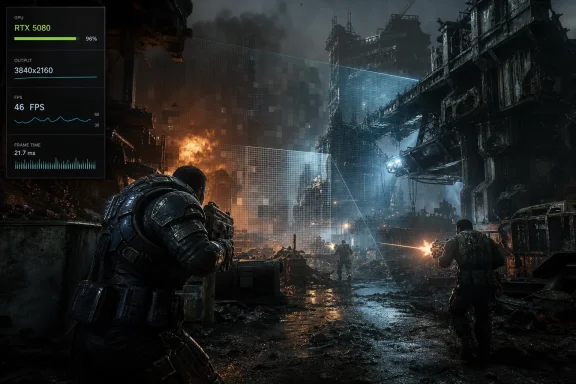 The 4K result is real footage, but not a native-4K verdict
Ariel Combo’s clips visibly show a performance overlay fluctuating through the 40s and into the 50s on an RTX 5080, while DSOGaming describes the test as 4K with maximum settings. The footage appears to support the broad claim: the beta can dip below 60 FPS even on very fast hardware when configured for maximum visual quality.What it cannot establish is whether the game was rendering every frame internally at 3840×2160. DSOGaming itself notes that it does not know whether DLSS was enabled. That omission changes the meaning of the number substantially. “4K” can describe the output resolution while DLSS Super Resolution renders the game at a materially lower internal resolution before reconstructing the image for the display.
NVIDIA has already confirmed that the PC beta includes DLSS Super Resolution and Reflex. For the October 6 release, NVIDIA also says E-Day will support DLSS 4.5 and Dynamic Multi Frame Generation on compatible GeForce RTX hardware. Those are useful features, but they make it even more important for early performance reports to identify the exact upscaling mode and whether generated frames are involved. A displayed frame-rate number is not automatically the same as underlying rendered-frame performance.
The videos also do not provide a complete hardware specification. An RTX 5080 alone does not tell readers the CPU, memory capacity and speed, storage configuration, Windows build, NVIDIA driver, or whether the game was compiled and streaming assets cleanly during that capture. Those variables matter particularly in an Unreal Engine 5 game, where shader compilation, asset streaming, CPU-side scene work, and traversal can affect responsiveness independently of average GPU throughput.
No other independent outlet appears to have published a like-for-like RTX 5080 test of this closed beta build. For now, the 40–50 FPS observation should be treated as a single captured result, not a recommended-spec target and not a final-release forecast.
Unreal Engine 5.8 makes the graphics load more complicated than an Ultra preset
The Coalition has built Gears of War: E-Day in Unreal Engine 5, and NVIDIA has filled in technical details that go beyond the usual marketing shorthand. According to NVIDIA, the game uses UE 5.8’s Lumen and MegaLights technologies, along with Nanite geometry and DirectX 12. NVIDIA says MegaLights will handle ray-traced shadows from up to 100 light sources, while Lumen supplies ray-traced global illumination and ambient occlusion.That backs up the underlying technical premise in the early report: E-Day is designed around expensive real-time lighting rather than simply pushing conventional rasterized shadows to a higher resolution. But it also corrects a piece of speculation. There is no need to infer that the game “will probably” use hardware-accelerated Lumen; NVIDIA has explicitly said RTX ray-tracing cores will accelerate the game’s UE 5.8 Lumen and MegaLights rendering.
MegaLights deserves attention because it is intended to make scenes with many dynamic, shadowed lights more viable. Epic’s Unreal Engine documentation says the technique uses a fixed ray budget per pixel and shifts the tradeoff away from the traditional model, where graphics cost rises directly with the number of lights. That does not make the lighting free. Epic also cautions that image quality can degrade as lighting complexity rises because the feature operates within a fixed sampling budget.
For Gears, that is a fitting toolset. Muzzle flashes, destructible interiors, smoke, volumetric effects, emergency lighting, and sudden breaches are central to the series’ visual identity. The gameplay clips show why the studio chose this route: rooms and streets retain a heavy, high-detail look even as objects are knocked around and combat breaks out. The performance consequence is that a static, quiet tutorial view and a fight full of particles, debris, shadows, and moving lights may not have remotely similar GPU costs.
The early footage does not demonstrate the traversal stutter often associated with some Unreal Engine 5 PC releases. It also does not rule it out. Short social-video captures, likely encoded after recording, are a poor way to evaluate frame-time consistency. A game can show a respectable average frame rate while still delivering noticeable hitches when entering new areas, loading effects, or compiling shaders.
Microsoft’s 4K/60 promise does not fill in the PC settings gap
Xbox’s product material says Gears of War: E-Day is built for 4K resolution and “up to 60 FPS” across campaign and multiplayer. It is a marketing performance target, not a detailed PC benchmark. The statement does not say which console or PC hardware profile it applies to, whether it refers to native rendering or reconstruction, what graphical compromises are permitted, or whether ray-tracing quality is reduced in the mode used to reach that number.That leaves a notable gap between the polished 60-FPS message and the beta footage’s 40–50 FPS readings. The two are not necessarily contradictory. One can be a broad platform claim, while the other can be a maximum-settings PC capture using unconfirmed internal-resolution and image-quality settings. But neither source gives PC players a clean answer to the practical question: what GPU will sustain a stable 60 FPS, at what internal resolution, with which Lumen and MegaLights settings enabled?
The comparison DSOGaming draws with Halo: Campaign Evolved does not solve that problem. Two Unreal Engine games can share an engine version family and still differ radically in lighting complexity, traversal design, CPU load, scene composition, content maturity, and optimization work. A 4K result from one title cannot verify the internal rendering mode or expected performance of another.
What the clips do establish is narrower but still valuable: maximum visual settings in E-Day are likely to be a serious workload, even before the game reaches its final release build. That is unsurprising given the confirmed use of ray-traced lighting, Nanite detail, real-time destruction, and volumetric effects. It should steer buyers away from assuming that a top-tier GPU automatically guarantees native 4K at a locked 60 FPS with every visual option maximized.
August 6 is early beta access, not universal PC access
The report’s timing for the multiplayer beta needs a correction. August 6, 2026 is the start of early access to the Open Beta for players who pre-order Gears of War: E-Day and for Game Pass Ultimate or PC Game Pass subscribers. The Coalition’s official beta information describes that access as an entitlement tied to those routes, and NVIDIA’s beta announcement says the same.It is therefore inaccurate to say that all PC gamers can simply join on August 6. The first weekend is gated. Windows Central has likewise reported that the August 6 early-access period is restricted to pre-order customers and the relevant Game Pass subscribers.
The Coalition’s July 30 multiplayer briefing identifies the beta as a multiplayer test and says it will include the Golden Quarter Horde Siege map. That means it will be useful for measuring PC behavior in a 12-player PvE mode with multiple squads, effects-heavy encounters, and the same new movement and combat systems that will ship in October. It will not, however, settle campaign performance, which may stress streaming and rendering differently.
Players who have access should approach the beta as a test session rather than a final purchasing benchmark:
- Record frame times, not only the average FPS counter, especially while crossing map boundaries and entering large fights.
- Test native output separately from each DLSS Super Resolution preset, and record the selected preset with every result.
- Disable a frame-rate cap only after testing a capped 60 FPS mode, since stability and input consistency may be more useful than a higher but erratic average.
- Note CPU utilization, GPU utilization, VRAM consumption, and the exact NVIDIA driver version before drawing conclusions.
References
- Primary source: DSOGaming
Published: 2026-08-02T13:21:00+00:00
Gears of War: E-Day Closed Beta Runs With 40-50FPS at 4K/Ultra on an NVIDIA GeForce RTX 5080
The NVIDIA RTX 5080 was able to run the Closed Beta of Gears of War: E-Day with framerates ranging from 40FPS to 50FPS at 4K/Ultra.www.dsogaming.com - Related coverage: xbox.com
Gears of War: E-Day – Available 10/6/2026 on XBOX and with Game Pass | XBOX
Pre-order now. Available October 6, 2026 on XBOX Series X|S, XBOX on PC, and with Game Pass. Experience the horror of Emergence Day.www.xbox.com - Related coverage: news.xbox.com
Rebuilding Brotherhood: How Gears of War: E-Day Renews a Legendary Franchise - XBOX Wire
During today's Gears of War: E-Day Direct following XBOX Games Showcase, we saw an extended look at the game's campaign, combat, characters, and more.news.xbox.com - Related coverage: gearsofwar.com
Gears of War | Gears of War: E-Day Editions, Pre-Order Bonus & Open Beta Access
The official website for Gears of Warwww.gearsofwar.com - Related coverage: news.xbox.com
Discover the Gears of War: E-Day Collector’s Edition - XBOX Wire
The Gears of War: E-Day Collector’s Edition is available to pre-order now, including the Premium Edition of the game alongside a curated set of physical items. Find out more inside.news.xbox.com - Related coverage: xbox.com
Buy Gears of War: E-Day Pre-Order Bonuses | Xbox
Exfil Legendary Weapon Skin Set Exfil Dom Legendary Character Skinwww.xbox.com - Related coverage: nvidia.com
Gears of War: E-Day Launches October 6th With DLSS 4.5 & Ray Tracing
Our technical partnership with developer The Coalition will ensure GeForce RTX players receive the definitive PC experience, in the August 6th Early Access Open Beta and the full game.www.nvidia.com - Related coverage: gamesradar.com
The Coalition says that Gears of War: E-Day "isn't a reaction to Gears 5" | GamesRadar+
Summer Preview | The Coalition takes you inside Gears of War: E-Day, the upcoming Xbox console exclusive that marks 20 years of Gearswww.gamesradar.com - Related coverage: gamesradar.com
With Gears of War: E-Day aiming to recapture "the vibes of the original games", its devs believe this "has the potential to be one of the best stories in the Gears franchise" | GamesRadar+
Learn more about Gears of War: E-Day in this exclusive interview with The Coalitionwww.gamesradar.com - Related coverage: as.com
- Related coverage: pcgamer.com
Gears of War: E-Day devs are embracing 'old-school' multiplayer in 2026: 'No battle pass, no tour of duty, no gimmicks, no bullsh*t' | PC Gamer
But, of course, there's a catch.www.pcgamer.com - Related coverage: windowscentral.com
Gears of War: E-Day's cooperative and competitive multiplayer modes pack content and chaos beyond what I imagined | Windows Central
A 12-player Horde mode with raid bosses, 4v4 Versus skirmishes, and more awaits you in Gears of War: E-Day's insane multiplayer.www.windowscentral.com - Related coverage: windowscentral.com
PREVIEW: Gears of War: E-Day's 'Horde Siege' is the most fun I've ever had in the entire history of the Gears franchise | Windows Central
Last week I had the opportunity to go hands on with Gears of War: E-Day and its new "Horde Siege" mode, which is far more chaotic, bombastic, and cinematic than I expected.www.windowscentral.com - Related coverage: pcgamer.com
Gears of War: E-Day multiplayer is so old, it feels new again | PC Gamer
Horde and Versus without the chaff.www.pcgamer.com - Related coverage: gfinityesports.com
Gears of War: E-Day PC System Requirements & Specs
The official PC system requirements for Gears of War: E-Day are here. Find out if your setup can handle the minimum and recommended specs. www.gfinityesports.com
- Related coverage: allthings.how
Gears of War: E-Day PC Requirements Drop GTX Cards and Demand an SSD
The October 6 shooter skips older GTX hardware, leans on DirectX 12 Ultimate GPUs, and needs 130GB of solid-state space.allthings.how - Related coverage: gamespot.com
Gears Of War: E-Day Open Beta: Start Dates And How To Get In Early - GameSpot
Here's everything we know so far about the open beta.www.gamespot.com - Related coverage: techtimes.com
Gears of War E-Day PC Requirements: 130 GB SSD, DX12 Ultimate Floor Locks Out Pre-2020 GPUs
Gears of War E-Day PC system requirements are now live on Steam: the RTX 2060 is the minimum GPU, 130 GB of SSD storage is mandatory and covers campaign, multiplayer, and co-op horde mode, and everywww.techtimes.com - Related coverage: shop.xboxgamestudios.com
Gears of War E-Day Collectors Edition FAQ – XBOX Game Studios Shop
Gears of War: E-Day Pre-Order Incentive FAQ Pre-Order bonus 1 (redeemable pre-launch): Early Access Open Beta (Weekend 1; exclusive to pre-order customers) Pre-Order bonus 2 (redeemable at launch): Exfil Legendary Weapon Skin Set; Exfil Dom Legendary Character Skin What is the Early Access Open... shop.xboxgamestudios.com
- Related coverage: kitguru.net
Gears of War E-Day PC system requirements announced | KitGuru
Following on from the Gears of War E-Day showcase earlier this month, the team at The Coalition haswww.kitguru.net - Related coverage: space.com
Gears of War E-Day developer The Coalition explains why the prequel was 'just too good to pass up' | Space
We checked out Gears of War E-Day and chatted to the devs at Summer Games Fest, to find out more about the latest chapter in the Gears saga.www.space.com