
NVIDIA’s GeForce Game Ready 610.88 driver already contains a fix for the long DirectX 12 pauses that have disrupted Path of Exile 2 sessions for roughly 18 months—and Grinding Gear Games got NVIDIA to reproduce the fault only after sending over the exact PC that could trigger it. The practical takeaway for Windows players is straightforward: if the game freezes, shows the Grinding Gear Games cog screen, then resumes after a long wait in DX12 mode, install GeForce 610.88 WHQL rather than waiting for a game patch.
The story, first detailed by PC Gamer from a Grinding Gear Games developer video, is more useful than the headline about mailing a PC suggests. GGG did not simply ship a desktop as a desperate hardware swap. The studio spent months building a replay system that turned a rare, hours-into-a-session driver failure into a repeatable test case. It then sent NVIDIA both that replay and the precise machine on which it occurred—monitor, mouse, and keyboard included.
NVIDIA’s own Windows 10 and Windows 11 release notes confirm the result. Driver 610.88, released on July 28, 2026, lists a fix for intermittent long pauses in Path of Exile 2 after extended DX12 gameplay. NVIDIA had already supplied the same repair in the optional 610.82 hotfix on July 22. The repair has now moved into the normal WHQL driver channel.
That timeline corrects the most important omission in the submitted account: the fix is no longer pending. It is already public, and it has been available in a fully certified driver for nearly a week.
NVIDIA’s wording is narrow: the resolved issue is “intermittent long pauses” after extended sessions in DirectX 12 mode. It is not a blanket claim that every Path of Exile 2 crash, hitch, shader-compilation stall, loading delay, or performance drop has been fixed. Players should resist treating the driver note as a cure for every complaint that has accumulated around the game since early access.
Still, the wording matches the failure mode many players have described: the game becomes unresponsive during play, displays the GGG cog or recovery screen, and eventually resumes rather than closing to the desktop. Community reports around the 610.82 hotfix and 610.88 WHQL release include players saying the recurring pauses disappeared, though others continue to report separate crashes and shader-related performance problems. Those individual reports are useful signals, not a substitute for NVIDIA’s much narrower official scope.
The distinction matters for support triage. A player whose system freezes during Windows startup, loses display output, blue-screens, crashes in Vulkan, or has a one-time stutter when encountering a new effect may have a different fault entirely. Updating to 610.88 is still sensible on supported GeForce hardware, but it should be treated as a targeted fix for the DX12 long-pause issue—not evidence that every instability originates in the NVIDIA driver.
NVIDIA’s documentation identifies the Path of Exile 2 repair with internal bug number 5090018. Its July 22 hotfix was based on Game Ready 610.74, and the July 28 610.88 WHQL package incorporated the same correction into the regular Windows driver branch. That is a meaningful operational difference: hotfix drivers are optional beta packages with abbreviated validation, while the later 610.88 build is the standard release most administrators and ordinary users should prefer.
GGG then created a specialized replay system capable of playing back lengthy gameplay sequences on office machines. According to Rogers, the team eventually obtained a replay that reproduced the problem every five to seven minutes. At that point, sending the relevant desktop to NVIDIA became rational: the GPU model, motherboard behavior, operating-system state, driver build, display chain, peripherals, game configuration, and captured workload could all be preserved together.
That package is why NVIDIA’s response took weeks rather than another year. A graphics-driver team cannot responsibly patch a fault it cannot make appear under controlled conditions. The fact that the studio had identified suspected NVIDIA driver code was insufficient on its own. A vendor needs a repeatable trigger to validate both the correction and the possibility that it breaks something else.
The monitor, keyboard, and mouse sound theatrical because they are peripheral to the eventual software change. But they also illustrate the discipline involved. When a defect only appears on one configuration, every removed variable creates room for the problem to disappear again. GGG sent the environment that failed, not a simplified approximation of it.
That changed the experience from a hard crash into a severe interruption. It also explains why players could see the cog animation, wait through a lengthy stall, and return to a live game world. The workaround preserved the session more often than a desktop crash would have, but it imposed a serious cost in an action RPG where a 10- to 30-second loss of control can mean a dead character, lost map progress, or a ruined boss attempt.
This was a sensible containment measure, but it also obscured diagnosis for players. A pause could look like server lag, an overloaded CPU, shader compilation, storage contention, a memory issue, or a network failure. The recovery screen made the symptom visible without identifying the cause. NVIDIA’s release note now ties one substantial cluster of those incidents specifically to DX12 gameplay on GeForce drivers.
According to PC Gamer’s reporting on the GGG video, NVIDIA’s eventual remedy involved increasing shader heap size. That detail provides a plausible explanation for why the game’s dense late-game activity and extended sessions were so valuable in reproducing the problem: a workload can operate normally until enough graphics resources or shader-related state accumulates to cross a driver-side limit. But NVIDIA has not published a technical postmortem, affected GPU list, or a precise explanation of what changed inside the driver. The driver note confirms the fix; it does not disclose the root-cause analysis.
A few precautions will make the result easier to interpret:
For IT staff supporting gaming PCs, the significant point is that this is a driver remediation, not a Path of Exile 2 content update. Reinstalling the game, resetting Windows, replacing a CPU, or repeatedly clearing shader caches may have been attempted by affected users over the past year and a half without addressing the underlying DX12 driver failure. The release notes give help desks a concrete baseline: verify whether the system is on 610.88 or later before escalating the particular long-pause symptom.
GGG deserves credit for building the replay infrastructure that made the issue reproducible instead of declaring it a vague compatibility problem. NVIDIA, for its part, did deliver the repair quickly once it had a reliable reproduction environment. The uncomfortable part of the record is the gap between those two events: reports were widespread enough that the studio had to create a recovery system, yet the vendor-side investigation appears to have moved decisively only after a complete failing rig arrived.
The immediate consequence is far less dramatic than the delivery box: update to 610.88, use DX12 if that was the affected renderer, and judge the result over a sustained session. The mailed PC has already done its job.
NVIDIA’s own Windows 10 and Windows 11 release notes confirm the result. Driver 610.88, released on July 28, 2026, lists a fix for intermittent long pauses in Path of Exile 2 after extended DX12 gameplay. NVIDIA had already supplied the same repair in the optional 610.82 hotfix on July 22. The repair has now moved into the normal WHQL driver channel.
That timeline corrects the most important omission in the submitted account: the fix is no longer pending. It is already public, and it has been available in a fully certified driver for nearly a week.
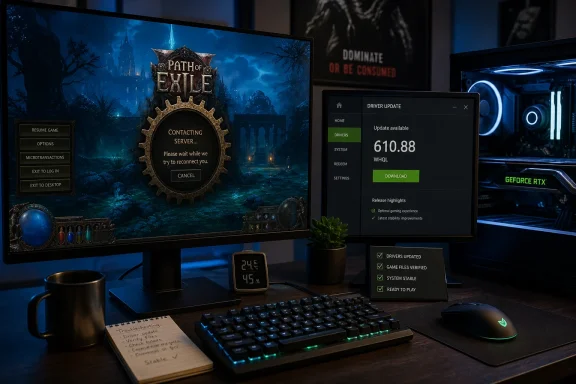 GeForce 610.88 is the release to install
NVIDIA’s wording is narrow: the resolved issue is “intermittent long pauses” after extended sessions in DirectX 12 mode. It is not a blanket claim that every Path of Exile 2 crash, hitch, shader-compilation stall, loading delay, or performance drop has been fixed. Players should resist treating the driver note as a cure for every complaint that has accumulated around the game since early access.Still, the wording matches the failure mode many players have described: the game becomes unresponsive during play, displays the GGG cog or recovery screen, and eventually resumes rather than closing to the desktop. Community reports around the 610.82 hotfix and 610.88 WHQL release include players saying the recurring pauses disappeared, though others continue to report separate crashes and shader-related performance problems. Those individual reports are useful signals, not a substitute for NVIDIA’s much narrower official scope.
The distinction matters for support triage. A player whose system freezes during Windows startup, loses display output, blue-screens, crashes in Vulkan, or has a one-time stutter when encountering a new effect may have a different fault entirely. Updating to 610.88 is still sensible on supported GeForce hardware, but it should be treated as a targeted fix for the DX12 long-pause issue—not evidence that every instability originates in the NVIDIA driver.
NVIDIA’s documentation identifies the Path of Exile 2 repair with internal bug number 5090018. Its July 22 hotfix was based on Game Ready 610.74, and the July 28 610.88 WHQL package incorporated the same correction into the regular Windows driver branch. That is a meaningful operational difference: hotfix drivers are optional beta packages with abbreviated validation, while the later 610.88 build is the standard release most administrators and ordinary users should prefer.
GGG’s mailed PC was a reproducibility package
The “entire PC” detail is real, but it leaves out the actual engineering work that made the shipment valuable. In the GGG video, game director Jonathan Rogers described a long effort to capture enough runtime state to reproduce the crash predictably. Initial testing reportedly involved having someone play for hours and wait for the issue to happen—a method that produces anecdotes, not a reliable failure case.GGG then created a specialized replay system capable of playing back lengthy gameplay sequences on office machines. According to Rogers, the team eventually obtained a replay that reproduced the problem every five to seven minutes. At that point, sending the relevant desktop to NVIDIA became rational: the GPU model, motherboard behavior, operating-system state, driver build, display chain, peripherals, game configuration, and captured workload could all be preserved together.
That package is why NVIDIA’s response took weeks rather than another year. A graphics-driver team cannot responsibly patch a fault it cannot make appear under controlled conditions. The fact that the studio had identified suspected NVIDIA driver code was insufficient on its own. A vendor needs a repeatable trigger to validate both the correction and the possibility that it breaks something else.
The monitor, keyboard, and mouse sound theatrical because they are peripheral to the eventual software change. But they also illustrate the discipline involved. When a defect only appears on one configuration, every removed variable creates room for the problem to disappear again. GGG sent the environment that failed, not a simplified approximation of it.
The visible “freeze” was designed to avoid a full game crash
The player-facing pause was not necessarily the original bug. Rogers said GGG first implemented a recovery mechanism after making little progress on the underlying failure. Instead of allowing the client to terminate when the GPU fault occurred, the game could recover by reloading textures, shaders, and portions of its engine state.That changed the experience from a hard crash into a severe interruption. It also explains why players could see the cog animation, wait through a lengthy stall, and return to a live game world. The workaround preserved the session more often than a desktop crash would have, but it imposed a serious cost in an action RPG where a 10- to 30-second loss of control can mean a dead character, lost map progress, or a ruined boss attempt.
This was a sensible containment measure, but it also obscured diagnosis for players. A pause could look like server lag, an overloaded CPU, shader compilation, storage contention, a memory issue, or a network failure. The recovery screen made the symptom visible without identifying the cause. NVIDIA’s release note now ties one substantial cluster of those incidents specifically to DX12 gameplay on GeForce drivers.
According to PC Gamer’s reporting on the GGG video, NVIDIA’s eventual remedy involved increasing shader heap size. That detail provides a plausible explanation for why the game’s dense late-game activity and extended sessions were so valuable in reproducing the problem: a workload can operate normally until enough graphics resources or shader-related state accumulates to cross a driver-side limit. But NVIDIA has not published a technical postmortem, affected GPU list, or a precise explanation of what changed inside the driver. The driver note confirms the fix; it does not disclose the root-cause analysis.
What Windows players should do now
For affected players on Windows 10 or Windows 11, the immediate action is to install GeForce Game Ready Driver 610.88 through the NVIDIA app or NVIDIA’s normal driver download channel, then test the game in DirectX 12. NVIDIA’s release notes say the 610.88 branch supports Windows 10 and Windows 11, and the Path of Exile 2 repair appears in the official WHQL fixed-issues list.A few precautions will make the result easier to interpret:
- Install 610.88 before changing several unrelated game settings, shader-cache limits, overlays, power plans, and renderer options at once. Changing everything makes it harder to tell whether the driver actually solved the pause.
- Test a comparable long DX12 session, ideally in the content where the pauses had occurred before. NVIDIA’s own description emphasizes extended gameplay rather than launch-time behavior.
- Keep a note of the renderer in use. The published fix is for DX12 mode; it does not establish that Vulkan or DirectX 11 failures share the same cause.
- If the long pauses persist on 610.88, document the GPU, driver version, Windows build, renderer, game version, and exact symptom before reporting it. “Still stutters” is too broad to distinguish the resolved pause issue from other performance faults.
For IT staff supporting gaming PCs, the significant point is that this is a driver remediation, not a Path of Exile 2 content update. Reinstalling the game, resetting Windows, replacing a CPU, or repeatedly clearing shader caches may have been attempted by affected users over the past year and a half without addressing the underlying DX12 driver failure. The release notes give help desks a concrete baseline: verify whether the system is on 610.88 or later before escalating the particular long-pause symptom.
NVIDIA’s release note understates the player impact
“Intermittent long pauses after extended gameplay sessions” reads like routine driver-release language. In Path of Exile 2, it covered a failure that GGG had been containing rather than fixing since early access: a GPU crash transformed into a forced reload while the player remained in the game. For an always-online action RPG built around repeated high-intensity encounters, that is a material playability problem.GGG deserves credit for building the replay infrastructure that made the issue reproducible instead of declaring it a vague compatibility problem. NVIDIA, for its part, did deliver the repair quickly once it had a reliable reproduction environment. The uncomfortable part of the record is the gap between those two events: reports were widespread enough that the studio had to create a recovery system, yet the vendor-side investigation appears to have moved decisively only after a complete failing rig arrived.
The immediate consequence is far less dramatic than the delivery box: update to 610.88, use DX12 if that was the affected renderer, and judge the result over a sustained session. The mailed PC has already done its job.
References
- Primary source: happygamer.com
Published: 2026-08-03T04:38:55+00:00
Loading…
happygamer.com - Related coverage: pcgamer.com
Loading…
www.pcgamer.com - Related coverage: nvidia.custhelp.com
Loading…
nvidia.custhelp.com - Related coverage: station-drivers.com
NVIDIA GeForce Game Ready Driver 610.88 (WHQL)
NVIDIA GeForce Game Ready Driver 610.88 (WHQL) Released July 28, 2026 Game Ready Driver Release Notes (PDF): us.download.nvidia.com/Windows/610.88/61...10-release-notes.pdf Control Panel User's Guide (PDF): us.download.nvidia.com/Windows/610.88/61...uick-start-guide.pdf Game Ready for Halo...station-drivers.com - Related coverage: windowsforum.com
Loading…
windowsforum.com - Related coverage: windowsforum.com
Loading…
windowsforum.com - Related coverage: ntcompatible.com
Loading…
www.ntcompatible.com - Related coverage: windowscentral.com
Loading…
www.windowscentral.com - Related coverage: forums.developer.nvidia.com
Loading…
forums.developer.nvidia.com - Related coverage: overclock3d.net
Loading…
overclock3d.net - Related coverage: forums.developer.nvidia.com
Loading…
forums.developer.nvidia.com - Related coverage: tweaktown.com
Loading…
www.tweaktown.com - Related coverage: computerbase.de
Loading…
www.computerbase.de - Related coverage: avforums.com
Loading…
www.avforums.com