
IGN’s Jackie Thomas is right to connect the worsening price of gaming hardware with the AI buildout now consuming the memory industry. But the stronger version of the argument is narrower than “AI is making games worse”: the data-center race is raising the cost of gaming hardware while vendors use the same AI label to sell players features that range from genuinely useful to plainly optional. Those are related developments, but they are not the same bill of materials problem—and treating them as one obscures where the pressure is actually coming from.
The immediate concern is real. Reporting over the past week indicates that board partners in China have raised prices on Nvidia GeForce RTX 50-series cards, in some cases sharply, as video-memory costs climb. PC Gamer also reports that AMD has prepared an increase in the supply price of GPU-and-VRAM bundles. Yet neither company has announced a U.S. retail MSRP increase for its consumer graphics cards, and the AMD move was reported as a plan rather than a completed global price change.
That distinction will not make a GPU cheaper for someone shopping this month. It does matter for understanding what has happened: this is not a single, officially declared “AI surcharge” on every gaming product. It is a memory-supply problem that is already moving through distributors, add-in-board partners, system builders, and retailers unevenly. The first cards affected may be those with expensive GDDR memory configurations or newly replenished inventory, rather than every GPU on a store shelf overnight.
The evidence behind an AI-linked memory squeeze is substantial. Reuters reported in December that large AI customers had sought broad, open-ended commitments for future Micron supply, while SK hynix said its 2026 output was effectively sold out and Samsung had lined up customers for forthcoming HBM production. High-bandwidth memory, or HBM, is stacked DRAM used alongside data-center accelerators; it commands far higher margins than ordinary desktop memory.
Samsung, SK hynix, and Micron are consequently prioritizing HBM and advanced server DRAM. S&P Global has also described the resulting dynamic directly: as those manufacturers shift capacity toward premium AI memory, supply of conventional DRAM tightens and prices rise. For PC builders, that means the same companies making the DDR5 in a 32GB desktop kit are balancing it against server and accelerator orders with vastly larger budgets.
That is the part of the story gamers cannot simply opt out of. A PC may not run an AI chatbot locally, but it still needs DRAM, NAND flash, and graphics memory. A graphics card maker facing higher GDDR costs can absorb them, reduce margins, redesign products with less memory, or pass them to buyers. Recent market reporting suggests the industry is choosing the last option.
The June lawsuit against Samsung, SK hynix, and Micron deserves more care than it has received in casual discussion. The proposed class action alleges that the three companies coordinated conventional-memory production cuts and pricing while shifting output to HBM. Those claims have not been proven, Samsung has called them unfounded, and a similar consumer case against the same manufacturers was dismissed in 2020. The complaint is evidence that buyers see a concentrated DRAM market and extraordinary price increases; it is not evidence that a court has found a conspiracy.
There is, however, no need to prove unlawful collusion to identify the commercial problem. Three suppliers control the overwhelming majority of the DRAM market, and all three have an obvious financial reason to put scarce manufacturing resources into products sold for AI infrastructure. A shortage can be real, profitable, and damaging to consumers without meeting the legal standard for price-fixing.
A PlayStation 5 uses GDDR6 unified memory; a typical gaming PC uses DDR5 system memory plus GDDR6 or GDDR7 on its graphics card; an AI server may use DDR5 alongside HBM. Those products compete indirectly for fab capacity, packaging resources, engineering investment, and suppliers’ attention, but they are not interchangeable bins of RAM being diverted one-for-one from consoles into data centers.
The more defensible conclusion is still troubling. Gaming hardware is exposed to the broader repricing of memory because the entire industry is increasingly optimized around serving hyperscale AI customers. Console makers may hedge supply years in advance, while a graphics-card partner may have to buy memory closer to production. Laptop vendors can respond by cutting memory configurations, while DIY buyers see the cost immediately in a RAM kit or a graphics card with 16GB of VRAM.
That is why the reported GPU pricing moves warrant attention even before U.S. shelves visibly change. They are a warning that a shortage which began in enterprise procurement is reaching consumer products. The cost increase is not payment for a Game Bar chatbot or a neural-rendering toggle. It is payment for a supply chain whose best customers now buy memory by the data-center rack.
But one important fact is missing from the argument: DLSS 5 is not yet a shipping game feature. Nvidia announced it for release this fall. The Resident Evil Requiem footage that drew criticism was a presentation demo, not evidence that players today are being forced to use the technology in released games.
Nvidia says DLSS 5 will give developers controls over where enhancements apply, along with options to mask objects or areas out of the effect. That is a vendor promise, not an independently established guarantee that games will look good or preserve the original art direction. The company’s own description also confirms the core criticism: the system infers lighting and material qualities from rendered imagery rather than merely reconstructing missing pixels in the manner of conventional upscaling.
The practical test will come when developers ship it. A technically optional feature can become functionally mandatory if a game is tuned around it, if performance targets assume it, or if visual defects are difficult to disable without sacrificing image quality or frame rate. Nvidia’s promise of artist control will matter only if developers have the time, budgets, and leverage to use those controls well.
It is also worth separating DLSS 5 from the earlier technologies bundled into the broader “AI in games” complaint. Nvidia introduced DLSS alongside the RTX 20 series in 2018, and the technology has become a mainstream performance tool. DLSS 3 frame generation was announced in September 2022 alongside the RTX 40 series, not in 2023 as the IGN column states. Both technologies have limitations—especially latency considerations and image artifacts—but they solve a concrete problem: rendering demanding games at playable performance.
Calling all of that AI slop flattens a useful distinction. AI-assisted image reconstruction can extend the life of existing hardware or make higher-quality settings viable. Generative rendering that changes the apparent surface of a character, scene, or object carries a different artistic risk. Players should be able to reject the latter without being expected to reject the former.
On the Xbox handhelds, a long press of the Library button can open Gaming Copilot for voice-based help. That implementation is convenient in the narrow sense that it eliminates the need to reach for a phone or open a browser. It also duplicates an established player habit: searching a guide, reading a wiki, asking friends, or using a walkthrough created by people who actually played the game.
The claim that Copilot gives “outdated advice” or performs poorly is a review observation, not a demonstrated platform-wide finding. No independent testing establishes a consistent failure rate across games, regions, or handheld configurations. Microsoft’s own beta status is the more meaningful fact: the company is distributing an assistant before it has shown that it is a necessary part of playing games on Windows.
Unlike DLSS, Copilot does not improve rendering performance or reduce a hardware requirement. Its value depends on whether the answer is accurate, timely, and less intrusive than the alternatives. For many players, an overlay that breaks concentration to offer generic advice is not an enhancement. It is another service layer placed between a game and the person trying to play it.
Steam’s policy already distinguishes between pre-generated AI content and live-generated AI content, and requires developers to explain how they use it. That information can tell a buyer whether a title contains generated art, generated dialogue, adaptive in-game outputs, or merely developer-side tooling. Those are materially different choices with different implications for quality, moderation, ownership, and accessibility.
A label does not settle whether a game is good. It gives players information about what they are buying. Removing it would chiefly benefit publishers that want AI’s cost savings without having to explain where the savings came from.
The cost of AI to gaming is already visible in component markets. The cultural cost is still being negotiated in storefront policies, developer workflows, and graphics pipelines. Players should resist the false choice between accepting every AI feature and rejecting useful technical advances. Demand lower hardware prices where the supply chain permits it, insist on clear disclosure where generative systems affect creative work, and judge DLSS 5 and Gaming Copilot by shipped results rather than keynote promises.
That distinction will not make a GPU cheaper for someone shopping this month. It does matter for understanding what has happened: this is not a single, officially declared “AI surcharge” on every gaming product. It is a memory-supply problem that is already moving through distributors, add-in-board partners, system builders, and retailers unevenly. The first cards affected may be those with expensive GDDR memory configurations or newly replenished inventory, rather than every GPU on a store shelf overnight.
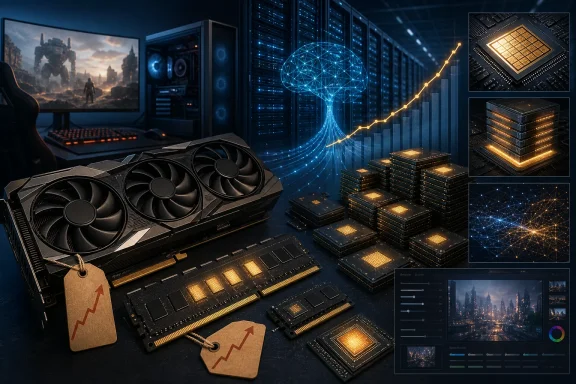 The RAM crunch has a real cause—and a much narrower culprit
The evidence behind an AI-linked memory squeeze is substantial. Reuters reported in December that large AI customers had sought broad, open-ended commitments for future Micron supply, while SK hynix said its 2026 output was effectively sold out and Samsung had lined up customers for forthcoming HBM production. High-bandwidth memory, or HBM, is stacked DRAM used alongside data-center accelerators; it commands far higher margins than ordinary desktop memory.Samsung, SK hynix, and Micron are consequently prioritizing HBM and advanced server DRAM. S&P Global has also described the resulting dynamic directly: as those manufacturers shift capacity toward premium AI memory, supply of conventional DRAM tightens and prices rise. For PC builders, that means the same companies making the DDR5 in a 32GB desktop kit are balancing it against server and accelerator orders with vastly larger budgets.
That is the part of the story gamers cannot simply opt out of. A PC may not run an AI chatbot locally, but it still needs DRAM, NAND flash, and graphics memory. A graphics card maker facing higher GDDR costs can absorb them, reduce margins, redesign products with less memory, or pass them to buyers. Recent market reporting suggests the industry is choosing the last option.
The June lawsuit against Samsung, SK hynix, and Micron deserves more care than it has received in casual discussion. The proposed class action alleges that the three companies coordinated conventional-memory production cuts and pricing while shifting output to HBM. Those claims have not been proven, Samsung has called them unfounded, and a similar consumer case against the same manufacturers was dismissed in 2020. The complaint is evidence that buyers see a concentrated DRAM market and extraordinary price increases; it is not evidence that a court has found a conspiracy.
There is, however, no need to prove unlawful collusion to identify the commercial problem. Three suppliers control the overwhelming majority of the DRAM market, and all three have an obvious financial reason to put scarce manufacturing resources into products sold for AI infrastructure. A shortage can be real, profitable, and damaging to consumers without meeting the legal standard for price-fixing.
The gaming-hardware impact is uneven, not universal
Thomas’s column goes too far when it implies that every device using memory—from a PlayStation 5 to a car—is already becoming more expensive specifically to expand AI capability. Memory is used everywhere, but the products do not use interchangeable memory chips, do not share identical supply chains, and do not all pass component inflation through at the same time.A PlayStation 5 uses GDDR6 unified memory; a typical gaming PC uses DDR5 system memory plus GDDR6 or GDDR7 on its graphics card; an AI server may use DDR5 alongside HBM. Those products compete indirectly for fab capacity, packaging resources, engineering investment, and suppliers’ attention, but they are not interchangeable bins of RAM being diverted one-for-one from consoles into data centers.
The more defensible conclusion is still troubling. Gaming hardware is exposed to the broader repricing of memory because the entire industry is increasingly optimized around serving hyperscale AI customers. Console makers may hedge supply years in advance, while a graphics-card partner may have to buy memory closer to production. Laptop vendors can respond by cutting memory configurations, while DIY buyers see the cost immediately in a RAM kit or a graphics card with 16GB of VRAM.
That is why the reported GPU pricing moves warrant attention even before U.S. shelves visibly change. They are a warning that a shortage which began in enterprise procurement is reaching consumer products. The cost increase is not payment for a Game Bar chatbot or a neural-rendering toggle. It is payment for a supply chain whose best customers now buy memory by the data-center rack.
DLSS 5 is an announced technology, not today’s gaming default
The column’s criticism of Nvidia’s DLSS 5 presentation has a firm factual basis: the company’s March 16 demonstration of neural rendering produced an immediate backlash, particularly around faces, materials, and the possibility that a model could impose a photorealistic look over an artist’s authored image. Ars Technica, GamesRadar, and others documented the concern after Jensen Huang’s GTC keynote.But one important fact is missing from the argument: DLSS 5 is not yet a shipping game feature. Nvidia announced it for release this fall. The Resident Evil Requiem footage that drew criticism was a presentation demo, not evidence that players today are being forced to use the technology in released games.
Nvidia says DLSS 5 will give developers controls over where enhancements apply, along with options to mask objects or areas out of the effect. That is a vendor promise, not an independently established guarantee that games will look good or preserve the original art direction. The company’s own description also confirms the core criticism: the system infers lighting and material qualities from rendered imagery rather than merely reconstructing missing pixels in the manner of conventional upscaling.
The practical test will come when developers ship it. A technically optional feature can become functionally mandatory if a game is tuned around it, if performance targets assume it, or if visual defects are difficult to disable without sacrificing image quality or frame rate. Nvidia’s promise of artist control will matter only if developers have the time, budgets, and leverage to use those controls well.
It is also worth separating DLSS 5 from the earlier technologies bundled into the broader “AI in games” complaint. Nvidia introduced DLSS alongside the RTX 20 series in 2018, and the technology has become a mainstream performance tool. DLSS 3 frame generation was announced in September 2022 alongside the RTX 40 series, not in 2023 as the IGN column states. Both technologies have limitations—especially latency considerations and image artifacts—but they solve a concrete problem: rendering demanding games at playable performance.
Calling all of that AI slop flattens a useful distinction. AI-assisted image reconstruction can extend the life of existing hardware or make higher-quality settings viable. Generative rendering that changes the apparent surface of a character, scene, or object carries a different artistic risk. Players should be able to reject the latter without being expected to reject the former.
Microsoft’s Gaming Copilot remains a beta feature looking for a need
Microsoft’s Gaming Copilot provides a more revealing example of AI feature creep. Microsoft began rolling it out through the Xbox Game Bar on Windows PC in September 2025, then positioned it for the ROG Xbox Ally and ROG Xbox Ally X handhelds. The feature remains labeled beta, and Microsoft has said it was continuing to optimize it for handheld use.On the Xbox handhelds, a long press of the Library button can open Gaming Copilot for voice-based help. That implementation is convenient in the narrow sense that it eliminates the need to reach for a phone or open a browser. It also duplicates an established player habit: searching a guide, reading a wiki, asking friends, or using a walkthrough created by people who actually played the game.
The claim that Copilot gives “outdated advice” or performs poorly is a review observation, not a demonstrated platform-wide finding. No independent testing establishes a consistent failure rate across games, regions, or handheld configurations. Microsoft’s own beta status is the more meaningful fact: the company is distributing an assistant before it has shown that it is a necessary part of playing games on Windows.
Unlike DLSS, Copilot does not improve rendering performance or reduce a hardware requirement. Its value depends on whether the answer is accurate, timely, and less intrusive than the alternatives. For many players, an overlay that breaks concentration to offer generic advice is not an enhancement. It is another service layer placed between a game and the person trying to play it.
Disclosure is becoming more valuable, not less
Epic Games chief executive Tim Sweeney has argued that AI disclosure labels on game store pages will become pointless because AI will be used everywhere. That is backwards. If AI-assisted production becomes routine, broad claims that a game “uses AI” may indeed communicate little. But disclosure can become more specific, not disappear.Steam’s policy already distinguishes between pre-generated AI content and live-generated AI content, and requires developers to explain how they use it. That information can tell a buyer whether a title contains generated art, generated dialogue, adaptive in-game outputs, or merely developer-side tooling. Those are materially different choices with different implications for quality, moderation, ownership, and accessibility.
A label does not settle whether a game is good. It gives players information about what they are buying. Removing it would chiefly benefit publishers that want AI’s cost savings without having to explain where the savings came from.
The cost of AI to gaming is already visible in component markets. The cultural cost is still being negotiated in storefront policies, developer workflows, and graphics pipelines. Players should resist the false choice between accepting every AI feature and rejecting useful technical advances. Demand lower hardware prices where the supply chain permits it, insist on clear disclosure where generative systems affect creative work, and judge DLSS 5 and Gaming Copilot by shipped results rather than keynote promises.
References
- Primary source: sea.ign.com
Published: 2026-08-01T16:00:00+00:00
- Related coverage: nvidianews.nvidia.com
NVIDIA DLSS 5 Delivers AI-Powered Breakthrough in Visual Fidelity for Games | NVIDIA Newsroom
NVIDIA today unveiled NVIDIA DLSS 5, the company’s most significant breakthrough in computer graphics since the debut of real-time ray tracing in 2018.nvidianews.nvidia.com - Related coverage: blogs.nvidia.cn
NVIDIA DLSS 5 以 AI 驱动游戏画质保真度的突破性飞跃 | NVIDIA 英伟达博客
新闻摘要: NVIDIA DLSS 5 将于今年秋季推出,引入实时神经网络渲染模型,让像素拥有照片级写实光照与材质效果。 DLSS 5 是自 2018 年实时光线追踪首次亮相以来,NVIDIA 在计算机图形领域最重大的突破。 诸多业界顶级发行商和游戏开发者将集成 DLSS 5,包括blogs.nvidia.cn - Related coverage: techcrunch.com
Nvidia’s DLSS 5 uses generative AI to boost photorealism in video games, with ambitions beyond gaming | TechCrunch
Nvidia’s new DLSS 5 uses generative AI and structured graphics data to make video games more realistic. CEO Jensen Huang says the approach could eventually spread to other industries.techcrunch.com - Related coverage: nvidia.com
Nine New Games Add DLSS For Improved Anti-Aliasing and Performance on GeForce RTX GPUs
25 titles are being enhanced with Deep Learning Super-Sampling, a new NVIDIA RTX technology that boosts performance by up to 2X at 4K.www.nvidia.com - Related coverage: developer.nvidia.com
DLSS: What Does It Mean for Game Developers? | NVIDIA Technical Blog
We have all heard a lot about the importance of two emerging technologies for games: real-time ray tracing and AI. The former is easy to grasp immediately…developer.nvidia.com
- Related coverage: nvidianews.nvidia.com
10 Years in the Making: NVIDIA Brings Real-Time Ray Tracing to Gamers with GeForce RTX | NVIDIA Newsroom
Gamescom—NVIDIA today unveiled the GeForce RTX series, the first gaming GPUs based on the new NVIDIA Turing architecture and the NVIDIA RTX platform, which fuses next-generation shaders with real-time ray tracing and all-new AI capabilities.nvidianews.nvidia.com - Related coverage: pcgamer.com
Tim Sweeney on the future of games, AI, and whether Valve will ever join forces with Epic: 'It's now clear that nobody's going to end up with an absolute monopoly' | PC Gamer
The Epic Games CEO discusses his vision for "Team Open," his objections to Steam's AI disclosure requirement, and the huge problems facing AAA game development.www.pcgamer.com
