

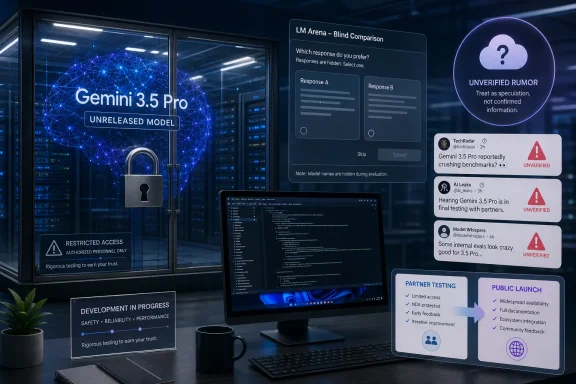
gemini-3.5-pro briefly surfaced in blind battles before being withdrawn; neither report provides a preserved Arena result, a named tracker, a screenshot with verifiable metadata, or a statement from Google or LM Arena.The distinction is important for developers deciding whether to delay a Gemini migration or refresh a Windows-based coding workflow around an imminent flagship model. Google has confirmed that Gemini 3.5 Pro is in partner testing and will be broadly available when ready. It has not confirmed a public Arena test, an API model ID, pricing, quotas, availability in Google AI Studio or Vertex AI, or a release during the week beginning August 3.
NokiaPowerUser’s two articles are not independent corroboration. The August 2 follow-up repeats and expands the August 1 account by the same author, on the same site, and relies on the same unnamed “community observations” from X and Discord. The reporting establishes that speculation is active; it does not establish a launch timetable.
Google’s last on-record position remains partner testing
The firmest public record is Google’s own status update from July 21. When Google released Gemini 3.6 Flash, Gemini 3.5 Flash-Lite, and Gemini 3.5 Flash Cyber, DeepMind product lead Logan Kilpatrick said Gemini 3.5 Pro was being tested with partners and that the company hoped it would “land soon.”
TechCrunch and Axios independently reported that status at the time. Both also noted what Google did not ship: Gemini 3.5 Pro was absent from the July 21 release, despite the company’s earlier indication that the Pro model would follow Gemini 3.5 Flash. Bloomberg, as cited by those outlets, reported that internal performance goals had delayed the flagship model.
That history makes “next week” an especially weak inference. July already produced a public batch of new Gemini models without the Pro release, followed by a partner-testing update rather than a date. A model can be technically present in an evaluation pipeline and still be weeks—or longer—from an API release, especially if Google is assessing reliability, safety behavior, tool use, rate limits, and serving cost across partner workloads.
The useful reading of Google’s statement is straightforward: Gemini 3.5 Pro exists as a development program being tested outside the company. The statement does not tell customers when it will become an option they can select, how much it will cost, or whether it will arrive simultaneously in the Gemini app, AI Studio, Vertex AI, Workspace products, Android Studio, and enterprise services.
What an LM Arena sighting could prove—and what it cannot
LM Arena’s blind-battle format is a credible place for model providers to obtain large-scale preference feedback. The organization says it works directly with providers and can host pre-release models under codenames. Users compare two anonymous responses, cast a preference vote, and then see the identities; only the anonymous voting phase contributes to the leaderboard.
So, if LM Arena itself were to confirm that Google supplied an experimental Gemini 3.5 Pro build, it would be meaningful evidence of external evaluation. It could show that Google was gathering feedback beyond its named partners. It would not, by itself, confirm a general launch date, final model behavior, benchmark score, context-window size, product availability, or API pricing.
The submitted NokiaPowerUser reporting goes further than that available evidence. Its August 1 article says the model was live for under an hour, that “automated tracking bots” saw it removed from rotation, and that Google developer infrastructure showed related “micro-outages and API hiccups.” But it does not identify the bot, publish its log, establish that the alleged outages were connected to the model, or explain how a blind-test participant could reliably distinguish a deliberate test from a routing or display mistake.
Its August 2 revision broadens the claim from one short incident to “repeated” sightings. It also describes unusually strong outputs from Flash models as possible evidence of shadow routing—sending some ordinary traffic to a different experimental model. That is an interpretation, not evidence. Output quality cannot establish which model answered a prompt, and a self-identification such as “I am Gemini” is weaker still: language models routinely make unsupported claims about their identity, training, tools, and internal configuration.
No official LM Arena notice, public leaderboard entry, or Google statement currently corroborates the specific gemini-3.5-pro Arena appearance described by NokiaPowerUser. Public discussion on Reddit contains users claiming they saw an unnamed or temporarily visible model, but those posts provide anecdotal observations rather than independently auditable proof.
The two reports also omit the details that would make the leak actionable
A genuine pre-release model report needs a few basic facts before it can guide technical planning. NokiaPowerUser provides none of the information that would let a developer reproduce, characterize, or even conclusively identify the alleged test:
- The reports do not publish the exact Arena conversation IDs, prompt-and-response transcripts, vote timestamps, or capture method behind the claimed
gemini-3.5-proidentifier. - They do not say whether the alleged model appeared in text, vision, coding, search, or another Arena category.
- They do not disclose whether the ID was shown by Arena after a vote, extracted from a network response, displayed in a user interface error, or merely asserted by the model in chat.
- They do not provide a model card, context limit, supported modalities, tool-use behavior, safety policy, region, rate limit, subscription tier, API endpoint, or price.
- They do not name an independent tester who could describe a repeatable result.
Those gaps matter because Google’s product labeling is no longer a simple indicator of a single capability tier. Gemini 3.6 Flash, 3.5 Flash-Lite, and 3.5 Flash Cyber illustrate the company’s current strategy: separate models for lower-latency work, high-volume lower-cost work, and a specialized security use case. A future Gemini 3.5 Pro could be better at long-context reasoning, coding agents, multimodal analysis, or all three—but none of that follows from a transient label in an evaluation interface.
For Windows users, the claims about “agentic coding” should be treated most cautiously. A better base model does not automatically translate into safe autonomous changes to repositories, local files, PowerShell scripts, Windows services, or cloud credentials. The operational questions are not yet answered: whether the model will have tool access; how it will be sandboxed; what audit records will be available; how it handles private code sent from Visual Studio Code or Android Studio; and whether Google will expose it through the standard Gemini API or reserve it first for a higher-priced enterprise tier.
Do not plan against an unnamed model
Teams with a near-term deployment should use an available, documented Gemini model and preserve a model-abstraction layer rather than betting a production deadline on Gemini 3.5 Pro. In practice, that means pinning the model version where Google permits it, recording prompt and tool-call behavior in regression tests, setting budget and rate-limit controls, and evaluating any replacement model on the organization’s own code and documents before changing defaults.
This is more than conservative procurement advice. Flash-family models are optimized around throughput and cost, while the missing Pro model is expected to target complex reasoning and coding. Substituting one for the other after a launch could change token consumption, latency, output format, tool-calling reliability, and usage caps. Those differences affect automation built around Windows endpoints, CI/CD pipelines, internal support bots, and developer tools far more than an Arena preference score does.
Organizations using Gemini for code should also resist using an unverified Arena sample as a security signal. A model that performs well on a handful of public prompts has not demonstrated that it can safely refactor a multi-repository Windows application, preserve PowerShell error handling, avoid exposing secrets in logs, or correctly remediate a vulnerability without creating a regression. Google’s July 21 limited-access positioning for Gemini 3.5 Flash Cyber is a reminder that the company itself separates security-sensitive deployment from ordinary model access.
What will turn the rumor into release news
The next credible milestone is not another screenshot or a model response claiming to be built by Google. It is a public Google announcement accompanied by at least some combination of a documented API model name, model card, pricing, quotas, supported regions, availability across AI Studio and Vertex AI, and concrete migration guidance from the current Pro offering.
An LM Arena confirmation would strengthen the case that Google is evaluating a particular build publicly, but it still would not establish that the build is final or that broad access is days away. Until Google publishes those production details, Gemini 3.5 Pro remains a partner-tested product with an unverified Arena rumor attached—not a scheduled upgrade Windows developers can safely plan around.
Update: New report claims an August 12 launch, but offers no verifiable evidence (August 4, 2026)
NokiaPowerUser now claims Gemini 3.5 Pro could launch on August 12, according to unspecified “community leaks” and early testing chatter. Google has not announced that date, and the report supplies no official statement, product documentation, API listing, or independently verifiable evidence tying Google to the timetable.
The new article also asserts a 2-million-token context window, an updated “Deep Think” mode, and major improvements to coding and agent workflows. Those specifications likewise appear without a model card, benchmark methodology, named tester, preserved LM Arena records, or confirmation from Google.
Contrary to what a launch-date headline may imply, this is not independent corroboration of the earlier Arena rumor: it is further reporting by the same outlet relying on the same general category of anonymous observations. The August 12 date should therefore be treated as speculation, not a deadline for migrations, procurement, or Windows development-roadmap decisions.
For IT teams, nothing operational has changed. Continue planning against currently documented Gemini offerings, keep model selection abstracted in applications, and wait for Google to publish availability, pricing, quotas, supported regions, and API identifiers before scheduling a Gemini 3.5 Pro rollout.
References
- Google might finally drop Gemini 3.5 Pro on August 12 with massive upgrades - nokiapoweruser.com nokiapoweruser.com · 2026-08-04T11:52:43+00:00
- Google’s Unreleased Gemini 3.5 Pro Just Appeared in LM Arena — Is Next Week the Drop? - nokiapoweruser.com nokiapoweruser.com · 2026-08-02T12:12:19+00:00