
Cloud Wars published its account on August 7, but Google’s launch record dates the three-model announcement to July 21, 2026. The supplied story also characterizes Gemini 3.6 Flash as replacing Gemini 3.5 Flash. Google is clearly positioning 3.6 Flash as the preferred newer workhorse, yet its current deprecation register does not list a retirement date or recommended replacement for the
gemini-3.5-flashendpoint. Existing API deployments are not being forcibly migrated today.
That distinction is more than release-note pedantry. Companies with production prompt evaluations, tool schemas, safety checks, and spend controls should treat 3.6 Flash as an elective upgrade that needs validation, rather than assume an automatic model swap is underway.
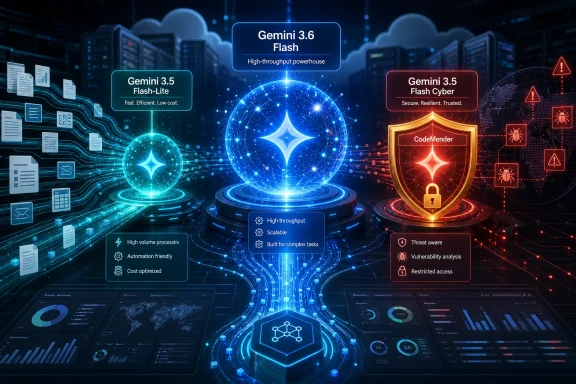 Gemini 3.6 Flash lowers the rate card and targets verbosity
Gemini 3.6 Flash, model ID
gemini-3.6-flash, takes over the high-throughput general-purpose role from Gemini 3.5 Flash. It accepts text, images, video, audio, and PDFs, supports a 1,048,576-token input context and up to 65,536 output tokens, and returns text rather than generated images, audio, or video.
Google’s core claim is that the new Flash model consumes 17% fewer output tokens than 3.5 Flash on the Artificial Analysis Index, while also requiring fewer reasoning steps and tool calls in some multistep workflows. Google says that translates into better coding, knowledge-work, and multimodal performance at lower cost; TechCrunch and Ars Technica both reported the launch and the absent Gemini 3.5 Pro release.
The hard-dollar comparison is clearer than the vendor language. Gemini 3.6 Flash is priced at $1.50 per million input tokens and $7.50 per million output tokens. Gemini 3.5 Flash remains listed at $1.50 input and $9 output. Input pricing is unchanged; output is roughly 16.7% cheaper before any token-efficiency benefit is counted.
For workloads dominated by generated text and reasoning tokens, the two changes compound. If a task truly uses 17% fewer output tokens and those tokens cost $7.50 rather than $9 per million, the output portion of that task costs roughly 31% less. That is a meaningful reduction for an agent that repeatedly drafts code changes, summarizes logs, produces test plans, or prepares support responses.
It is not, however, a universal 31% saving. Large Windows deployment inventories, event-log corpora, ticket exports, and document-analysis jobs can be input-heavy. Search grounding also carries its own metered charge after Google’s shared monthly allowance. The operational test is therefore not Google’s token benchmark but a replay of an organization’s own prompts, tool calls, and source documents.
Google’s API documentation calls out a second issue that tends to get lost in the performance charts: the sampling controls
temperature,
top_p, and
top_kare deprecated. Teams that have used those parameters to stabilize PowerShell generation, incident-response summaries, or structured automation should test API behavior during migration, not merely switch the model name.
Flash-Lite is cheaper to run than Flash, but it costs more than its predecessor
Gemini 3.5 Flash-Lite, model ID
gemini-3.5-flash-lite, is Google’s volume tier. The company rates it at 350 output tokens per second through the Artificial Analysis measurement and positions it for high-throughput work such as classification, translation, document processing, retrieval subagents, and repetitive customer-service tasks.
At $0.30 per million input tokens and $2.50 per million output tokens, it is vastly cheaper than Gemini 3.6 Flash’s standard API pricing. For organizations using a controller-and-worker agent design, the sensible pattern is increasingly obvious: use 3.6 Flash for planning and harder reasoning, then delegate extraction, tagging, routing, first-pass summaries, and other routine steps to Flash-Lite.
But “most cost-effective” needs context. The prior Gemini 3.1 Flash-Lite rate was $0.25 per million text, image, and video input tokens and $1.50 per million output tokens. Gemini 3.5 Flash-Lite’s input price is 20% higher and its output price is about 67% higher. Google’s argument is that the new model is materially stronger and can complete agentic tasks with fewer calls or less reasoning; it has published benchmark gains in coding, long-context work, and computer use to support that claim.
The bill does not automatically fall just because a model has a Lite label. A Windows administrator using it to classify thousands of Intune remediation logs may save on latency and avoid escalating work to a larger model. A developer using it to generate lengthy reports, verbose code explanations, or repeated agent traces can still spend more per output token than on 3.1 Flash-Lite. The right comparison is completed-work cost and error rate, not the front-page price.
Flash-Lite has the same million-token input context and 65,536-token output ceiling as 3.6 Flash, and it supports tools such as function calling, search grounding, and computer use. That means Google is selling it as more than a basic chatbot model. It is a candidate for the high-fan-out workers in an automated system, where a more expensive model would be called hundreds or thousands of times.
The Cyber model is a controlled CodeMender capability, not an API release
Gemini 3.5 Flash Cyber is the most consequential announcement and the least available one. Google DeepMind describes it as a lightweight model built on Gemini 3.5 Flash and fine-tuned to find, validate, and patch software vulnerabilities. The company says it will be used through CodeMender, its code-security agent, in a limited-access pilot for governments and trusted partners, with broader expansion promised but no public timetable.
That makes the Cloud Wars framing of a new model launch technically correct but potentially misleading for IT buyers. There is no public Gemini API model ID to plug into an application, no published public price, no general-access enrollment path, and no stated date when ordinary enterprises can use the specialized model. TechRepublic similarly reported that the best-equipped version of CodeMender remains restricted while the general offering is in preview.
Google has published striking internal and benchmark claims. It says a CodeMender configuration that invokes Flash Cyber up to five times can compete with much larger models on CyberGym, and that the model found 55 confirmed unique issues in an evaluation of V8, compared with 47 for mainline Gemini 3.5 Flash and 36 for Claude Opus 4.6. Google also says the model has been finding and fixing vulnerabilities across internal codebases including Chrome, Android, Cloud, Ads, and YouTube.
Those are Google’s results, not independently replicated field evidence. The five-call detail is especially important: the demonstrated capability belongs to the CodeMender orchestration system, repeated model invocations, tooling, and verification loop—not necessarily to one prompt sent to a model. Security teams should resist treating a vulnerability-finding benchmark as proof that an agent can be allowed to author and deploy production patches without review.
Google’s restricted rollout also reflects the dual-use problem. A model capable of recognizing a flaw, determining whether it is exploitable, and generating a reliable proof of concept can help defenders close holes faster, but the same sequence can shorten an attacker’s path from source access to exploitation. Limited access reduces that exposure, but it also means the announcement changes little for a Windows-centric enterprise that wants to scan a private .NET, C++, PowerShell, or driver codebase this quarter.
Gemini 3.5 Pro remains the missing product
Google acknowledged that Gemini 3.5 Pro is still being tested with partners and said it plans broad availability once it is ready. It did not announce a release date, technical specification, price, or API model ID. Axios noted that Bloomberg had reported the anticipated flagship was months behind schedule, but Google’s own announcement offers no timetable beyond the open-ended partner-testing statement.
The absence matters because 3.6 Flash is being asked to cover two jobs: be a low-latency, lower-cost operational model and provide enough reasoning quality for increasingly complex agent workflows. Google’s product line now has an efficient public workhorse, a high-volume worker tier, and a gated security specialist. It still lacks a newly released public flagship in the 3.5 generation.
For now, the immediate action is straightforward. Test
gemini-3.6-flashagainst existing
gemini-3.5-flashevaluations before moving a production workflow, route truly repetitive subagent work to
gemini-3.5-flash-lite, and do not budget around Flash Cyber unless Google has explicitly admitted your organization to CodeMender. The older 3.5 Flash endpoint remains live with no announced shutdown date, while the cyber capability remains a promise of access rather than a tool most defenders can deploy.
References
- Primary source: Cloud Wars
Published: August 7, 2026 at 3:00 PM UTC
Google Launches Gemini 3.6 Flash Alongside New Flash-Lite and Cyber AI models - Cloud Wars
Google has introduced Gemini 3.6 Flash, Gemini 3.5 Flash-Lite, and Gemini 3.5 Flash Cyber, focusing on lower costs, faster AI agents, improved coding, and specialized cybersecurity capabilities for enterprise customers.cloudwars.com - Related coverage: deepmind.google
Introducing Gemini 3.5 Flash Cyber — Google DeepMind
Google introduces Gemini 3.5 Flash Cyber to help defenders find, validate, and patch software vulnerabilities quickly and efficiently.deepmind.google - Related coverage: deepmind.google
Gemini 3.6 Flash — Google DeepMind
Our workhorse model that reduces output token usage by 17% compared to 3.5 Flash, according to Artificial Analysis Index.deepmind.google - Related coverage: ai.google.dev
- Related coverage: blog.google
3.6 Flash, 3.5 Flash-Lite, and 3.5 Flash Cyber
We’re introducing new Gemini models, including Gemini 3.6 Flash, 3.5 Flash-Lite and 3.5 Flash Cyber.blog.google - Related coverage: ai.google.dev
- Related coverage: techcrunch.com
Google releases three new Gemini models — but no 3.5 Pro | TechCrunch
Google released Gemini 3.6 Flash, 3.5 Flash-Lite, and Flash Cyber, but the continued absence of Gemini 3.5 Pro raises fresh questions about its AI strategy.techcrunch.com - Related coverage: blog.google
‘제미나이 3.5 플래시 사이버’(Gemini 3.5 Flash Cyber)를 소개합니다
구글은 보안 담당자가 이러한 위협에 더욱 잘 대비할 수 있도록 지원해 온 오랜 노력의 일환으로 ‘제미나이 3.5 플래시 사이버(Gemini 3.5 Flash Cyber)’를 새롭게 선보입니다.blog.google - Related coverage: apidog.com
- Related coverage: techrepublic.com
Google Holds Back Gemini 3.5 Flash Cyber as CodeMender Enters Preview - TechRepublic
Google is restricting Gemini 3.5 Flash Cyber to select partners as CodeMender enters preview. Here’s what security teams should verify before adoption.www.techrepublic.com
- Related coverage: techradar.com
I gave Gemini 3.6 Flash and GPT-5.6 access to my entire digital life — here’s which one actually helped me more | TechRadar
I compared Google's new default AI to OpenAI's default reasoning modelwww.techradar.com - Related coverage: cincodias.elpais.com
- Related coverage: tokencost.app
Gemini 3.5 Flash-Lite Price Increase Explained | TokenCost
Gemini 3.5 Flash-Lite costs $0.30/$2.50 per 1M tokens, up 20% and 67% over 3.1 Flash-Lite. Fewer output tokens, 63% higher bill. Full cost breakdown.tokencost.app
- Related coverage: github.blog
Upcoming deprecation of Gemini 2.5 Pro and Gemini 3 Flash - GitHub Changelog
We will deprecate Gemini 2.5 Pro and Gemini 3 Flash across all GitHub Copilot experiences (including Copilot Chat, inline edits, ask and agent modes, and code completions) on July 31st,…github.blog
- Related coverage: aicost.tools
Gemini 3.5 Flash-Lite API Pricing 2026 — Cost per 1M Tokens · AI//COST
Gemini 3.5 Flash-Lite API pricing: $0.30 input, $2.50 output, $0.03 cached input per 1M tokens (2026 rates). Cost calculator, scenarios, and cheaper Gemini alternatives.aicost.tools - Related coverage: aireiter.com
Gemini 3.5 Flash-Lite: Pricing, Speed & When to Use
Gemini 3.5 Flash-Lite is the cheapest Gemini tier at $0.30/$2.50 per 1M. First-hand speed and cost tests, plus when to use it over 3.6 Flash.aireiter.com - Related coverage: axios.com
Google releases series of new cheaper Gemini models
The AI deployment race has shifted from benchmark bragging rights to who can provide the best model at the lowest price.www.axios.com
- Related coverage: discuss.ai.google.dev
Clarification on Stable Replacement Models for gemini-2.5-flash and gemini-2.5-pro Before June 2026 Deprecation - Gemini API - Google AI Developers Forum
We are currently using the gemini-2.5-flash and gemini-2.5-pro models in our production environment. As per the deprecation notice, these models are scheduled to be deprecated on June 17, 2026. We would like to plan our… discuss.ai.google.dev
- Related coverage: concentrate.ai
Gemini 3.5 Flash Lite - Google | API Pricing & Providers | Concentrate.ai
Compare pricing, performance, benchmarks, and integrations for Gemini 3.5 Flash Lite by Google. From $0.30/M input, $2.50/M output tokens. Access through one unified API.concentrate.ai - Related coverage: storage.googleapis.com
- Related coverage: modelcards.withgoogle.com
Model cards — Google DeepMind
Simple, structured overviews of how an advanced AI model was designed and evaluated.modelcards.withgoogle.com - Related coverage: androidcentral.com
Gemini 2.5 Flash-Lite now 'generally available' following Google's month-long preview | Android Central
Google's "fastest" Gemini model is here, acting as the finale to its 2.5 series.www.androidcentral.com - Related coverage: tomsguide.com
Biggest Google I/O 2026 announcements — Gemini Spark, Intelligent Eyewear glasses and more | Tom's Guide
Android, Gemini and an explosion of news featured at this year's I/O keynotewww.tomsguide.com - Related coverage: techradar.com
Google I/O 2026 as it happened — Gemini Spark, Samsung XR glasses, and everything else announced at Google's giant software showcase | TechRadar
Google's opening keynote was jam-packed full of AI-related announcements — and we finally saw some smart glasseswww.techradar.com - Related coverage: reposhub.com
Gemini 3.6 Flash Pricing (2026): $1.50 / $7.50 — and Why “Flash” Now Means Three Prices
Google shipped Gemini 3.6 Flash at $1.50 per 1M input tokens and $7.50 per 1M output, alongside 3.5 Flash-Lite at $0.30 / $2.50 and a Cyber model with no published price. Three models, one name, a 3x spread on output. The sourced numbers and how to pick.reposhub.com - Related coverage: 9to5google.com
Google launches Gemini 3.6 Flash and teases Gemini 4
As we wait for 3.5 Pro, Google today announced Gemini 3.6 Flash and 3.5 Flash-Lite, while providing updates on what comes next.9to5google.com - Related coverage: artdirectiondaily.com
Gemini 3.6 Flash pricing and the 3.5 Flash-Lite, Flash Cyber tiers | Art Direction Daily
Google shipped Gemini 3.6 Flash, 3.5 Flash-Lite, and a governments-only Flash Cyber. Real per-token prices, plus Webflow MCP 2.0 and Qwen-Image-3.0 shipping closed. artdirectiondaily.com
- Related coverage: apidog.com
- Related coverage: codingsalt.com
Gemini 3.6 Flash Pricing: What Changes for Developers — CodingSalt
Gemini 3.6 Flash cuts output pricing to $7.50/1M tokens and uses 17% fewer tokens per task. Here is the real cost math and what to check before migrating.www.codingsalt.com
- Related coverage: arstechnica.com
Google announces Gemini 3.6 Flash and cybersecurity AI, teases 3.5 Pro and Gemini 4 - Ars Technica
There are new 3.6 and 3.5 models today, but Google is already training Gemini 4.arstechnica.com - Related coverage: agentpedia.codes
Gemini 3.6 Flash Guide: API, Pricing and Benchmarks
Gemini 3.6 Flash guide to model IDs, API pricing, benchmark caveats, Antigravity and Copilot availability, Flash-Lite, Cyber, and migration tests.agentpedia.codes - Related coverage: storage.googleapis.com
- Related coverage: androidcentral.com
Google’s new $100 AI plan wants to turn Gemini into a full productivity machine | Android Central
Google removes daily prompt limits and launches a cheaper $100 AI ultra plan.www.androidcentral.com
