
Google DeepMind has introduced Gemini Robotics 2, a model suite intended to give humanoid robots whole-body control rather than limiting them to tabletop arm movements. In a demonstration highlighted by Robotics & Automation News, Apptronik’s Apollo 2 humanoid walks to retrieve a watering can and places it on a lower shelf—combining locomotion, balance, perception and manipulation in one task.
DeepMind’s July 30 announcement frames the release as an “intelligence layer” for robots that must work in human-designed spaces. The core Gemini Robotics 2 vision-language-action model takes camera input and natural-language instructions, then translates them into motion for full humanoids and dual-arm systems.
The practical change is that a robot can now crouch, reach, walk, adjust its center of gravity and use its hands as parts of one coordinated action. Earlier Gemini Robotics work centered more heavily on upper-body manipulation; Gemini Robotics 2 extends control from “feet to fingertips,” according to Google DeepMind.
The same model checkpoint was demonstrated across multiple platforms, including Apollo 2 configurations and the Franka Duo dual-arm system. That cross-platform aim matters more than any single demo: hardware-specific training has been one of robotics’ biggest deployment bottlenecks.
DeepMind also published performance figures that underline both the progress and the limits. With Apollo 2 and Inspire hands, the model achieved 68.4% success lifting objects from a table, 45.7% from the floor and 76.3% from a shelf. Fine manipulation with five-fingered hands remains uneven: unscrewing a light bulb reached 92%, while screwing one in reached 36%.
For Windows-based industrial and enterprise environments, the on-device element may be the more consequential detail. Google says On-Device 2 can be adapted to new dual-arm robot designs with fewer than 200 real-world examples and only a few hours of additional training. That points toward deployments that keep operational control local instead of treating a remote AI service as a hard dependency.
Those are necessary controls, but they are not a substitute for conventional machine safeguarding, site risk assessments or operator procedures. A model capable of broader motion also expands the range of potential mistakes, particularly in mixed human-robot settings.
Gemini Robotics ER 2 is available through Google AI Studio and in private preview on the Gemini Enterprise Agent Platform. The full Robotics 2 and On-Device 2 models are currently limited to early-access partners, meaning the near-term story is validation on real hardware—not a broad rollout of general-purpose humanoids.
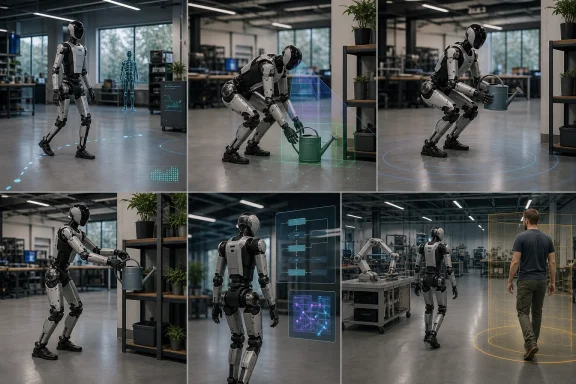 Apollo 2 Shows the Shift From Arms to Full-Body Control
The practical change is that a robot can now crouch, reach, walk, adjust its center of gravity and use its hands as parts of one coordinated action. Earlier Gemini Robotics work centered more heavily on upper-body manipulation; Gemini Robotics 2 extends control from “feet to fingertips,” according to Google DeepMind.The same model checkpoint was demonstrated across multiple platforms, including Apollo 2 configurations and the Franka Duo dual-arm system. That cross-platform aim matters more than any single demo: hardware-specific training has been one of robotics’ biggest deployment bottlenecks.
DeepMind also published performance figures that underline both the progress and the limits. With Apollo 2 and Inspire hands, the model achieved 68.4% success lifting objects from a table, 45.7% from the floor and 76.3% from a shelf. Fine manipulation with five-fingered hands remains uneven: unscrewing a light bulb reached 92%, while screwing one in reached 36%.
Three Models Divide Motion, Planning and Local Operation
Gemini Robotics 2 is not a single release so much as a three-part stack:- Gemini Robotics 2 is the primary vision-language-action model for humanoid and dual-arm motion.
- Gemini Robotics ER 2 is the high-level embodied reasoning model that plans, monitors and revises multi-step jobs.
- Gemini Robotics On-Device 2 is a lighter model designed to run on the robot itself where cloud connectivity or network latency is unacceptable.
For Windows-based industrial and enterprise environments, the on-device element may be the more consequential detail. Google says On-Device 2 can be adapted to new dual-arm robot designs with fewer than 200 real-world examples and only a few hours of additional training. That points toward deployments that keep operational control local instead of treating a remote AI service as a hard dependency.
Safety Claims Will Need Real-World Scrutiny
Google DeepMind is pairing the release with ASIMOV-Agentic, a benchmark for whether a robotic agent can refuse unsafe actions, recognize an impossible task and ask for human help when uncertain. ER 2 also adds human-proximity detection intended to trigger a safe stop when someone enters the robot’s workspace.Those are necessary controls, but they are not a substitute for conventional machine safeguarding, site risk assessments or operator procedures. A model capable of broader motion also expands the range of potential mistakes, particularly in mixed human-robot settings.
Gemini Robotics ER 2 is available through Google AI Studio and in private preview on the Gemini Enterprise Agent Platform. The full Robotics 2 and On-Device 2 models are currently limited to early-access partners, meaning the near-term story is validation on real hardware—not a broad rollout of general-purpose humanoids.
References
- Primary source: Robotics & Automation News
Published: 2026-07-31T10:26:39+00:00
Loading…
roboticsandautomationnews.com - Independent coverage: GIGAZINE
Published: 2026-07-31T01:37:00+00:00
Loading…
gigazine.net - Independent coverage: SiliconANGLE
Published: 2026-07-30T23:42:24+00:00
Loading…
siliconangle.com - Independent coverage: Interesting Engineering
Published: 2026-07-30T20:41:04+00:00
Loading…
interestingengineering.com - Independent coverage: Google DeepMind
Published: 2026-07-30T16:00:00+00:00
Loading…
deepmind.google