
Google DeepMind has introduced Gemini Robotics 2, a model suite intended to give humanoid robots whole-body control rather than limiting them to tabletop arm movements. In a demonstration highlighted by Robotics & Automation News, Apptronik’s Apollo 2 humanoid walks to retrieve a watering can and places it on a lower shelf—combining locomotion, balance, perception and manipulation in one task.
DeepMind’s July 30 announcement frames the release as an “intelligence layer” for robots that must work in human-designed spaces. The core Gemini Robotics 2 vision-language-action model takes camera input and natural-language instructions, then translates them into motion for full humanoids and dual-arm systems.
The practical change is that a robot can now crouch, reach, walk, adjust its center of gravity and use its hands as parts of one coordinated action. Earlier Gemini Robotics work centered more heavily on upper-body manipulation; Gemini Robotics 2 extends control from “feet to fingertips,” according to Google DeepMind.
The same model checkpoint was demonstrated across multiple platforms, including Apollo 2 configurations and the Franka Duo dual-arm system. That cross-platform aim matters more than any single demo: hardware-specific training has been one of robotics’ biggest deployment bottlenecks.
DeepMind also published performance figures that underline both the progress and the limits. With Apollo 2 and Inspire hands, the model achieved 68.4% success lifting objects from a table, 45.7% from the floor and 76.3% from a shelf. Fine manipulation with five-fingered hands remains uneven: unscrewing a light bulb reached 92%, while screwing one in reached 36%.
For Windows-based industrial and enterprise environments, the on-device element may be the more consequential detail. Google says On-Device 2 can be adapted to new dual-arm robot designs with fewer than 200 real-world examples and only a few hours of additional training. That points toward deployments that keep operational control local instead of treating a remote AI service as a hard dependency.
Those are necessary controls, but they are not a substitute for conventional machine safeguarding, site risk assessments or operator procedures. A model capable of broader motion also expands the range of potential mistakes, particularly in mixed human-robot settings.
Gemini Robotics ER 2 is available through Google AI Studio and in private preview on the Gemini Enterprise Agent Platform. The full Robotics 2 and On-Device 2 models are currently limited to early-access partners, meaning the near-term story is validation on real hardware—not a broad rollout of general-purpose humanoids.
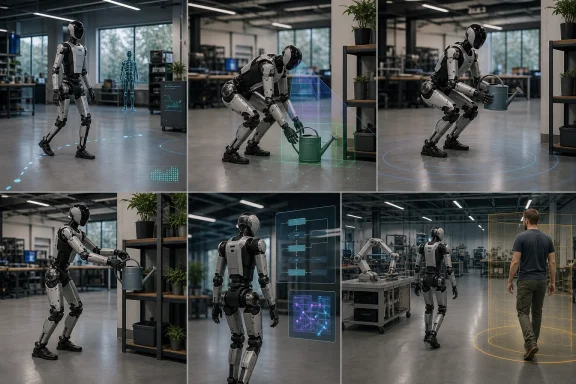 Apollo 2 Shows the Shift From Arms to Full-Body Control
The practical change is that a robot can now crouch, reach, walk, adjust its center of gravity and use its hands as parts of one coordinated action. Earlier Gemini Robotics work centered more heavily on upper-body manipulation; Gemini Robotics 2 extends control from “feet to fingertips,” according to Google DeepMind.The same model checkpoint was demonstrated across multiple platforms, including Apollo 2 configurations and the Franka Duo dual-arm system. That cross-platform aim matters more than any single demo: hardware-specific training has been one of robotics’ biggest deployment bottlenecks.
DeepMind also published performance figures that underline both the progress and the limits. With Apollo 2 and Inspire hands, the model achieved 68.4% success lifting objects from a table, 45.7% from the floor and 76.3% from a shelf. Fine manipulation with five-fingered hands remains uneven: unscrewing a light bulb reached 92%, while screwing one in reached 36%.
Three Models Divide Motion, Planning and Local Operation
Gemini Robotics 2 is not a single release so much as a three-part stack:- Gemini Robotics 2 is the primary vision-language-action model for humanoid and dual-arm motion.
- Gemini Robotics ER 2 is the high-level embodied reasoning model that plans, monitors and revises multi-step jobs.
- Gemini Robotics On-Device 2 is a lighter model designed to run on the robot itself where cloud connectivity or network latency is unacceptable.
For Windows-based industrial and enterprise environments, the on-device element may be the more consequential detail. Google says On-Device 2 can be adapted to new dual-arm robot designs with fewer than 200 real-world examples and only a few hours of additional training. That points toward deployments that keep operational control local instead of treating a remote AI service as a hard dependency.
Safety Claims Will Need Real-World Scrutiny
Google DeepMind is pairing the release with ASIMOV-Agentic, a benchmark for whether a robotic agent can refuse unsafe actions, recognize an impossible task and ask for human help when uncertain. ER 2 also adds human-proximity detection intended to trigger a safe stop when someone enters the robot’s workspace.Those are necessary controls, but they are not a substitute for conventional machine safeguarding, site risk assessments or operator procedures. A model capable of broader motion also expands the range of potential mistakes, particularly in mixed human-robot settings.
Gemini Robotics ER 2 is available through Google AI Studio and in private preview on the Gemini Enterprise Agent Platform. The full Robotics 2 and On-Device 2 models are currently limited to early-access partners, meaning the near-term story is validation on real hardware—not a broad rollout of general-purpose humanoids.
References
- Primary source: Robotics & Automation News
Published: 2026-07-31T10:26:39+00:00
Google DeepMind launches Gemini Robotics 2 for humanoid robots and physical AI
Google DeepMind has unveiled Gemini Robotics 2, enabling whole-body humanoid control, advanced dexterity and multi-robot collaboration, demonstrated on Apptronik's Apollo 2 robot.roboticsandautomationnews.com - Independent coverage: GIGAZINE
Published: 2026-07-31T01:37:00+00:00
Google DeepMind has announced 'Gemini Robotics 2,' an AI model for robots that can control the entire body, from walking to fine motor skills with both hands. - GIGAZINE
On July 30, 2026, Google DeepMind announced ' Gemini Robotics 2 ,' a suite of AI models capable of integrating and executing robotic walking, posture control, and object manipulation. It can control humanoid robots from toe to fingertips, and also supports collaborative work by multiple robots...gigazine.net - Independent coverage: SiliconANGLE
Published: 2026-07-30T23:42:24+00:00
Google DeepMind debuts Gemini Robotics 2 model series for humanoid robots - SiliconANGLE
Google DeepMind debuts Gemini Robotics 2 model series for humanoid robots - SiliconANGLE siliconangle.com
- Independent coverage: Interesting Engineering
Published: 2026-07-30T20:41:04+00:00
Google's Gemini Robotics 2 gives humanoid robots full-body control
Google's Gemini Robotics 2 brings whole-body control, better dexterity and teamwork to next-generation humanoid robots.interestingengineering.com - Independent coverage: Google DeepMind
Published: 2026-07-30T16:00:00+00:00
Gemini Robotics 2 brings whole body intelligence to robots — Google DeepMind
From feet to fingertips — we are teaching robots intelligent whole-body control, fine dexterity, and teamwork to complete a broad range of complex tasks.deepmind.google
