

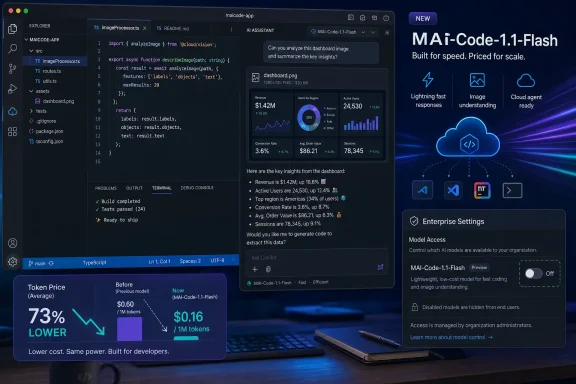
GitHub detailed the rollout in an August 11 changelog entry, while its Copilot documentation now lists MAI-Code-1.1-Flash as a generally available Microsoft model. The new model can be selected by paid individual, business, and enterprise customers in Copilot CLI, the Copilot cloud agent, the GitHub Copilot app, Copilot Chat on GitHub, Visual Studio Code, Visual Studio, GitHub Mobile, JetBrains IDEs, Eclipse, and Xcode. Copilot Free and Copilot Student users are limited to having it selected automatically.
The important news is less that Copilot has gained another model picker entry than that Microsoft is trying to push a lower-cost model into the normal developer workflow without limiting it to text-only requests. GitHub says MAI-Code-1.1-Flash adds native vision support, alongside claimed improvements in coding quality, instruction following, tool use, and performance. But the company has not published independent benchmark results or a task-by-task comparison against the models Copilot users are likely to choose instead.
The token prices confirm GitHub’s 73% claim
GitHub’s pricing table puts MAI-Code-1.1-Flash at $0.20 per million input tokens, $0.02 per million cached-input tokens, and $1.20 per million output tokens. MAI-Code-1-Flash remains listed at $0.75, $0.075, and $4.50 respectively.
That makes the successor exactly 73.3% cheaper across all three listed token categories. This is not a selective calculation built around inexpensive input context while leaving generated code expensive: the lower rate applies equally to output tokens, which are often the material cost in code generation, explanations, and agentic edits.
For teams on Copilot’s current usage-based billing, that price is converted to GitHub AI Credits, with one credit worth $0.01. Included credit allowances vary by plan; after an allowance is exhausted, the listed token rates determine additional spending. Code completions and next-edit suggestions remain outside this per-token AI Credit bill, so the change primarily affects Chat, CLI, agents, and other model-driven interactions rather than ordinary inline completions.
GitHub also says existing annual Copilot Pro and Pro+ subscribers who remain on the older request-based billing scheme will be charged at a 0.25× premium-request multiplier. In plain terms, four MAI-Code-1.1-Flash prompts consume the equivalent of one standard premium request under that legacy system.
That unusually low multiplier makes the model financially attractive for repetitive work: small refactors, codebase orientation, test generation, shell-command assistance, routine documentation changes, and first-pass issue triage. It does not mean every interaction will cost a quarter of a request for every subscriber. The multiplier applies specifically to annual customers still on GitHub’s legacy request-based arrangement; current plans are metered through AI Credits and token consumption.
Vision is the capability change, but GitHub leaves the workflow details open
MAI-Code-1.1-Flash’s defining addition is native vision support: the model can understand images rather than only source code and text. That potentially makes it useful for turning screenshots into HTML and CSS, reading UI error dialogs, examining architecture diagrams, reasoning over a photo of a whiteboard, or comparing a rendered page with a design reference.
GitHub’s announcement is narrower than the marketing implication. It says the model has image-understanding capability and can be selected across ten Copilot surfaces, but it does not say which of those surfaces can accept image attachments for this particular model, whether the feature works uniformly across desktop and mobile clients, or whether vision use changes token accounting. A model appearing in a picker is not the same thing as every client exposing every input modality.
The company’s supported-model documentation lists Visual Studio Code version 1.121 as the known minimum for MAI-Code-1.1-Flash. It does not name minimum versions for Visual Studio, JetBrains IDEs, Eclipse, Xcode, or GitHub Mobile. That omission matters for Windows developers: an organization can enable the policy and still find that a client’s Copilot extension or IDE build does not expose the new model cleanly.
GitHub advises users to keep their IDE and Copilot extension updated because models may work better on current versions even if an older client presents them in the picker. For a Windows fleet, that means updating Visual Studio Code and the GitHub Copilot extension should be part of any pilot rather than a cleanup step after developers report inconsistent behavior.
Enterprise access is deliberately gated
The rollout breaks along plan lines. Copilot Free and Student accounts can receive MAI-Code-1.1-Flash only through automatic model selection, which means those users cannot deliberately choose it for image-oriented or low-cost coding work. Copilot Pro, Pro+, Max, Business, and Enterprise users can manually select it where their client supports the picker.
Business and Enterprise are different again: GitHub says administrators must enable the MAI-Code-1.1-Flash policy in Copilot settings, and that policy starts disabled. This protects organizations from unexpectedly widening their approved model set, but it also means the phrase “available in GitHub Copilot” should not be read as “available to every managed Copilot user today.”
Administrators should treat the change as a model-governance decision, not merely a cost-control toggle. Before enabling it broadly, they need to verify the organization’s existing rules around image inputs, source-code handling, retention commitments, and allowed model providers. GitHub’s model documentation says availability can be restricted by policies, and enterprise settings can control which models members may use.
There is a second operational consequence. Auto model selection can choose among available models based on the request, but a Business or Enterprise tenant that leaves MAI-Code-1.1-Flash disabled removes it from that pool. Teams that want the promised cost savings cannot rely on auto selection until they enable the policy, then monitor whether the model is actually being selected for suitable tasks.
Cheap coding assistance still needs a quality gate
Microsoft claims improvements in coding quality, instruction following, tools, and performance, but neither Microsoft nor GitHub has supplied public comparative results in the rollout materials that would let IT teams assess how MAI-Code-1.1-Flash fares against GPT-5 mini, GPT-5.4 mini, Claude Haiku 4.5, or GitHub’s own Raptor mini on the team’s codebase.
That is a notable gap because the model is being positioned for work where lower operating cost can encourage higher-volume usage. More agent sessions, more code-review prompts, more generated tests, and more requests to interpret screenshots can lower the per-request bill while increasing total model activity. A cheaper rate is valuable only if the extra review, remediation, and developer time do not erase it.
GitHub’s own documentation continues to make the right baseline explicit: developers should validate generated code and perform thorough human review before putting suggestions into production, particularly for security-sensitive work. Native vision adds another review point. A model can misread a screenshot, infer a UI state that is not present, or turn a visual cue into an incorrect code change with convincing prose.
A sensible pilot is small and measurable:
- Enable MAI-Code-1.1-Flash for a controlled group rather than changing the policy for the entire tenant on day one.
- Test text-only coding tasks and image-based tasks separately, because vision support is the new feature and not yet documented consistently across clients.
- Compare accepted suggestions, test failures, security-review findings, latency, and token use against the team’s current lightweight default.
- Confirm that Visual Studio Code clients meet version 1.121 or later and that other supported IDEs have current Copilot integrations before treating missing model options as a licensing problem.
GitHub has delivered the pricing information needed to judge the cost claim, and the math checks out. What remains unproven is whether MAI-Code-1.1-Flash provides enough quality improvement—and enough reliable image understanding—to replace an existing lightweight default for a given Windows development team.
For now, its clearest role is a controlled, low-cost option for routine Copilot work. Enterprise administrators who do nothing will not get that option at all, because GitHub has made the policy disabled by default.