
Microsoft says it has been placed in the Leaders quadrant of Gartner’s inaugural 2026 Magic Quadrant for AI-Augmented Code Modernization Tools, a new category focused on software that combines AI agents, generative AI, and deterministic code analysis to move legacy applications forward. For Windows and Azure shops, the useful news is less the quadrant graphic than the product maturity behind it: GitHub Copilot modernization’s IDE-based upgrade tools are generally available for .NET, Java, and C++, while the portfolio-scale Modernize CLI agent remains a public preview for assessment and planning.
Microsoft made the announcement on August 6, tying its placement to GitHub Copilot modernization and Azure migration tooling. Gartner’s own public Magic Quadrant catalog lists the report under a July 8, 2026 date, while Microsoft’s announcement identifies the cited report as dated August 3, 2026. Neither company explains the difference. It may reflect Gartner’s publication-versus-report-date conventions, but buyers comparing procurement materials should record the discrepancy rather than treating the dates as interchangeable.
The recognition itself is a vendor position in a paid research product, not an independent performance test of a migration. Gartner explicitly says its Magic Quadrants are opinions and not endorsements or statements of fact. Microsoft’s announcement should therefore be read as confirmation that Gartner has created and evaluated vendors in this market category—not as proof that a given .NET Framework, Java, or C++ estate can be converted safely at the speed Microsoft advertises.
Microsoft describes GitHub Copilot modernization as a two-layer workflow. The first is the Modernize CLI, which assesses repositories, produces plans, and can coordinate work across multiple applications. The second is the in-IDE Copilot experience, where developers carry out framework upgrades, dependency changes, Azure service migrations, infrastructure-as-code generation, and deployment work.
That division is important because Microsoft’s current documentation makes a sharper availability distinction than the announcement’s broad “end-to-end” language. The IDE experience is generally available for language, framework, and toolset upgrades for .NET, Java, and C++; migration scenarios are generally available for .NET and Java. The Modernize CLI’s assessment and planning functions, however, are still listed as public preview.
For an IT organization, that means Copilot modernization is presently more mature as an assisted engineering tool than as a hands-off portfolio migration system. A developer can use it now to modernize a supported project, review the changes, run tests, and open a pull request. An enterprise architect considering a batch program across hundreds of repositories is being asked to incorporate a preview command-line component into a workflow that may touch source code, CI/CD pipelines, and Azure target services.
Microsoft’s own setup guidance also puts a few operational boundaries around the product. The modernization agent runs on Windows x64 and ARM64, alongside supported Linux and macOS systems, and requires GitHub CLI authentication plus a GitHub Copilot subscription. It can be installed on Windows through WinGet as
That does not necessarily mean Python support is absent. It could indicate a narrower capability, an early-stage feature, or documentation that has not caught up with the announcement. But Microsoft has not supplied the details required for a customer to plan around it: no supported Python versions, framework coverage, migration targets, availability status, or limits appear in the public documentation reviewed for this story.
The same caution applies to “Azure migration” as a phrase. A source-code transformation is only one element of modernization. Moving a .NET Framework line-of-business application off a Windows Server and IIS estate can involve identity and authorization, SQL Server dependencies, file shares, scheduled jobs, COM components, certificate handling, network rules, observability, licensing, disaster recovery, and deployment ownership. Copilot can help convert code and produce infrastructure definitions, but it cannot make those surrounding design decisions disappear.
Microsoft’s documented workflow does preserve an essential safeguard: the company says recommendations are transparent, changes are reviewable, and validation remains in the customer’s tests and pipelines. That is the right model for code modernization. It also means the phrase agentic modernization should be understood as managed automation with human review, not a guaranteed autonomous conversion of a production application estate.
Without those details, the figures cannot be translated into a forecast for a particular organization. A 500,000-line application with modern unit tests, a clean build, one supported language, well-mapped dependencies, and a simple deployment path is fundamentally different from a smaller application tied to an undocumented database schema, a Windows service, a legacy identity provider, and several external vendors.
Microsoft also says more than 1.4 million developers have installed the modernization experience. Installation is a weak adoption measure for a tool whose value depends on successful, reviewed, tested, and deployed changes. The company does not say how many of those installations are active, how many are paid enterprise users, how many completed a modernization project, or how many projects reached production.
The evidence supports a more restrained conclusion: Microsoft has assembled a credible automation stack around a common Azure customer problem, especially upgrades from older Java and .NET runtimes and dependency sets. It has not published enough independent operational data to establish that its claimed time savings hold across heterogeneous enterprise portfolios.
That integration may be attractive to organizations already standardized on Microsoft identity, GitHub, Azure DevOps or GitHub Actions, Azure Policy, Defender for Cloud, and Azure-hosted deployment targets. The ability to make repeatable migration patterns—such as moving secrets into Azure Key Vault, adopting managed identities, or replacing storage dependencies—available as reusable tasks and custom skills could reduce variation between teams.
It also means the recognition should not be read as a neutral recommendation of a modernization methodology independent of cloud provider. Microsoft’s product is designed to make legacy applications fit Azure’s services and operating model. That can lower friction for Azure customers, but it naturally steers architecture, operational tooling, and future AI workloads toward Microsoft’s platform.
The key question for administrators is therefore not whether Gartner placed Microsoft in a Leaders quadrant. It is whether the organization’s applications match the currently documented support matrix, whether the preview CLI is acceptable in the delivery process, and whether each application has enough tests and dependency knowledge for AI-generated changes to be safely reviewed.
Microsoft’s Gartner recognition adds market validation to a category that did not have a Magic Quadrant last year. The immediate action for Windows and Azure teams is narrower: pilot GitHub Copilot modernization against one representative, well-tested .NET or Java application, measure the review and remediation burden alongside code-generation speed, and keep production migration decisions separate from the marketing claim that the work now takes days.
The recognition itself is a vendor position in a paid research product, not an independent performance test of a migration. Gartner explicitly says its Magic Quadrants are opinions and not endorsements or statements of fact. Microsoft’s announcement should therefore be read as confirmation that Gartner has created and evaluated vendors in this market category—not as proof that a given .NET Framework, Java, or C++ estate can be converted safely at the speed Microsoft advertises.
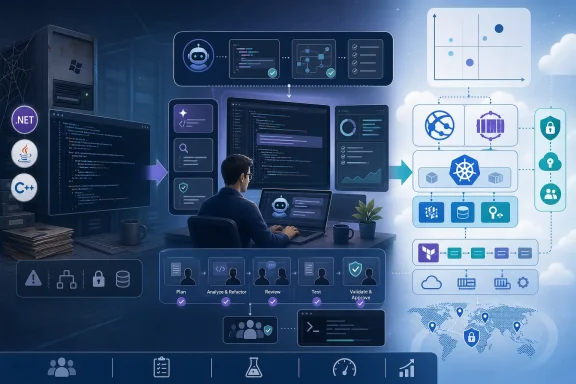 The practical product is split between the IDE and the CLI
Microsoft describes GitHub Copilot modernization as a two-layer workflow. The first is the Modernize CLI, which assesses repositories, produces plans, and can coordinate work across multiple applications. The second is the in-IDE Copilot experience, where developers carry out framework upgrades, dependency changes, Azure service migrations, infrastructure-as-code generation, and deployment work.That division is important because Microsoft’s current documentation makes a sharper availability distinction than the announcement’s broad “end-to-end” language. The IDE experience is generally available for language, framework, and toolset upgrades for .NET, Java, and C++; migration scenarios are generally available for .NET and Java. The Modernize CLI’s assessment and planning functions, however, are still listed as public preview.
For an IT organization, that means Copilot modernization is presently more mature as an assisted engineering tool than as a hands-off portfolio migration system. A developer can use it now to modernize a supported project, review the changes, run tests, and open a pull request. An enterprise architect considering a batch program across hundreds of repositories is being asked to incorporate a preview command-line component into a workflow that may touch source code, CI/CD pipelines, and Azure target services.
Microsoft’s own setup guidance also puts a few operational boundaries around the product. The modernization agent runs on Windows x64 and ARM64, alongside supported Linux and macOS systems, and requires GitHub CLI authentication plus a GitHub Copilot subscription. It can be installed on Windows through WinGet as
GitHub.Copilot.modernization.agent, which makes it comparatively easy to pilot on developer workstations. Easy installation should not be confused with a low-risk production rollout: the agent’s recommendations still need normal change control, test coverage, security review, and rollback planning.
Python is in the announcement, but not in the current availability record
Microsoft’s blog says GitHub Copilot modernization spans .NET, Java, C++, and Python. Its product documentation, however, says the solution analyzes and upgrades Java, .NET, and C++ applications, and its current-availability section names those same three languages. Python is not listed there as a generally available upgrade or migration workload.That does not necessarily mean Python support is absent. It could indicate a narrower capability, an early-stage feature, or documentation that has not caught up with the announcement. But Microsoft has not supplied the details required for a customer to plan around it: no supported Python versions, framework coverage, migration targets, availability status, or limits appear in the public documentation reviewed for this story.
The same caution applies to “Azure migration” as a phrase. A source-code transformation is only one element of modernization. Moving a .NET Framework line-of-business application off a Windows Server and IIS estate can involve identity and authorization, SQL Server dependencies, file shares, scheduled jobs, COM components, certificate handling, network rules, observability, licensing, disaster recovery, and deployment ownership. Copilot can help convert code and produce infrastructure definitions, but it cannot make those surrounding design decisions disappear.
Microsoft’s documented workflow does preserve an essential safeguard: the company says recommendations are transparent, changes are reviewable, and validation remains in the customer’s tests and pipelines. That is the right model for code modernization. It also means the phrase agentic modernization should be understood as managed automation with human review, not a guaranteed autonomous conversion of a production application estate.
“Days or weeks” is an aspiration, not a published service level
The announcement says modernization is shifting from multi-year programs to work teams complete in days or weeks. It also says customers have reported up to 70% less time spent on migration and 50% less effort for application upgrades, and that some customers have moved more than 500,000 lines of code in weeks. Those are Microsoft customer-reported figures, not Gartner findings, and the announcement does not provide a methodology, sample size, baseline application mix, defect rate, remediation workload, or total cost of the Azure destination.Without those details, the figures cannot be translated into a forecast for a particular organization. A 500,000-line application with modern unit tests, a clean build, one supported language, well-mapped dependencies, and a simple deployment path is fundamentally different from a smaller application tied to an undocumented database schema, a Windows service, a legacy identity provider, and several external vendors.
Microsoft also says more than 1.4 million developers have installed the modernization experience. Installation is a weak adoption measure for a tool whose value depends on successful, reviewed, tested, and deployed changes. The company does not say how many of those installations are active, how many are paid enterprise users, how many completed a modernization project, or how many projects reached production.
The evidence supports a more restrained conclusion: Microsoft has assembled a credible automation stack around a common Azure customer problem, especially upgrades from older Java and .NET runtimes and dependency sets. It has not published enough independent operational data to establish that its claimed time savings hold across heterogeneous enterprise portfolios.
The Azure destination is part of the offer
Microsoft’s positioning is tightly coupled to Azure. The tooling can migrate dependencies to Azure services, generate infrastructure-as-code, containerize applications, and deploy them to Azure. Microsoft names Azure App Service, Azure Container Apps, and Azure Kubernetes Service as destinations, then frames modernization as preparation for Microsoft Foundry and its AI services.That integration may be attractive to organizations already standardized on Microsoft identity, GitHub, Azure DevOps or GitHub Actions, Azure Policy, Defender for Cloud, and Azure-hosted deployment targets. The ability to make repeatable migration patterns—such as moving secrets into Azure Key Vault, adopting managed identities, or replacing storage dependencies—available as reusable tasks and custom skills could reduce variation between teams.
It also means the recognition should not be read as a neutral recommendation of a modernization methodology independent of cloud provider. Microsoft’s product is designed to make legacy applications fit Azure’s services and operating model. That can lower friction for Azure customers, but it naturally steers architecture, operational tooling, and future AI workloads toward Microsoft’s platform.
The key question for administrators is therefore not whether Gartner placed Microsoft in a Leaders quadrant. It is whether the organization’s applications match the currently documented support matrix, whether the preview CLI is acceptable in the delivery process, and whether each application has enough tests and dependency knowledge for AI-generated changes to be safely reviewed.
Microsoft’s Gartner recognition adds market validation to a category that did not have a Magic Quadrant last year. The immediate action for Windows and Azure teams is narrower: pilot GitHub Copilot modernization against one representative, well-tested .NET or Java application, measure the review and remediation burden alongside code-generation speed, and keep production migration decisions separate from the marketing claim that the work now takes days.
References
- Primary source: Microsoft Azure
Published: 2026-08-06T15:00:00+00:00
Loading…
azure.microsoft.com - Related coverage: gartner.com
Loading…
www.gartner.com - Related coverage: gartner.com
Loading…
www.gartner.com - Related coverage: learn.microsoft.com
Loading…
learn.microsoft.com - Related coverage: learn.microsoft.com
Loading…
learn.microsoft.com - Related coverage: gcomdr.pdo.aws.gartner.com
Loading…
gcomdr.pdo.aws.gartner.com - Related coverage: ited.edu.kg
Loading…
ited.edu.kg - Related coverage: emt.gartnerweb.com
Loading…
emt.gartnerweb.com - Related coverage: community.rocketsoftware.com
Loading…
community.rocketsoftware.com