
GMKtec’s NEO-X1 is a 14.6-liter desktop that pairs AMD’s Ryzen 9 9955HX or Ryzen 9 9955HX3D mobile processors with desktop GeForce RTX 5060 Ti or RTX 5070 graphics, but prospective buyers should treat the detailed configuration and availability claims circulating this week as unverified until a retail listing appears. The system was announced in China on July 28, not newly launched on major e-commerce sites in August, and the published pricing already conflicts across reports.
IT Home reported on July 28 that GMKtec had formally introduced the NEO-X1 and NEO-X1 Pro for eventual sale through JD.com. Its report put the entry-level Ryzen 9 9955HX and RTX 5060 Ti 8GB model at 11,999 yuan, while the Ryzen 9 9955HX3D and RTX 5070 12GB Pro version started at 16,499 yuan. Crucially, IT Home said it could not find a JD listing at publication and could not verify the installed memory or storage configurations.
That differs from TechNetBooks’ August 3 report, which says sales will open later in August and assigns 17,499 yuan to a 32GB/2TB Ryzen 9 9955HX3D and RTX 5070 configuration, plus 19,699 yuan for 64GB of memory. Those may turn out to be later SKU prices, but GMKtec has not published a visible global product page or a live retail page that resolves the difference. Its international storefront currently surfaces the older EVO-X1 mini PC, rather than the NEO-X1 desktop.
For Windows users and small-form-factor builders, the useful news is that GMKtec is attempting something more substantial than a mini PC with an external GPU dock. The warning is that this remains a China-market product announcement with key buying details still missing.
“MoDT” means mobile on desktop: a system built around a high-performance notebook processor but housed and powered like a desktop. AMD classifies the Ryzen 9 9955HX as a processor for both laptops and desktops, but it is still an FL1-package mobile part rather than an AM5 socket CPU that an owner can replace later.
The base NEO-X1 uses the 16-core, 32-thread Ryzen 9 9955HX, a Zen 5 Fire Range processor rated by AMD at a 55W default TDP and a 55W–75W configurable range. The Pro model moves to the Ryzen 9 9955HX3D, another 16-core Fire Range chip, adding AMD’s 3D V-Cache for a reported 144MB of total cache. That makes the Pro configuration the gaming-oriented version, particularly in games that respond well to extra cache and in CPU-heavy simulation, strategy, and competitive titles.
GMKtec says the motherboard uses 13-phase power delivery and supports “160W processor performance release,” with liquid cooling inside the 14.6-liter chassis. That wording needs interpretation. It does not establish that the 9955HX or 9955HX3D will consume 160W indefinitely under all-core workloads, nor does it identify AMD’s package-power settings, boost duration, fan curve, coolant-loop design, or sustained temperatures.
There is a meaningful distinction between a platform having enough electrical headroom for transient CPU boosts and a cooling system holding high clocks during a 30-minute compile, Blender render, or Unreal Engine shader build. GMKtec has not published sustained-load benchmarks, noise measurements, or thermal data, so its 160W claim is a capability statement rather than a demonstrated result.
The CPU also appears to be a permanent platform decision. Buyers who expect a conventional desktop upgrade path should understand that the graphics card may be standard desktop hardware, but the processor and board are not being presented as user-swappable components.
That should give the NEO-X1 a different performance and expansion profile from a gaming laptop built around the same processor family. It also introduces questions GMKtec has not answered: which add-in-board vendor supplies the GPU, whether it runs at reference power limits, what physical card dimensions fit, how the GPU receives power, and whether the card can be replaced without compromising airflow or chassis clearance.
NVIDIA explicitly notes that board-partner dimensions, clock speeds, and electrical requirements vary by card manufacturer. In a 14.6-liter case with an internal liquid loop and an 850W power supply, those details are central. A short dual-slot RTX 5070 and a larger, factory-overclocked three-slot RTX 5070 are materially different products even if both are sold under the same GPU name.
The 8GB RTX 5060 Ti is also the less durable configuration for buyers targeting demanding new games at high texture settings, large local AI models, GPU rendering, or multi-year workstation use. The GPU itself is contemporary Blackwell hardware with DLSS 4 and Nvidia’s current video engine features, but 8GB of VRAM remains a tangible constraint when compared with the 12GB RTX 5070 option—and with the 16GB version of the RTX 5060 Ti that NVIDIA also permits partners to sell.
GMKtec’s 850W fully modular Gold-rated supply should be sufficient on paper for an RTX 5070-class system and a high-powered mobile CPU. But “Gold-rated” specifies an efficiency tier, not the manufacturer, ATX standard, transient-load behavior, connector type, warranty length, or cable quality. Those are not minor omissions in a compact machine that will operate near concentrated CPU and GPU heat sources.
The storage claim is especially loose. “Up to 16TB” normally means the system has two M.2 sockets and has been validated, or at least marketed, for two 8TB SSDs. It does not mean GMKtec will ship a 16TB configuration, include PCIe 5.0 drives, or guarantee that every drive’s thermal solution will work within the case. High-speed Gen5 NVMe SSDs can run hot, making the physical placement of the M.2 slots and heatsinks more important than the interface label alone.
Likewise, DDR5-5600 may describe memory speed but says nothing about whether the system uses standard SODIMMs, whether both slots are accessible, how memory training behaves after upgrades, or which 64GB modules GMKtec validates. Those details determine whether this can operate as a maintainable workstation rather than a sealed appliance.
Windows 11 Pro is potentially useful for BitLocker management, Hyper-V, Remote Desktop hosting, Group Policy, and domain or Entra ID-oriented deployments. However, TechNetBooks is the only report located that assigns Windows 11 Pro to every model. Until GMKtec publishes a SKU page, buyers should not assume the license type, language pack, regional activation status, recovery-image availability, or whether it is an OEM installation that can be cleanly reinstalled without driver hunting.
But the record supports a narrower conclusion than the promotional specifications suggest. IT Home’s July 28 reporting confirms the announcement, the two CPU/GPU pairings, the 14.6-liter chassis, the liquid cooling claim, the 13-phase board, the 850W supply, and the starting 11,999-yuan price. It also establishes that there was no discoverable JD product page at that time. The later claims around 32GB and 64GB memory bundles, 1TB and 2TB SSDs, a 17,499-yuan Pro configuration, and an August sales window have not been independently corroborated.
The practical move is to wait for the exact retail SKU, board photographs, I/O layout, GPU model, warranty terms, and independent thermal testing. Until those appear, the NEO-X1 is an interesting compact desktop announcement—not yet a configuration IT buyers can safely specify or consumers can meaningfully compare against a self-built AM5 system.
That differs from TechNetBooks’ August 3 report, which says sales will open later in August and assigns 17,499 yuan to a 32GB/2TB Ryzen 9 9955HX3D and RTX 5070 configuration, plus 19,699 yuan for 64GB of memory. Those may turn out to be later SKU prices, but GMKtec has not published a visible global product page or a live retail page that resolves the difference. Its international storefront currently surfaces the older EVO-X1 mini PC, rather than the NEO-X1 desktop.
For Windows users and small-form-factor builders, the useful news is that GMKtec is attempting something more substantial than a mini PC with an external GPU dock. The warning is that this remains a China-market product announcement with key buying details still missing.
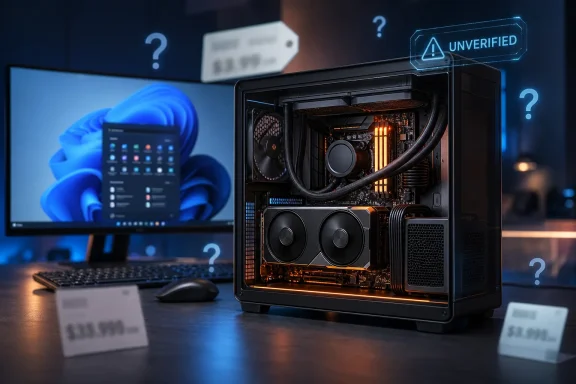 The NEO-X1 uses a laptop CPU in a desktop built around a real graphics card
“MoDT” means mobile on desktop: a system built around a high-performance notebook processor but housed and powered like a desktop. AMD classifies the Ryzen 9 9955HX as a processor for both laptops and desktops, but it is still an FL1-package mobile part rather than an AM5 socket CPU that an owner can replace later.The base NEO-X1 uses the 16-core, 32-thread Ryzen 9 9955HX, a Zen 5 Fire Range processor rated by AMD at a 55W default TDP and a 55W–75W configurable range. The Pro model moves to the Ryzen 9 9955HX3D, another 16-core Fire Range chip, adding AMD’s 3D V-Cache for a reported 144MB of total cache. That makes the Pro configuration the gaming-oriented version, particularly in games that respond well to extra cache and in CPU-heavy simulation, strategy, and competitive titles.
GMKtec says the motherboard uses 13-phase power delivery and supports “160W processor performance release,” with liquid cooling inside the 14.6-liter chassis. That wording needs interpretation. It does not establish that the 9955HX or 9955HX3D will consume 160W indefinitely under all-core workloads, nor does it identify AMD’s package-power settings, boost duration, fan curve, coolant-loop design, or sustained temperatures.
There is a meaningful distinction between a platform having enough electrical headroom for transient CPU boosts and a cooling system holding high clocks during a 30-minute compile, Blender render, or Unreal Engine shader build. GMKtec has not published sustained-load benchmarks, noise measurements, or thermal data, so its 160W claim is a capability statement rather than a demonstrated result.
The CPU also appears to be a permanent platform decision. Buyers who expect a conventional desktop upgrade path should understand that the graphics card may be standard desktop hardware, but the processor and board are not being presented as user-swappable components.
Desktop RTX branding does not answer the most important GPU questions
The NEO-X1’s key differentiator is its use of desktop GeForce RTX 50-series graphics rather than an RTX Laptop GPU. The standard model is described as carrying an RTX 5060 Ti with 8GB of GDDR7 memory; NVIDIA lists the desktop RTX 5060 Ti in both 8GB and 16GB variants, with a reference total graphics power of 180W. The Pro system reportedly uses the desktop RTX 5070 with 12GB of GDDR7.That should give the NEO-X1 a different performance and expansion profile from a gaming laptop built around the same processor family. It also introduces questions GMKtec has not answered: which add-in-board vendor supplies the GPU, whether it runs at reference power limits, what physical card dimensions fit, how the GPU receives power, and whether the card can be replaced without compromising airflow or chassis clearance.
NVIDIA explicitly notes that board-partner dimensions, clock speeds, and electrical requirements vary by card manufacturer. In a 14.6-liter case with an internal liquid loop and an 850W power supply, those details are central. A short dual-slot RTX 5070 and a larger, factory-overclocked three-slot RTX 5070 are materially different products even if both are sold under the same GPU name.
The 8GB RTX 5060 Ti is also the less durable configuration for buyers targeting demanding new games at high texture settings, large local AI models, GPU rendering, or multi-year workstation use. The GPU itself is contemporary Blackwell hardware with DLSS 4 and Nvidia’s current video engine features, but 8GB of VRAM remains a tangible constraint when compared with the 12GB RTX 5070 option—and with the 16GB version of the RTX 5060 Ti that NVIDIA also permits partners to sell.
GMKtec’s 850W fully modular Gold-rated supply should be sufficient on paper for an RTX 5070-class system and a high-powered mobile CPU. But “Gold-rated” specifies an efficiency tier, not the manufacturer, ATX standard, transient-load behavior, connector type, warranty length, or cable quality. Those are not minor omissions in a compact machine that will operate near concentrated CPU and GPU heat sources.
Storage, memory, ports, and Windows 11 Pro remain reported—not confirmed—specifications
The circulated specification sheet describes two PCIe 5.0 M.2 slots, up to 16TB of storage, DDR5-5600 memory in 32GB or 64GB configurations, 2.5GbE Ethernet, Wi-Fi 7, and Windows 11 Pro installed at the factory. This is a plausible platform feature set, but the retail record has not yet confirmed it.The storage claim is especially loose. “Up to 16TB” normally means the system has two M.2 sockets and has been validated, or at least marketed, for two 8TB SSDs. It does not mean GMKtec will ship a 16TB configuration, include PCIe 5.0 drives, or guarantee that every drive’s thermal solution will work within the case. High-speed Gen5 NVMe SSDs can run hot, making the physical placement of the M.2 slots and heatsinks more important than the interface label alone.
Likewise, DDR5-5600 may describe memory speed but says nothing about whether the system uses standard SODIMMs, whether both slots are accessible, how memory training behaves after upgrades, or which 64GB modules GMKtec validates. Those details determine whether this can operate as a maintainable workstation rather than a sealed appliance.
Windows 11 Pro is potentially useful for BitLocker management, Hyper-V, Remote Desktop hosting, Group Policy, and domain or Entra ID-oriented deployments. However, TechNetBooks is the only report located that assigns Windows 11 Pro to every model. Until GMKtec publishes a SKU page, buyers should not assume the license type, language pack, regional activation status, recovery-image availability, or whether it is an OEM installation that can be cleanly reinstalled without driver hunting.
The announcement is ahead of the buying evidence
GMKtec has announced an unusually compact desktop concept that combines AMD’s fastest Fire Range mobile chips with desktop-class Nvidia graphics. The machine’s 14.6-liter volume, integrated liquid cooling, 2.5GbE, Wi‑Fi 7, and 850W internal power supply describe a much more complete system than the company’s familiar palm-sized mini PCs.But the record supports a narrower conclusion than the promotional specifications suggest. IT Home’s July 28 reporting confirms the announcement, the two CPU/GPU pairings, the 14.6-liter chassis, the liquid cooling claim, the 13-phase board, the 850W supply, and the starting 11,999-yuan price. It also establishes that there was no discoverable JD product page at that time. The later claims around 32GB and 64GB memory bundles, 1TB and 2TB SSDs, a 17,499-yuan Pro configuration, and an August sales window have not been independently corroborated.
The practical move is to wait for the exact retail SKU, board photographs, I/O layout, GPU model, warranty terms, and independent thermal testing. Until those appear, the NEO-X1 is an interesting compact desktop announcement—not yet a configuration IT buyers can safely specify or consumers can meaningfully compare against a self-built AM5 system.
References
- Primary source: Technetbook
Published: 2026-08-03T17:05:00+00:00
GMKtec NEO X1 MoDT Gaming Workstation Launches with AMD Fire Range and NVIDIA RTX 50 Graphics | Technetbook
GMKtec NEO X1 gaming workstation features AMD Ryzen 9 9955HX3D and RTX 5070 desktop graphics starting at 11999 RMB approx $1650 USD.www.technetbooks.com
- Related coverage: techradar.com
GMKtec launches the new Evo-X1 Pro with an early bird deal | TechRadar
The AI mini PC packs 64GB of RAM, Radeon 890M graphics, and a 55 TOPS NPU inside the chassis.www.techradar.com - Related coverage: hp.com
HyperX OMEN Gaming Laptop 16z-ap100, 16", 16-inch, Windows 11 Home, AMD ryzen 9, 16GB RAM, 512GB SSD, Shadow Black, CQ3C9AV_275652 | HP® Store
Shop the HyperX OMEN Gaming Laptop 16z-ap100, 16", (CQ3C9AV_275652) with 16-inch, Windows 11 Home, AMD ryzen 9, 16GB RAM, and 512GB SSD. Available in Shadow Black. Order now at the HP® Store.www.hp.com
- Related coverage: gmktec.com

- Related coverage: gmktec.com
- Related coverage: techradar.com
GMKtec EVO-X1 AI mini PC review | TechRadar
Far more than I'd expected from a mini PC all due to that Oculink portwww.techradar.com - Related coverage: forum.level1techs.com
Custom cooling possible? GMKtec Evo-X1 - MiniPCs and Specialty PCs - Level1Techs Forums
I’m considering a GMKtec Evo-X1 which sounds great but according to reviews doesn’t, uh, sound great. Everyone says the same thing - very noisy fans. I know little about cooling but this device meets my needs and I’m wo… forum.level1techs.com
- Related coverage: minipclab.com
GMKtec Mini PCs for Homelab 2026 — Full Lineup Guide
We compared the GMKtec lineup for homelab use. The K11 is our top pick — dual 2.5GbE, Ryzen 9 8945HS, and OculLink. Real power data and honest assessments.minipclab.com - Related coverage: nvidia.com
NVIDIA GeForce RTX 5060 Family Graphics Cards
NVIDIA GeForce RTX 5060 Ti and RTX 5060, powered by the NVIDIA Blackwell architecture, enables game-changing AI capabilities in the latest games and apps.www.nvidia.com - Related coverage: nvidia.com
NVIDIA GeForce RTX 5070 Family Graphics Cards
Get game-changing performance with the GeForce RTX 5070 Ti and RTX 5070, powered by NVIDIA Blackwell and unlock new experiences with the power of AI.www.nvidia.com - Related coverage: amd.com
CES 2025: AMD Announces Gaming Products for Ultimate Gameplay Experience - AMD Newsroom
AMD Ryzen 9950X3D and 9900X3D, AMD Ryzen Z2 and AMD Ryzen 9000 Mobile processors elevate gaming performance across desktop, handheld and mobile gaming systems.www.amd.com - Related coverage: ir.amd.com
AMD Announces New Graphics and Gaming Products for Ultimate Gameplay Experience at CES :: Advanced Micro Devices, Inc. (AMD)
AMD Ryzen™ 9950X3D and 9900X3D, AMD Ryzen™ Z2, and AMD Ryzen™ 9000 Mobile processors elevate gaming performance across desktop, handheld…...ir.amd.com - Related coverage: images.nvidia.com