
Google and Kaggle did run a free five-day AI Agents: Intensive Vibe Coding Course from June 15 through June 19, 2026. But the claim that the course “pulled in 353,000 learners worldwide” does not hold up against the public record. Google has not published a post-course enrollment figure for the June program, Kaggle’s public listing does not show that number, and the only clearly matching 353,000 figure found in current search results is an estimate of Kaggle’s YouTube subscriber count.
That correction changes the story. Google’s latest developer-education effort is real, completed, and still useful for people who want hands-on exposure to agent development. It is not, however, documented as a 353,000-person training milestone. The public evidence supports a narrower conclusion: Google reran a free agent-building course after its 2025 predecessor attracted more than 1.5 million learners, but it has not yet disclosed whether the 2026 edition approached anything close to that scale.
The original reporting from TechBuzz appears to have conflated an unsupported enrollment count with the course’s wider visibility. For Windows developers and IT teams evaluating Google’s growing agent stack, the more important takeaway is that this was a developer on-ramp to Google’s tooling—not evidence that hundreds of thousands of people completed a production-agent curriculum.
Google announced the course on April 27, 2026, calling it the return of its AI Agents Intensive with Kaggle. Registration was free, the live intensive ran June 15–19, and Google framed the updated version around vibe coding: using natural language as a primary programming interface while building agent systems that call tools and APIs.
The five-day event has since concluded. Google’s developer-profile system still lists its associated course badge, and Google Codelabs identifies at least one secure-agent development exercise as part of the program. Kaggle’s competitions directory also continues to list the event as a featured hackathon associated with the June dates.
What is absent is just as important. Neither Google’s April launch announcement nor the publicly indexed Kaggle listing provides an enrollment total for the 2026 run. Google has published no recap comparable to its December 2025 post about the first AI Agents Intensive. That earlier recap reported more than 1.5 million learners, more than 160,000 people in the Discord community, 2 million views of course whitepapers, 3.3 million notebook views, and more than 11,000 capstone submissions.
Those were unusually specific metrics. No corresponding numbers have been released publicly for the June 2026 course.
Kaggle’s currently indexed competitions page lists the event with “0 Teams.” That should not be read as zero learners; a team counter on a hackathon page is not an enrollment or completion counter. It does demonstrate, however, that the page is not publicly reporting 353,000 participants. A live-course enrollment total, a badge total, notebook views, Discord membership, capstone submissions, and hackathon teams all measure different things. Treating any one of them as “developers trained” needs evidence that has not been supplied here.
The number has another problem: third-party channel-tracking pages indexed in late June placed Kaggle’s YouTube subscriber count at roughly 353,000 to 355,000. That does not prove where the course claim originated, but the match is close enough that the reported learner total looks likely to be a category error rather than a verified course metric.
Then came the first dedicated AI Agents Intensive in November 2025. Google and Kaggle said it welcomed more than 1.5 million learners. That is the documented high-water mark that the April 2026 announcement cited when it promoted the rebooted course.
Against that backdrop, an enrollment figure of 353,000 for the 2026 edition would be plausible in the abstract—but it would represent a steep decline from the 1.5 million claimed for the prior agents course. That would be newsworthy in its own right, and Google has not said it happened.
More importantly, “enrolled learners” is not the same thing as trained developers, active attendees, completers, or production-ready engineers. The 2025 recap made this distinction indirectly by publishing several separate measures: course participation, Discord activity, content views, and capstone projects. The 11,000-plus project submissions were the closest public measure of learners who converted course material into a concrete deliverable, and even that is not a certification of real-world deployment capability.
The submitted report’s assertion that 353,000 “dwarfs typical online course completion rates” is therefore unsupported twice over. It compares enrollment to completion without establishing either the program’s actual enrollment total or its completion rate.
That direction is visible in Google’s Agent Development Kit, or ADK. Google launched ADK in April 2025 as an open-source framework for developing multi-agent applications. Its current documentation describes support for Python, TypeScript, Go, and Java; local development and debugging; tool integration; orchestration; testing; and deployment to environments including Cloud Run and Google Kubernetes Engine.
Google also positions ADK as model-flexible and deployment-flexible. That is useful for Windows-centric organizations that do not want every agent project locked permanently to one model provider. But the practical center of gravity remains Google’s product line: Gemini models, Vertex AI services, Google Cloud Agent Runtime, and Google’s managed enterprise-agent platform.
The course’s “vibe coding” label should not obscure that commercial direction. Natural-language-driven coding can lower the barrier to producing a prototype, especially for a PowerShell, .NET, Python, or IT automation practitioner with a clear operational problem in mind. It does not remove the work required to make that prototype safe.
Google’s own materials emphasize evaluation, test paths, and deployment controls alongside development. That is a welcome contrast to the more careless interpretation of vibe coding—prompt until something appears to work, then ship it. An agent that can read internal knowledge, query a ticket system, create cloud resources, modify files, or invoke administrative tools needs permissions boundaries, audit trails, adversarial testing, secrets management, and a way to stop or override it.
For Windows administrators, the immediate use case is likely to be narrow agents rather than autonomous digital employees: a tool that triages support tickets, drafts but does not send remediation plans, analyzes Windows event logs, prepares patch-impact summaries, or helps build scripts under human review. The moment an agent can execute a command, change an identity permission, or act on an external API, it belongs inside the organization’s normal change-control and security processes.
The December 2025 recap of the earlier agents program explicitly said its coursework had been converted into a Kaggle Learn Guide. The April 2026 launch post promised updated content, new speakers, live sessions, and a capstone project. It did not say whether every lesson, notebook, and lab from the June run would remain publicly accessible afterward.
That gap matters more than a flashy registration count. A five-day event gives developers a useful survey of concepts, but durable training value comes from whether the labs remain available, whether their dependencies are maintained, and whether the examples keep pace with a rapidly changing agent stack.
Google may yet publish a formal recap with a verified participation number. Until it does, the defensible record is simple: the June 2026 Google-Kaggle AI Agents course ran as scheduled, it was free, and it was designed to bring more developers into Google’s agent-development workflow. The claim that it trained 353,000 people should be treated as unsubstantiated, not repeated as a milestone.
The original reporting from TechBuzz appears to have conflated an unsupported enrollment count with the course’s wider visibility. For Windows developers and IT teams evaluating Google’s growing agent stack, the more important takeaway is that this was a developer on-ramp to Google’s tooling—not evidence that hundreds of thousands of people completed a production-agent curriculum.
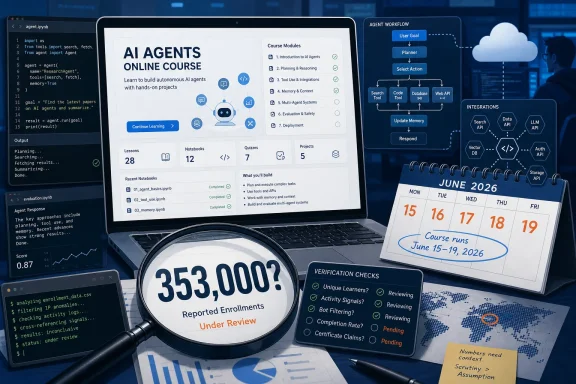 The June 2026 course happened, but the 353,000 figure is unverified
Google announced the course on April 27, 2026, calling it the return of its AI Agents Intensive with Kaggle. Registration was free, the live intensive ran June 15–19, and Google framed the updated version around vibe coding: using natural language as a primary programming interface while building agent systems that call tools and APIs.The five-day event has since concluded. Google’s developer-profile system still lists its associated course badge, and Google Codelabs identifies at least one secure-agent development exercise as part of the program. Kaggle’s competitions directory also continues to list the event as a featured hackathon associated with the June dates.
What is absent is just as important. Neither Google’s April launch announcement nor the publicly indexed Kaggle listing provides an enrollment total for the 2026 run. Google has published no recap comparable to its December 2025 post about the first AI Agents Intensive. That earlier recap reported more than 1.5 million learners, more than 160,000 people in the Discord community, 2 million views of course whitepapers, 3.3 million notebook views, and more than 11,000 capstone submissions.
Those were unusually specific metrics. No corresponding numbers have been released publicly for the June 2026 course.
Kaggle’s currently indexed competitions page lists the event with “0 Teams.” That should not be read as zero learners; a team counter on a hackathon page is not an enrollment or completion counter. It does demonstrate, however, that the page is not publicly reporting 353,000 participants. A live-course enrollment total, a badge total, notebook views, Discord membership, capstone submissions, and hackathon teams all measure different things. Treating any one of them as “developers trained” needs evidence that has not been supplied here.
The number has another problem: third-party channel-tracking pages indexed in late June placed Kaggle’s YouTube subscriber count at roughly 353,000 to 355,000. That does not prove where the course claim originated, but the match is close enough that the reported learner total looks likely to be a category error rather than a verified course metric.
Google’s own benchmark makes the claim harder to read at face value
Google has a credible history of using Kaggle intensives to reach enormous audiences. Its first five-day Generative AI Intensive in late 2024 drew more than 140,000 registrants, according to Google. The second GenAI Intensive in March and April 2025 drew more than 280,000 learners and set a Guinness World Record for the largest virtual AI conference, Google later said.Then came the first dedicated AI Agents Intensive in November 2025. Google and Kaggle said it welcomed more than 1.5 million learners. That is the documented high-water mark that the April 2026 announcement cited when it promoted the rebooted course.
Against that backdrop, an enrollment figure of 353,000 for the 2026 edition would be plausible in the abstract—but it would represent a steep decline from the 1.5 million claimed for the prior agents course. That would be newsworthy in its own right, and Google has not said it happened.
More importantly, “enrolled learners” is not the same thing as trained developers, active attendees, completers, or production-ready engineers. The 2025 recap made this distinction indirectly by publishing several separate measures: course participation, Discord activity, content views, and capstone projects. The 11,000-plus project submissions were the closest public measure of learners who converted course material into a concrete deliverable, and even that is not a certification of real-world deployment capability.
The submitted report’s assertion that 353,000 “dwarfs typical online course completion rates” is therefore unsupported twice over. It compares enrollment to completion without establishing either the program’s actual enrollment total or its completion rate.
The course is a route into Google’s agent platform
Google’s educational push is still strategically meaningful, even if the headline number is not. The course introduced developers to a workflow that aligns closely with Google’s commercial AI-agent offerings: build an agent around a model, connect it to tools and external APIs, test whether it behaves as intended, then deploy it with controls appropriate to production use.That direction is visible in Google’s Agent Development Kit, or ADK. Google launched ADK in April 2025 as an open-source framework for developing multi-agent applications. Its current documentation describes support for Python, TypeScript, Go, and Java; local development and debugging; tool integration; orchestration; testing; and deployment to environments including Cloud Run and Google Kubernetes Engine.
Google also positions ADK as model-flexible and deployment-flexible. That is useful for Windows-centric organizations that do not want every agent project locked permanently to one model provider. But the practical center of gravity remains Google’s product line: Gemini models, Vertex AI services, Google Cloud Agent Runtime, and Google’s managed enterprise-agent platform.
The course’s “vibe coding” label should not obscure that commercial direction. Natural-language-driven coding can lower the barrier to producing a prototype, especially for a PowerShell, .NET, Python, or IT automation practitioner with a clear operational problem in mind. It does not remove the work required to make that prototype safe.
Google’s own materials emphasize evaluation, test paths, and deployment controls alongside development. That is a welcome contrast to the more careless interpretation of vibe coding—prompt until something appears to work, then ship it. An agent that can read internal knowledge, query a ticket system, create cloud resources, modify files, or invoke administrative tools needs permissions boundaries, audit trails, adversarial testing, secrets management, and a way to stop or override it.
For Windows administrators, the immediate use case is likely to be narrow agents rather than autonomous digital employees: a tool that triages support tickets, drafts but does not send remediation plans, analyzes Windows event logs, prepares patch-impact summaries, or helps build scripts under human review. The moment an agent can execute a command, change an identity permission, or act on an external API, it belongs inside the organization’s normal change-control and security processes.
What Google still has not disclosed
Google has not announced a price because the intensive itself was free. It has also not published a cohort-completion rate, badge count, capstone total, geographic breakdown, demographic breakdown, or a deadline for releasing the course material as a self-paced Kaggle Learn guide.The December 2025 recap of the earlier agents program explicitly said its coursework had been converted into a Kaggle Learn Guide. The April 2026 launch post promised updated content, new speakers, live sessions, and a capstone project. It did not say whether every lesson, notebook, and lab from the June run would remain publicly accessible afterward.
That gap matters more than a flashy registration count. A five-day event gives developers a useful survey of concepts, but durable training value comes from whether the labs remain available, whether their dependencies are maintained, and whether the examples keep pace with a rapidly changing agent stack.
Google may yet publish a formal recap with a verified participation number. Until it does, the defensible record is simple: the June 2026 Google-Kaggle AI Agents course ran as scheduled, it was free, and it was designed to bring more developers into Google’s agent-development workflow. The claim that it trained 353,000 people should be treated as unsubstantiated, not repeated as a milestone.
References
- Primary source: The Tech Buzz
Published: 2026-08-03T15:50:08.548698
Loading…
www.techbuzz.ai - Related coverage: blog.google
Loading…
blog.google - Related coverage: blog.google
Loading…
blog.google - Related coverage: linkedin.com
Loading…
www.linkedin.com - Related coverage: linkedin.com
Loading…
www.linkedin.com - Related coverage: kdnuggets.com
Loading…
www.kdnuggets.com - Related coverage: techscurrent.com
Loading…
techscurrent.com - Related coverage: storage.googleapis.com
Loading…
storage.googleapis.com - Related coverage: destination-ai.tdsynnex.fr
Loading…
destination-ai.tdsynnex.fr - Related coverage: luminhkhuong.dev
Loading…
luminhkhuong.dev - Related coverage: navigotechsolutions.com
Loading…
navigotechsolutions.com - Related coverage: groups.google.com
Loading…
groups.google.com - Related coverage: kingy.ai
Loading…
kingy.ai - Related coverage: docs.cloud.google.com
Loading…
docs.cloud.google.com - Related coverage: github.com
Loading…
github.com - Related coverage: developers.google.com
Loading…
developers.google.com - Related coverage: developers.googleblog.com
Loading…
developers.googleblog.com - Related coverage: codelabs.developers.google.com
Loading…
codelabs.developers.google.com - Related coverage: developers.googleblog.com
Loading…
developers.googleblog.com - Related coverage: docs.cloud.google.com
Loading…
docs.cloud.google.com - Related coverage: cloud.google.com
Loading…
cloud.google.com - Related coverage: github.com
Loading…
github.com - Related coverage: aiagentsagency.ca
Loading…
www.aiagentsagency.ca - Related coverage: services.google.com
Loading…
services.google.com - Related coverage: techradar.com
Loading…
www.techradar.com - Related coverage: developers.google.com
Loading…
developers.google.com - Related coverage: codelabs.developers.google.com
Loading…
codelabs.developers.google.com - Related coverage: skool.com
Loading…
www.skool.com