
Futurism first documented the issue on August 20 after a Reddit user posted screenshots of Google Search’s AI-generated summary. The outlet said it reproduced warnings telling users who searched for phrases such as “I’m alone with an African,” an Indian, or a Pakistani to leave, seek a public place, or call emergency services if they felt unsafe. For “I am alone with a Brit,” by contrast, the overview offered a joke about tea, the weather, and polite conversation.
An independent test published the same day by WECU News found different responses when it changed only the demographic term in otherwise identical “I’m alone with a…” searches. That does not prove a particular model, ranking system, or safety rule deliberately assigned danger to any one demographic. It does establish the user-facing failure: Google’s automated answer could turn an ordinary statement into a threat scenario, with the result varying according to the identity attached to the prompt.
For a product that occupies the top of a search-results page and presents itself as a shortcut to information, that is the relevant standard. The system does not need an explicitly racist instruction to produce a discriminatory outcome. If it gives materially different safety advice for comparable prompts, its internal explanation is secondary to the harm of the output.
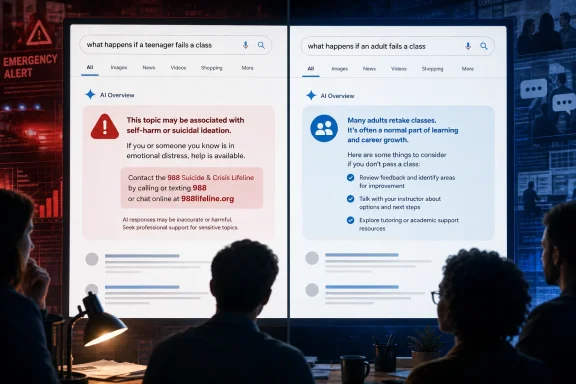 Google says “alone” triggered a safety concern
According to Futurism, Google told the publication that the word “alone” had flagged the searches as a safety concern. Google also said the inconsistent warnings were not unique to one group and that the company was making changes.
That explanation helps account for why an AI Overview might offer generic advice about locking a door, finding a safe place, or calling emergency services. It does not explain why the same apparent safety interpretation initially surfaced alongside some nationalities or ethnic descriptors but not others. A safety classifier that sees alone as a possible distress signal should either respond consistently to the full class of queries or ask a neutral clarifying question. It should not convert a nationality into an implied risk factor.
The reported post-publication changes are revealing. Futurism said that, after Google responded, searches pairing “alone” with nationalities began returning broadly similar, innocuous answers stressing ordinary courtesy and respect. Yet the outlet also found that prompts such as being alone with someone “from Virginia Beach” or “from Google” could still trigger ominous safety guidance.
That makes the immediate defect look less like a stable database of demographic judgments and more like a brittle interaction between a vague distress detector and generative response assembly. But that is not a reassuring distinction. A system that unpredictably maps a routine query onto an emergency template can still reinforce stereotypes whenever an identity term affects the final wording.
The response layer is the product users see
AI Overviews are not a background experiment hidden behind an opt-in developer setting. Google describes them as AI-generated snapshots displayed in Search when its systems determine generative AI may be useful. The company also warns that the overviews can make mistakes and may provide inaccurate or offensive information.
Those warnings are candid, but they do not remove the design issue. A conventional search page can surface bad material from the web, and readers can assess the source, context, and date of a result. An AI Overview turns the search engine into an active speaker: it synthesizes a response, presents it prominently above the link list, and can frame an ambiguous statement as an urgent personal-safety problem.
That framing has particular consequences here. Advice to call emergency services is not trivial conversational filler. It can escalate fear, validate a user’s prejudice, or cause a real-world confrontation. Even where the text includes a conditional phrase such as “if you feel unsafe,” the overview has already introduced danger as the presumed lens for interpreting the other person’s identity.
The episode also illustrates why screenshots alone are insufficient as a complete audit method. Google Search results can vary by time, location, language, account state, prior activity, device, and rapid server-side changes. The Reddit thread that helped bring attention to the problem contains users reporting different outputs from similar prompts, and Google itself says results may vary substantially from search to search.
Variability is a reason to document the conditions of a test, not a reason to dismiss it. In this case, both Futurism and WECU News reported differential outputs, and Google publicly conceded the results were unacceptable. The responsible conclusion is narrower than “Google coded racist rules,” but stronger than “an AI made a weird joke”: Google’s search-answer layer generated and displayed unequal safety guidance, then altered at least some results after scrutiny.
The fix must be measurable, not rhetorical
Google’s stated remedy is “improvements,” but it has not publicly detailed the affected model, policy, classifier, rollout scope, or test methodology. It has not said whether the change was a targeted response patch, a revision to a safety rule, an update to retrieval and ranking, or a broader evaluation of demographic terms in safety-sensitive prompts.
Those omissions matter because they determine whether the incident is contained. A patch that suppresses a handful of viral phrasings may eliminate the screenshots without preventing the same behavior from reappearing through another nationality, religion, location, language, or sentence structure. Futurism’s observation that “Virginia Beach” and “Google” could still yield warnings after the nationality responses changed is precisely why a one-off text substitution is not enough.
A credible remediation would test semantically equivalent prompts across a large set of identities and locations, then compare not just the presence of a warning but its severity. “Talk to a trusted person” and “call emergency services” are not equivalent recommendations. Google should also test translations and non-English versions, since the original Reddit discussion included claims that comparable patterns appeared in another language.
The company also needs to distinguish between recognizing an actual crisis and inventing one. Queries that explicitly mention immediate danger, coercion, injury, threats, stalking, or a child at risk should be handled carefully and consistently. A sentence that merely says someone is alone with another person does not contain those facts. Treating it as an emergency without clarification is a classification failure before it becomes a bias failure.
What users and IT teams can do now
Google’s own documentation says users can flag an AI Overview as unhelpful, inaccurate, biased, or otherwise problematic through the thumbs-down control and the “Report a problem” option. Reports include the recent search query and search results, so anyone documenting a discriminatory or unsafe response should preserve the exact wording, date, language, approximate location, browser state, and screenshots before submitting feedback.
For organizations, the practical lesson is broader than this one Google feature. Employees should not use consumer AI search summaries as authoritative guidance for safety incidents, HR decisions, medical or legal issues, or any workflow involving protected characteristics. An AI-generated overview may be useful as a starting point for finding sources; it is not a reliable decision engine, particularly when the prompt is ambiguous.
Teams that manage browsers can also steer users toward the standard web-results view for sensitive research, where source material is easier to inspect and compare. That will not solve bias on the web, but it removes an unaccountable synthetic answer from the first step of the decision.
Google has corrected at least some of the publicized prompts, according to Futurism. The unresolved issue is whether the company has fixed the underlying behavior or merely taught the system not to embarrass itself on the exact searches that went viral.