
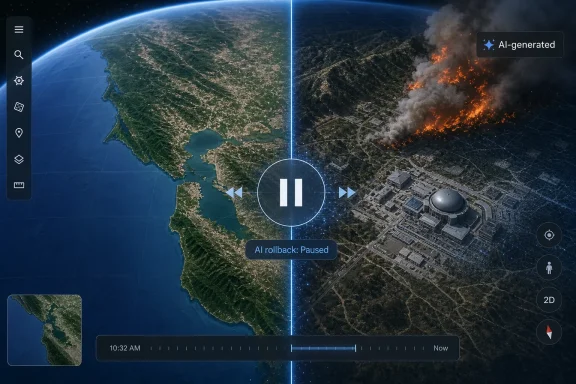
Google has paused the Nano Banana 2 image-generation feature it had just introduced in Google Earth after users shared generated imagery that appeared to violate company policy. The rollback, disclosed by Google’s official news account and reported by Android Authority, arrived less than a day after the company positioned the Gemini-powered tool as a way to create imaginative, location-based visualizations.
The feature did not alter the underlying Google Earth imagery visible to other users, Google said. Generated pictures were also marked as AI-created. But that separation was not enough to overcome the risk created when synthetic scenes are presented in the visual context of a service many people treat as a dependable record of real-world geography.
Google Earth is not merely another image canvas. It is used by educators, researchers, journalists, planners, emergency-response teams, and geospatial professionals, which gives screenshots from the product a degree of implied credibility that a standalone Gemini image may lack.
According to Android Authority, Google acknowledged useful professional applications for the tool but said it had seen shared screenshots that appeared to breach its policies. The company did not identify the offending images or specify which policies were implicated, leaving open whether the immediate concern was deceptive imagery, harmful content, intellectual-property issues, or some combination of those risks.
The key distinction is practical: a visible watermark can help identify a generated file, but it does not prevent a screenshot from being cropped, reposted, or described misleadingly once it leaves the product. In a mapping interface, a convincing fabricated wildfire, damaged facility, military installation, or altered landmark can acquire context that makes ordinary AI imagery more persuasive.
Nano Banana 2, Google’s fast image-generation and editing model built into Gemini services, is designed to use broad contextual knowledge when producing visuals. That is useful when generating a historical-style illustration or educational graphic tied to a place; it is also precisely what makes location-specific synthetic imagery difficult to govern safely.
For IT teams and Windows users who access Google Earth through its web and desktop experiences, the immediate operational change is simple: the generative image option is unavailable for now. Existing Google Earth imagery and the service’s standard exploration tools are unaffected.
Google has not set a return date or described the protections it intends to add. Until it does, the episode is a reminder that the hardest part of putting generative AI into mapping software is not creating a plausible scene—it is ensuring viewers can reliably tell where the map ends and the invention begins.
 A Short-Lived Experiment in a Trusted Mapping Product
Google Earth is not merely another image canvas. It is used by educators, researchers, journalists, planners, emergency-response teams, and geospatial professionals, which gives screenshots from the product a degree of implied credibility that a standalone Gemini image may lack.According to Android Authority, Google acknowledged useful professional applications for the tool but said it had seen shared screenshots that appeared to breach its policies. The company did not identify the offending images or specify which policies were implicated, leaving open whether the immediate concern was deceptive imagery, harmful content, intellectual-property issues, or some combination of those risks.
The key distinction is practical: a visible watermark can help identify a generated file, but it does not prevent a screenshot from being cropped, reposted, or described misleadingly once it leaves the product. In a mapping interface, a convincing fabricated wildfire, damaged facility, military installation, or altered landmark can acquire context that makes ordinary AI imagery more persuasive.
Stronger Guardrails Are Now the Requirement
Google says it will bring the capability back after implementing stronger safeguards. That wording suggests the company sees a path to restoring creative and professional uses rather than permanently removing Gemini generation from Earth.Nano Banana 2, Google’s fast image-generation and editing model built into Gemini services, is designed to use broad contextual knowledge when producing visuals. That is useful when generating a historical-style illustration or educational graphic tied to a place; it is also precisely what makes location-specific synthetic imagery difficult to govern safely.
For IT teams and Windows users who access Google Earth through its web and desktop experiences, the immediate operational change is simple: the generative image option is unavailable for now. Existing Google Earth imagery and the service’s standard exploration tools are unaffected.
The Trust Problem Is Bigger Than the Feature
Google’s abrupt reversal underlines a growing problem for platforms that combine authoritative data with generative AI. A model may produce an image privately, label it correctly, and still create a public misinformation issue once the result is captured and circulated without its original context.Google has not set a return date or described the protections it intends to add. Until it does, the episode is a reminder that the hardest part of putting generative AI into mapping software is not creating a plausible scene—it is ensuring viewers can reliably tell where the map ends and the invention begins.
References
- Primary source: Android Authority
Published: 2026-07-31T20:26:48+00:00
Google Earth slams the brakes on Gemini image generation for depressingly predictable reasons
Google is disabling Google Earth's new AI image generation after spotting too many policy violations from users.www.androidauthority.com - Related coverage: theatlantic.com
Google Just Torched the Credibility of Its Satellite Images - The Atlantic
Google Earth was a boon for researchers—and then came the deepfakes.www.theatlantic.com
- Related coverage: developers.google.com
Google Earth content policy | Google for Developers
 developers.google.com
- Related coverage: blog.google
Meet Nano Banana 2, Now Live on Gemini App and Google Search in the Arab World
Nano Banana 2, Google’s latest state of the art image model is now available in the Middle East and North Africa. The model is accessible on Google Gemini (desktop and mobile app) and Google Search via Google Lens and AI Mode.Nano Banana 2 brings the high-speed intelligence of Gemini Flash to...blog.google - Related coverage: support.google.com
- Related coverage: transparency.google

Google Earth Policies and Guidelines - Transparency Center
Our policies outline what is acceptable on our platform. Browse Google Earth product policies to learn about our terms, rules and guidelines.
transparency.google