
The immediate practical point is that this is not a permit approval and not a hearing about every environmental issue connected to Google’s Indiana footprint. It is a narrow state review of one Phase 3 wetland application. But the application is consequential because it is tied to physical capacity growth at a site Google is building out for cloud and AI-era infrastructure.
WOWO first reported the hearing as a permit request by Google. IDEM’s public notice identifies the actual applicant as Hatchworks LLC, with Aaron McGarry listed at Google’s Mountain View address, and identifies the project as “Project Zodiac Phase 3.” That distinction is more than paperwork: it shows the permit is being carried through a development entity, while the underlying campus is Google’s.
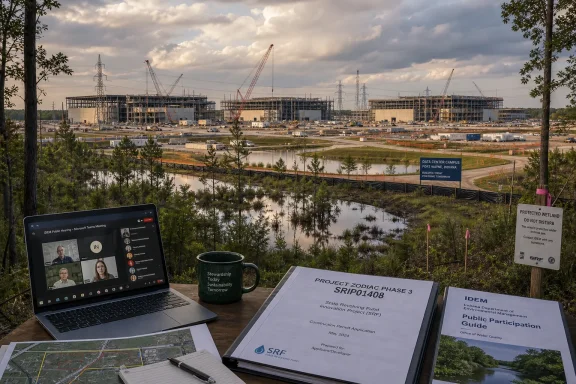 The permit covers three new buildings, not a general campus plan
IDEM’s notice says the proposed Phase 3 work covers three additional buildings, utility infrastructure, internal drives and stormwater facilities on an 858-acre parcel east of Adams Center Road and north of East Tillman Road in Fort Wayne. WPTA/21Alive reported earlier Tuesday that the expansion is part of a multi-phase, roughly $2 billion data center project.
For IT and cloud users, the significance is physical rather than product-facing. Google has not said what services, regions, machine types or customer workloads the Fort Wayne campus will host. There is no evidence in the permit record that it is being built for a particular Google Cloud launch, Gemini capacity pool, Workspace service, or consumer product.
Still, the construction request is a concrete indicator that the company wants more campus capacity. Google’s own infrastructure executives have said AI demand is changing data-center planning because power availability, network design and physical capacity can become constraints before demand for compute does. A permit for new buildings does not tell customers when new capacity will appear, but it does show that site expansion remains active rather than frozen at the initial buildout.
The application’s geography also matters. IDEM describes six Class II isolated forested wetlands and one Class I isolated non-forested wetland on the property. The permit request seeks approval to place clean earthen fill in 2.13 acres of the Class II forested wetlands.
The state notice separately lists 0.93 acre of isolated-wetland impacts that are exempt from the state permit requirement. That is why the headline number in public discussion needs care: the 2.13 acres are the regulated impacts before IDEM in this case, while the project documents also describe additional wetland impacts that Indiana law does not require IDEM to permit.
The public hearing tests water-quality compliance, not whether Fort Wayne wants a data center
IDEM says its review will determine whether the proposal complies with Indiana water-quality standards and applicable provisions of the state’s isolated-wetlands law. The virtual hearing gives the public a chance to submit relevant information before the agency decides whether to issue or deny the individual permit.
That is a narrower legal test than the broader policy arguments now surrounding large data centers: electricity demand, local tax incentives, water use, construction traffic, land-use planning and the number of permanent jobs after construction. Residents may raise those concerns, but IDEM’s wetland-permit record is most useful when comments address the project’s direct water-quality, wetland-impact, stormwater, avoidance and mitigation claims.
The official notice confirms that Phase 3’s impacts to federally jurisdictional surface waters had already been authorized through a separate Section 401 Water Quality Certification, WQC001454. In other words, this proceeding is not a redo of federal-water authorization. It concerns remaining state-regulated isolated wetlands on the site.
That split is a meaningful procedural detail. Readers following the project should not assume a state isolated-wetland permit represents the last environmental authorization for the entire campus, or that it can revisit approvals outside its scope. Conversely, an existing federal-related authorization does not eliminate IDEM’s obligation to decide this state application on its own record.
The hearing is being held through Microsoft Teams, but the deadline that matters after Tuesday evening is Friday, August 28. IDEM’s notice invites written comments and asks commenters to identify SRIP01408. The agency’s regulatory portal also contains the underlying application materials under “Project Zodiac Phase 3,” rather than only the short public notice.
Google’s mitigation plan relies on private wetland-bank credits
Hatchworks proposes to offset the regulated wetland loss by purchasing 4.26 acres of forested wetland credits from the Openings Mitigation Bank in Fort Wayne. The proposed credit purchase is nearly twice the 2.13-acre regulated fill footprint, though acreage alone does not establish whether mitigation is equivalent in ecological function, location, timing or long-term durability.
This is the central substantive question behind the permit: whether replacing the loss through bank credits satisfies Indiana’s requirements, not whether the project can claim a simple acre-for-acre environmental balance. Forested wetlands provide functions that vary with site conditions, including water storage, filtration and habitat. A credit purchase can be an accepted regulatory mechanism, but it does not mean that a wetland destroyed at the data center site has been physically recreated there.
The distinction is especially important because the 4.26 acres are proposed credits from a private mitigation bank, Openings Mitigation Bank, not a purchase from Indiana’s state-run in-lieu-fee mitigation program. Those two systems are often blurred together in public debate.
Under Indiana DNR’s in-lieu-fee program, a developer can buy advance credits and transfer the legal responsibility to complete compensatory mitigation to the state-sponsored program. The DNR has warned that availability can be constrained in some service areas, and credit sales do not reserve supply before permits are approved. The Google developer’s proposed private-bank purchase should therefore not be treated as another transaction within the delayed state program.
That distinction also limits the relevance of a recent Journal Gazette opinion column cited by WOWO, which raised concerns about overdue work in Indiana’s mitigation system. WFYI independently reported in July that just 66 of more than 1,000 purchases in the state in-lieu-fee program were considered fulfilled, while more than 940 remained unfulfilled. The figures are a legitimate warning about the state program’s backlog, but they do not by themselves demonstrate that Openings Mitigation Bank’s credits are unavailable, overdue or invalid.
The open issue for IDEM is more specific: whether the proposed credits meet the conditions required for this project and compensate for the permitted loss. The public notice does not say whether those credits are already secured, whether they are available for immediate purchase, or what monitoring history applies to the bank parcels. Those are the details that determine whether “4.26 acres of credits” is a meaningful mitigation commitment or merely a number in an application.
Fort Wayne’s cloud buildout now has a permitting dependency
The published record establishes that Google’s developer wants to add three more buildings and that IDEM is holding a formal hearing before deciding the associated isolated-wetland permit. What it does not establish is a construction schedule for Phase 3, a planned in-service date, or an estimate of added server, storage, network or power capacity.
That missing operational detail matters for anyone trying to draw conclusions about Google Cloud availability. A wetland permit, even if issued, would be only one dependency in a capital project that also requires utility work, construction sequencing, equipment procurement, commissioning and network integration. It is evidence of expansion intent, not a cloud-capacity announcement.
The permit case nevertheless offers a more useful signal than a generic claim that AI demand is driving data-center construction. It names the site, the development phase, the affected wetlands, the planned fill footprint and the proposed mitigation mechanism. It also puts the project into a public record at a point when a state agency can still impose conditions or deny the request.
For Fort Wayne, the next immediate milestone is IDEM’s close of public comment on August 28. For Google, the practical consequence is simpler: Phase 3 cannot treat the 2.13-acre isolated-wetland fill as routine site preparation until the state permit process is complete.
