
Google’s $99.99 Google Home Speaker is a meaningful hardware refresh, but its Gemini for Home experience is still uneven enough that buyers should treat it as an early-generation AI appliance rather than a dependable automation hub.
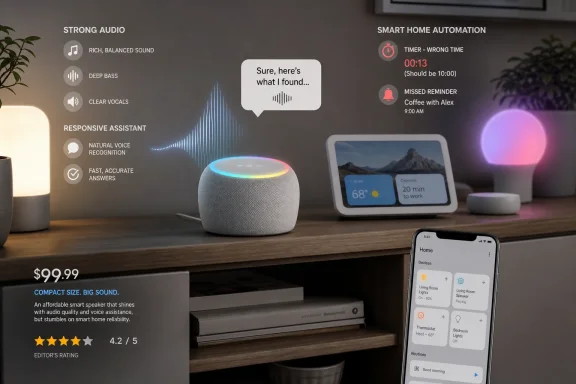
In a hands-on review published July 31, T3 found that the first Google speaker designed around Gemini delivers strong 360-degree audio, a compact redesign, responsive presence sensing and notably more natural follow-up conversations than Google Assistant-era hardware. But the review also reports delays, missed reminders and a timer error—precisely the kinds of failures that make a smart speaker difficult to trust for routine household tasks.
Google introduced the speaker in June and positioned it as the first audio device built specifically for Gemini. It works with existing Nest speakers, displays and Google Cast devices, while Google’s Home app remains the control point for device setup, routines and connected services such as Philips Hue and Spotify.
The standout feature is Continued Conversation. Users can ask follow-up questions or interrupt Gemini without repeating the “Hey Google” wake phrase each time, making exchanges feel less like issuing isolated commands to an old-style voice assistant.
That is a real improvement for casual requests, music playback and general questions. Google has also extended Gemini for Home capabilities across compatible older devices, but the new speaker benefits from the company’s newest hardware and a redesigned light ring that visualizes voice interactions.
The problem is that conversational AI is being asked to handle mundane, time-sensitive controls. T3 said Gemini sometimes took exceptionally long to respond, while a 20-minute timer apparently reported 12 minutes remaining when it should have expired. The publication also encountered a case in which a reminder created in the Google Home app did not trigger through the speaker.
For a device expected to run lights, schedules, alerts and household routines, these are not cosmetic bugs. A smart-home assistant can be imaginative or verbose without much harm; it cannot be casually wrong about a timer, reminder or automation.
Some of the device’s more ambitious Gemini features, including Gemini Live-style freeform interaction, sit behind that subscription layer. That changes the economics: the $99.99 speaker is not necessarily the full cost of Google’s new smart-home experience.
For Windows users already invested in Android, Google services, Spotify and Cast-compatible endpoints, the speaker may still be an attractive way to bring Gemini into a room without relying on a phone. IT-minded households, however, should assess the subscription requirement and test core routines before replacing a working Nest or Assistant-based setup.
That makes the Google Home Speaker easier to recommend as a compact music device with voice controls than as the central brain of an automated home. Existing Nest owners also have little reason to discard older hardware immediately: Google says compatible legacy speakers and displays will continue receiving necessary updates.
Google has finally produced a speaker that looks and sounds ready for the Gemini era. The remaining question is whether Gemini can become reliable enough that users will let it run the parts of home life where “almost right” is not good enough.
Google introduced the speaker in June and positioned it as the first audio device built specifically for Gemini. It works with existing Nest speakers, displays and Google Cast devices, while Google’s Home app remains the control point for device setup, routines and connected services such as Philips Hue and Spotify.
 Gemini Changes the Conversation—and Raises the Stakes
The standout feature is Continued Conversation. Users can ask follow-up questions or interrupt Gemini without repeating the “Hey Google” wake phrase each time, making exchanges feel less like issuing isolated commands to an old-style voice assistant.That is a real improvement for casual requests, music playback and general questions. Google has also extended Gemini for Home capabilities across compatible older devices, but the new speaker benefits from the company’s newest hardware and a redesigned light ring that visualizes voice interactions.
The problem is that conversational AI is being asked to handle mundane, time-sensitive controls. T3 said Gemini sometimes took exceptionally long to respond, while a 20-minute timer apparently reported 12 minutes remaining when it should have expired. The publication also encountered a case in which a reminder created in the Google Home app did not trigger through the speaker.
For a device expected to run lights, schedules, alerts and household routines, these are not cosmetic bugs. A smart-home assistant can be imaginative or verbose without much harm; it cannot be casually wrong about a timer, reminder or automation.
The Subscription Is Part of the Purchase Decision
The Google Home Speaker includes a six-month Google Home Premium trial. Google lists the Standard plan at $10 per month or $100 annually in the US, while the Advanced plan costs $20 monthly or $200 annually.Some of the device’s more ambitious Gemini features, including Gemini Live-style freeform interaction, sit behind that subscription layer. That changes the economics: the $99.99 speaker is not necessarily the full cost of Google’s new smart-home experience.
For Windows users already invested in Android, Google services, Spotify and Cast-compatible endpoints, the speaker may still be an attractive way to bring Gemini into a room without relying on a phone. IT-minded households, however, should assess the subscription requirement and test core routines before replacing a working Nest or Assistant-based setup.
Audio Hardware Is No Longer the Weak Link
T3’s review is clear that the speaker itself is appealing. The rounded, fabric-covered unit has a small footprint, an extra-long power cable, a physical microphone-mute switch and a colored base light ring. Its 360-degree sound was one of the review’s strongest points, with clear voice output and sufficiently powerful music playback.That makes the Google Home Speaker easier to recommend as a compact music device with voice controls than as the central brain of an automated home. Existing Nest owners also have little reason to discard older hardware immediately: Google says compatible legacy speakers and displays will continue receiving necessary updates.
Google has finally produced a speaker that looks and sounds ready for the Gemini era. The remaining question is whether Gemini can become reliable enough that users will let it run the parts of home life where “almost right” is not good enough.
References
- Primary source: t3.com
Published: 2026-07-31T16:00:00+00:00
Loading…
www.t3.com - Related coverage: androidcentral.com
Loading…
www.androidcentral.com - Related coverage: blog.google
Loading…
blog.google - Related coverage: store.google.com
Loading…
store.google.com - Related coverage: techcrunch.com
Loading…
techcrunch.com - Related coverage: androidauthority.com
Loading…
www.androidauthority.com