
OpenAI executive Thibault “Tibo” Sottiaux has revived a familiar claim about Google’s pre-ChatGPT work: that the company built a ChatGPT-like system roughly a year before OpenAI’s November 30, 2022 launch, then chose not to ship it because a conversational assistant could disrupt Google Search. The important new detail is the alleged internal name, “LMChat.” The problem is that the name and the stated decision chain remain unverified outside Sottiaux’s own post.
Mashable reported Sottiaux’s comments after he replied to AI engineer Cheng Lou on X, saying he had worked on the project and that Google was “too nervous” to release it. Sottiaux is a credible firsthand participant in Google-era AI work: his public professional history places him at Google and DeepMind before he joined OpenAI in 2024, and he is now one of OpenAI’s product leaders. But credibility of the speaker does not turn an internal codename or a sweeping account of executive intent into a documented fact.
What the public record does establish is narrower and, in some respects, more revealing: Google had publicly demonstrated advanced open-domain conversational models well before ChatGPT, but repeatedly stopped short of launching the kind of broadly accessible, general-purpose chat product that made ChatGPT a mass-market event.
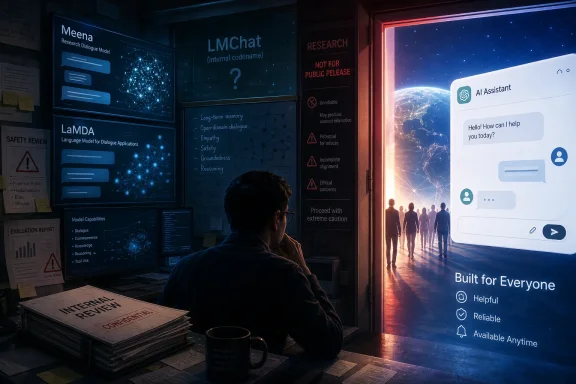
Neither Google’s published research archive nor its product announcements identify a project called LMChat. Searches of contemporaneous reporting, academic papers, Google announcements, and the company’s public material on Meena, LaMDA, AI Test Kitchen, Bard, and Gemini turn up no corroboration for the name.
That does not prove the codename was invented. Internal projects routinely use names that never appear in research papers, launch material, or press reports. It does mean the headline formulation — that Google “developed ChatGPT earlier” under the name LMChat — runs beyond what the available evidence can verify.
There is another historical imprecision worth correcting. Google DeepMind, the combined organization, did not exist until April 2023, when Google merged DeepMind with the Google Research Brain team. The public work most often cited as Google’s pre-ChatGPT chatbot lineage came from Google Research and the Brain team, not from an organization then called Google DeepMind.
That distinction is more than corporate trivia. It makes it difficult to map Sottiaux’s recollection cleanly onto Meena or LaMDA, even though those are the obvious public predecessors. Sottiaux may be describing a separate internal implementation, a product shell built around existing models, or a project that never surfaced publicly. No independent outlet has yet reported the timing, capabilities, ownership, or cancellation of LMChat.
By January 2022, Google Research’s Brain team had published the LaMDA technical paper. The paper described a family of dialogue-focused Transformer models with up to 137 billion parameters, trained on public dialogue and web text. The size figure is not a direct measure of real-world usefulness, but it establishes that this was serious large-language-model research, not a rudimentary rules-based assistant.
Google also did more than publish papers. At Google I/O on May 11, 2022 — more than six months before ChatGPT launched — it announced LaMDA 2 and AI Test Kitchen, an experimental app intended to let people try and give feedback on emerging AI technology. Google later expanded access to the Test Kitchen in selected markets.
So the claim that Google simply kept conversational AI under wraps is inaccurate. Google openly presented the technology, published research, and gave controlled users access to an experimental interface. What it did not do was turn LaMDA into a simple, globally available consumer chat service with the low-friction onboarding and open-ended prompt box that defined ChatGPT’s research preview.
That is the consequential difference. A research demo, a waitlisted experiment, and a public chatbot may use related technology, but they are different products with different risk profiles, support requirements, data-handling rules, safety exposure, compute costs, and reputational stakes.
OpenAI’s November 30, 2022 release was itself explicitly framed as a research preview. Yet the product was available to the public, memorable, easy to share, and designed for general interaction. That deployment decision created the feedback loop Google had avoided: enormous usage produced enormous attention, rapid discovery of failures, and a new expectation that a language model should be directly usable by ordinary people.
But plausible is not the same as proven.
The most detailed contemporaneous account came from The Wall Street Journal in March 2023. Its reporting described Google researchers who wanted to release Meena in a limited form and later pursued LaMDA deployments. According to the Journal’s sources, Google leadership rejected the proposals because the systems did not meet the company’s AI principles on safety and fairness. The report also said the researchers believed a better chatbot could change how people searched and interacted with computers.
That record supports a more complicated conclusion than “Google buried ChatGPT to protect ad revenue.” Safety, factuality, fairness, misuse, and brand exposure were documented concerns. Google’s own May 2021 LaMDA announcement explicitly warned that language models could reproduce biases, hateful language, and misleading information. When Google announced Bard on February 6, 2023, it said the service would first go to trusted testers and stressed quality, safety, and grounding in real-world information.
The company’s caution was not hypothetical. Bard’s first public rollout quickly became an example of the reputational hazard Google feared when an error in a promotional response drew intense scrutiny. Subsequent Google AI products, including AI Overviews, also showed how mistakes in generative answers become larger incidents when they appear alongside a trusted search brand.
At the same time, the search-business explanation should not be dismissed. The Justice Department’s successful search-monopoly case established how central search distribution and search advertising were to Google’s business. A company with that exposure had stronger incentives than a startup to avoid releasing a product that could alter user behavior before it had a defensible answer on accuracy, monetization, and publisher relationships.
The record supports both pressures. It does not support treating either one as the sole documented reason Google delayed a broad launch.
Google’s later product strategy also undercuts the notion that conversational AI and Search were irreconcilable. Rather than preserve a clean separation between a chatbot and search results, Google put generative answers directly into Search, developed AI Mode, and expanded Gemini across Android, Workspace, and its consumer services.
That integration has brought the exact trade-off Sottiaux described into the open. Search can retain the user while offering an answer-like interface, but it must now manage attribution, outbound traffic, publisher complaints, accuracy failures, higher inference costs, and the possibility that users stop clicking the web results that traditionally underpinned the search economy.
Google’s latest reported scale demonstrates why this is no longer a speculative threat. During Alphabet’s second-quarter 2026 earnings call in July, Google said the Gemini app had reached 950 million monthly active users. The number is notable, but it should not be treated as proof that Gemini and ChatGPT are interchangeable products or that either company has solved AI search economics. Monthly active-user metrics say little about query type, time spent, subscription conversion, citation behavior, or referral traffic to publishers.
That is a product decision, not merely a model-development decision. ChatGPT’s impact came from packaging a capable model as a public interface, accepting a visible level of imperfection, and learning from massive real-world use. Google had more reason to be careful, but that caution left space for OpenAI to set the category’s expectations.
Sottiaux’s LMChat claim may eventually add an important missing chapter to that history. For now, it adds one uncorroborated codename and one former insider’s interpretation to a story whose main facts were already visible: Google disclosed the underlying technology early, tested parts of it publicly, and delayed the consumer launch that mattered most.
What the public record does establish is narrower and, in some respects, more revealing: Google had publicly demonstrated advanced open-domain conversational models well before ChatGPT, but repeatedly stopped short of launching the kind of broadly accessible, general-purpose chat product that made ChatGPT a mass-market event.
 “LMChat” is the part nobody else has documented
Neither Google’s published research archive nor its product announcements identify a project called LMChat. Searches of contemporaneous reporting, academic papers, Google announcements, and the company’s public material on Meena, LaMDA, AI Test Kitchen, Bard, and Gemini turn up no corroboration for the name.That does not prove the codename was invented. Internal projects routinely use names that never appear in research papers, launch material, or press reports. It does mean the headline formulation — that Google “developed ChatGPT earlier” under the name LMChat — runs beyond what the available evidence can verify.
There is another historical imprecision worth correcting. Google DeepMind, the combined organization, did not exist until April 2023, when Google merged DeepMind with the Google Research Brain team. The public work most often cited as Google’s pre-ChatGPT chatbot lineage came from Google Research and the Brain team, not from an organization then called Google DeepMind.
That distinction is more than corporate trivia. It makes it difficult to map Sottiaux’s recollection cleanly onto Meena or LaMDA, even though those are the obvious public predecessors. Sottiaux may be describing a separate internal implementation, a product shell built around existing models, or a project that never surfaced publicly. No independent outlet has yet reported the timing, capabilities, ownership, or cancellation of LMChat.
Google had already shown the underlying technology
The broad idea that Google possessed ChatGPT-like conversational technology before ChatGPT is not controversial. Google published its Meena research in January 2020, describing an end-to-end, multi-turn chatbot designed for open-domain conversation. In May 2021, Google publicly introduced LaMDA, its Language Model for Dialogue Applications, and described it as capable of free-flowing conversation across many topics.By January 2022, Google Research’s Brain team had published the LaMDA technical paper. The paper described a family of dialogue-focused Transformer models with up to 137 billion parameters, trained on public dialogue and web text. The size figure is not a direct measure of real-world usefulness, but it establishes that this was serious large-language-model research, not a rudimentary rules-based assistant.
Google also did more than publish papers. At Google I/O on May 11, 2022 — more than six months before ChatGPT launched — it announced LaMDA 2 and AI Test Kitchen, an experimental app intended to let people try and give feedback on emerging AI technology. Google later expanded access to the Test Kitchen in selected markets.
So the claim that Google simply kept conversational AI under wraps is inaccurate. Google openly presented the technology, published research, and gave controlled users access to an experimental interface. What it did not do was turn LaMDA into a simple, globally available consumer chat service with the low-friction onboarding and open-ended prompt box that defined ChatGPT’s research preview.
That is the consequential difference. A research demo, a waitlisted experiment, and a public chatbot may use related technology, but they are different products with different risk profiles, support requirements, data-handling rules, safety exposure, compute costs, and reputational stakes.
OpenAI’s November 30, 2022 release was itself explicitly framed as a research preview. Yet the product was available to the public, memorable, easy to share, and designed for general interaction. That deployment decision created the feedback loop Google had avoided: enormous usage produced enormous attention, rapid discovery of failures, and a new expectation that a language model should be directly usable by ordinary people.
Safety concerns are documented; search cannibalization is not
Sottiaux’s central explanation is that Google feared a conversational assistant would reduce use of conventional Search. That concern is commercially plausible. Google’s core search business depended on a results page that routed users through links, ads, and Google services; a chatbot that directly synthesizes answers can change where the click goes, whether a click occurs at all, and which party bears the cost of the answer.But plausible is not the same as proven.
The most detailed contemporaneous account came from The Wall Street Journal in March 2023. Its reporting described Google researchers who wanted to release Meena in a limited form and later pursued LaMDA deployments. According to the Journal’s sources, Google leadership rejected the proposals because the systems did not meet the company’s AI principles on safety and fairness. The report also said the researchers believed a better chatbot could change how people searched and interacted with computers.
That record supports a more complicated conclusion than “Google buried ChatGPT to protect ad revenue.” Safety, factuality, fairness, misuse, and brand exposure were documented concerns. Google’s own May 2021 LaMDA announcement explicitly warned that language models could reproduce biases, hateful language, and misleading information. When Google announced Bard on February 6, 2023, it said the service would first go to trusted testers and stressed quality, safety, and grounding in real-world information.
The company’s caution was not hypothetical. Bard’s first public rollout quickly became an example of the reputational hazard Google feared when an error in a promotional response drew intense scrutiny. Subsequent Google AI products, including AI Overviews, also showed how mistakes in generative answers become larger incidents when they appear alongside a trusted search brand.
At the same time, the search-business explanation should not be dismissed. The Justice Department’s successful search-monopoly case established how central search distribution and search advertising were to Google’s business. A company with that exposure had stronger incentives than a startup to avoid releasing a product that could alter user behavior before it had a defensible answer on accuracy, monetization, and publisher relationships.
The record supports both pressures. It does not support treating either one as the sole documented reason Google delayed a broad launch.
Google’s eventual response shows the risk had become unavoidable
ChatGPT’s release changed Google’s calculation. Reports in December 2022 described Google declaring a “code red” after ChatGPT’s rise, and Google announced Bard barely over two months later. Bard moved from trusted testers to wider availability in March 2023, initially on a lightweight version of LaMDA.Google’s later product strategy also undercuts the notion that conversational AI and Search were irreconcilable. Rather than preserve a clean separation between a chatbot and search results, Google put generative answers directly into Search, developed AI Mode, and expanded Gemini across Android, Workspace, and its consumer services.
That integration has brought the exact trade-off Sottiaux described into the open. Search can retain the user while offering an answer-like interface, but it must now manage attribution, outbound traffic, publisher complaints, accuracy failures, higher inference costs, and the possibility that users stop clicking the web results that traditionally underpinned the search economy.
Google’s latest reported scale demonstrates why this is no longer a speculative threat. During Alphabet’s second-quarter 2026 earnings call in July, Google said the Gemini app had reached 950 million monthly active users. The number is notable, but it should not be treated as proof that Gemini and ChatGPT are interchangeable products or that either company has solved AI search economics. Monthly active-user metrics say little about query type, time spent, subscription conversion, citation behavior, or referral traffic to publishers.
The real missed opportunity was product execution
Google did not fail to invent conversational AI. Meena and LaMDA show that plainly. The missed opportunity was failing to make a controlled but broadly accessible conversational product the center of its strategy before OpenAI did.That is a product decision, not merely a model-development decision. ChatGPT’s impact came from packaging a capable model as a public interface, accepting a visible level of imperfection, and learning from massive real-world use. Google had more reason to be careful, but that caution left space for OpenAI to set the category’s expectations.
Sottiaux’s LMChat claim may eventually add an important missing chapter to that history. For now, it adds one uncorroborated codename and one former insider’s interpretation to a story whose main facts were already visible: Google disclosed the underlying technology early, tested parts of it publicly, and delayed the consumer launch that mattered most.
References
- Primary source: Mashable India
Published: 2026-08-03T17:41:50.703097+00:00
Loading…
in.mashable.com - Related coverage: blog.google
Loading…
blog.google - Related coverage: 9to5google.com
Loading…
9to5google.com - Related coverage: theinformation.com
Loading…
www.theinformation.com - Related coverage: searchengineland.com
Loading…
searchengineland.com - Related coverage: blog.google
Loading…
blog.google - Related coverage: theguardian.com
Loading…
www.theguardian.com - Related coverage: wired.com
Loading…
www.wired.com - Related coverage: techspot.com
Loading…
www.techspot.com - Related coverage: ciodive.com
Loading…
www.ciodive.com - Related coverage: news9live.com
Loading…
www.news9live.com - Related coverage: courthousenews.com
Loading…
www.courthousenews.com - Related coverage: tech.yahoo.com
Loading…
tech.yahoo.com - Related coverage: cio.economictimes.indiatimes.com
Loading…
cio.economictimes.indiatimes.com - Related coverage: itpro.com
Loading…
www.itpro.com - Related coverage: blog.progressiverobot.com
Loading…
blog.progressiverobot.com - Related coverage: wired.com
Meet the OpenAI Engineer Leading ChatGPT’s Biggest Transformation Yet | WIRED
Thibault Sottiaux helped make AI coding one of OpenAI’s fastest-growing businesses. Now he’s overseeing a sweeping overhaul of ChatGPT.www.wired.com - Related coverage: linkedin.com
Loading…
www.linkedin.com - Related coverage: linkedin.com
Loading…
www.linkedin.com - Related coverage: byte.eco
Loading…
www.byte.eco - Related coverage: vivatech.com
Loading…
vivatech.com - Related coverage: openai.com
Loading…
openai.com - Related coverage: help.openai.com
Loading…
help.openai.com - Related coverage: developers.google.com
Loading…
developers.google.com - Related coverage: ai.google
Loading…
ai.google - Related coverage: history.com
ChatGPT is released to the public | HISTORY
OpenAI launched its generative AI chatbot in November 2022.www.history.com - Related coverage: businessinsider.es
Loading…
www.businessinsider.es - Related coverage: techcrunch.com
Loading…
techcrunch.com - Related coverage: foxbusiness.com
Loading…
www.foxbusiness.com - Related coverage: axios.com
Loading…
www.axios.com - Related coverage: techradar.com
Loading…
www.techradar.com - Related coverage: tomshardware.com
OpenAI declares ‘Code Red’ as Google’s Gemini AI outpaces ChatGPT in industry benchmarks, report claims — Sam Altman sets all hands to the pump on flagship LLM, parks other projects | Tom's Hardware
Google's advancements have apparently gotten Sam Altman nervous.www.tomshardware.com - Related coverage: windowscentral.com
Loading…
www.windowscentral.com - Related coverage: axios.com
OpenAI opens its top AI models to 100,000 academic researchers
The program will provide selected researchers access to advanced models through 2027.www.axios.com
- Related coverage: techrepublic.com
Loading…
www.techrepublic.com - Related coverage: techcrunch.com
Loading…
techcrunch.com - Related coverage: openai.com
OpenAI’s new economic analysis | OpenAI
Analysis provides insights into ChatGPT’s impact on the economy. OpenAI also launches new research collaboration to study AI’s broader effects on the labor market and productivity.openai.com - Related coverage: gadgetsnow.indiatimes.com
Gemini's 950 Million User Milestone: How Google Closed the AI Gap With ChatGPT
Google's Gemini has amassed an impressive 950 million monthly users, effectively leveraging its ecosystem integration. In comparison, ChatGPT stands out with one billion monthly users, showcasing notable weekly engagement. Although Anthropic's Claude caters to fewer users, it excels by...gadgetsnow.indiatimes.com
- Related coverage: techspot.com
ChatGPT adds 100 million users in two months, making it the fastest-growing "app" ever | TechSpot
According to analysis by Swiss bank UBS, the speed at which ChatGPT has added 100 million users makes it the fastest-growing consumer app in history--- more than...www.techspot.com - Related coverage: implicator.ai
Gemini Hits 950 Million Users as Alphabet Burns Cash
Alphabet said the Gemini app reached 950 million monthly active users in the second quarter, the same period it posted its first negative free cash flow since going public in 2004 and raised 2026 capital spending to as much as $205 billion. www.implicator.ai
- Related coverage: en.cryptonomist.ch
Google Gemini User Growth Nears 1 Billion Monthly Milestone
Explore Google Gemini user growth as it surpasses 950 million monthly users, reshaping the AI assistant market in 2026. en.cryptonomist.ch
- Related coverage: cdn.openai.com
- Related coverage: justice.gov
Department of Justice Wins Significant Remedies Against Google
Today, the Justice Department’s Antitrust Division won significant remedies in its monopolization case against Google in online search. In United States et al. v. Google, the U.S. District Court for the District of Columbia prohibited Google from entering or maintaining exclusive contracts...www.justice.gov - Related coverage: justice.gov
U.S. and Plaintiff States v. Google LLC [2020]
www.justice.gov
- Related coverage: developers.google.com
- Related coverage: en.wikisource.org
- Related coverage: digital-markets-act.ec.europa.eu
Alphabet specification proceedings - Sharing of Google Search data
Alphabet Google Search specification proceedingsdigital-markets-act.ec.europa.eu - Related coverage: casefilingsalert.com
- Related coverage: deepmind.google
Announcing Google DeepMind — Google DeepMind
DeepMind and the Brain team from Google Research will join forces to accelerate progress towards a world in which AI helps solve the biggest challenges facing humanity.deepmind.google - Related coverage: deepmind.google
2023: A Year of Groundbreaking Advances in AI and Computing — Google DeepMind
This has been a year of incredible progress in the field of Artificial Intelligence (AI) research and its practical applications.deepmind.google - Related coverage: research.google
Towards a Human-like Open-Domain Chatbot
 research.google
- Related coverage: blog.research.google
Latest News from Google Research Blog - Google Research
blog.research.google
- Related coverage: research.google
LaMDA: Towards Safe, Grounded, and High-Quality Dialog Models for Everything
Posted by Heng-Tze Cheng, Senior Staff Software Engineer and Romal Thoppilan, Senior Software Engineer, Google Research, Brain Team Language models...research.google - Related coverage: cloud.google.com
Google creates new Systems Research Group for hyperscalers | Google Cloud Blog
The new SystemsResearch@Google (SRG) is focused on the future of hyperscalar systems design for the Google ecosystem.cloud.google.com
- Related coverage: research.google.com
- Related coverage: ai.google
- Related coverage: sosp2021.mpi-sws.org
