
Android Authority has refreshed its Authority Insights hub with a new batch of reported Google and Android feature teardowns, led by a potential Google Messages search overhaul and interface changes reportedly in development for Google Keep.
The July 31 update is not a Google product release announcement. Instead, it collects Android Authority’s reporting on unreleased features found through app analysis, leaks, and in-progress software changes. That distinction matters for users and administrators: none of the listed capabilities should be treated as committed, available, or supported until Google and its partners ship them.
Among the newest reports, Android Authority says Google Messages may receive a revised search experience intended to make conversations and attachments easier to locate. Google Keep is also said to be testing a new UI, a change that could improve consistency but disrupt established workflows for frequent note-takers.
The broader collection points to Google applying Gemini and AI features across its consumer services. Reported work includes Gemini tools for new Android-phone setup, richer notebook capabilities, file sharing in Gemini Live conversations, customizable daily briefs, and visual explanations for medical laboratory results in Google Health.
Google’s Files app may also gain stronger document-scanning capabilities, while Google Translate is reportedly preparing a Live Translate widget. Those are familiar productivity categories for Windows users: capture, search, translation, and AI-assisted organization increasingly span Android phones, web services, and desktop browsers rather than remaining isolated to one device.
That combination creates a familiar tension. Google is attempting to add security guardrails around app installation and account protection while also expanding automation and assistant capabilities that can touch device activity. Administrators should expect the operational details — device-policy controls, app verification requirements, logging, and user exceptions — to matter far more than the marketing language around convenience.
The hub also highlights possible improvements to Google Play Store search, per-app screen zoom settings on Samsung devices, Android gaming clip capture, and a reworked Watch Unlock feature for Pixel hardware.
For Windows users who manage Android alongside Microsoft 365, Entra ID, Chrome, or Google Workspace, the immediate takeaway is simple: watch these features for policy and support implications, but do not plan deployments around them yet. The next meaningful milestone is an official Google, Samsung, or Android release with documented availability and administrative controls.
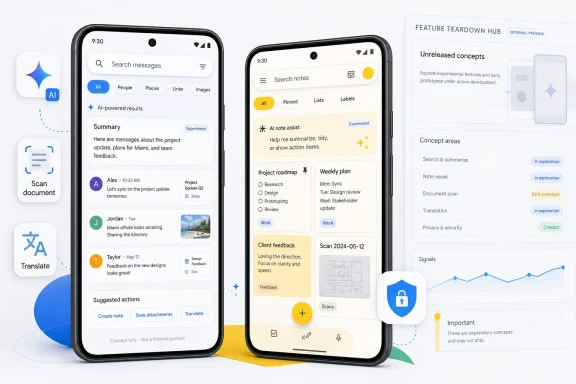 Google’s apps are becoming more searchable, visual, and AI-led
Among the newest reports, Android Authority says Google Messages may receive a revised search experience intended to make conversations and attachments easier to locate. Google Keep is also said to be testing a new UI, a change that could improve consistency but disrupt established workflows for frequent note-takers.The broader collection points to Google applying Gemini and AI features across its consumer services. Reported work includes Gemini tools for new Android-phone setup, richer notebook capabilities, file sharing in Gemini Live conversations, customizable daily briefs, and visual explanations for medical laboratory results in Google Health.
Google’s Files app may also gain stronger document-scanning capabilities, while Google Translate is reportedly preparing a Live Translate widget. Those are familiar productivity categories for Windows users: capture, search, translation, and AI-assisted organization increasingly span Android phones, web services, and desktop browsers rather than remaining isolated to one device.
Security and device control remain the enterprise-relevant threads
The more consequential items for IT pros are not the visual refreshes. Android Authority reports that Google is making Advanced Protection easier to use ahead of Android sideloading changes, while another report suggests Android may gain more task automation even on a locked device.That combination creates a familiar tension. Google is attempting to add security guardrails around app installation and account protection while also expanding automation and assistant capabilities that can touch device activity. Administrators should expect the operational details — device-policy controls, app verification requirements, logging, and user exceptions — to matter far more than the marketing language around convenience.
The hub also highlights possible improvements to Google Play Store search, per-app screen zoom settings on Samsung devices, Android gaming clip capture, and a reworked Watch Unlock feature for Pixel hardware.
Treat the hub as an early-warning feed, not a roadmap
Android Authority describes Authority Insights as a destination for exclusive reports, app teardowns, leaks, and deeper coverage. Its current list shows Google’s development focus converging around AI assistants, cross-app workflows, search, accessibility, and security controls.For Windows users who manage Android alongside Microsoft 365, Entra ID, Chrome, or Google Workspace, the immediate takeaway is simple: watch these features for policy and support implications, but do not plan deployments around them yet. The next meaningful milestone is an official Google, Samsung, or Android release with documented availability and administrative controls.
References
- Primary source: Android Authority
Published: 2026-07-31T18:00:23.684452
Loading…
www.androidauthority.com