
That distinction is getting lost in the volume of Pixel 11 reporting. International Business Times Australia and Artvoice both describe an unusually complete pre-release picture, while Android Authority, Android Central, 9to5Google, TechRadar, Ars Technica and Droid-Life have independently tracked parts of the same leak cycle. The evidence is substantial enough to set expectations, but it does not justify calling most of the hardware details “confirmed.”
For prospective buyers, the practical takeaway is simple: August 12 is the decision point, not August 9. Google has confirmed that ordering begins Wednesday; the key questions are whether the apparent price increases are real, whether the modem change materializes, and whether the base Pixel 11 loses features that were introduced on the Pixel 10.
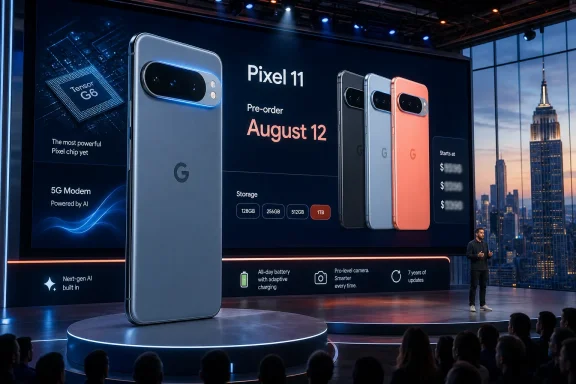 Google confirms the Pixel 11 date, but little else
Google’s own U.S. Store now says “Google Pixel 11” and “Pre-order August 12,” while its Pixel 11 event page says the next generation of Pixel will take the stage live from New York City. Android Central reports the event is set for 6 p.m. Eastern Time on August 12, and Google’s Store marketing confirms the New York venue even where the event time is not displayed prominently.
That is the firm record: a Pixel 11 launch and pre-orders on August 12.
Google has not, on its public Store pages, named a Pixel 11 Pro, Pixel 11 Pro XL, or Pixel 11 Pro Fold. It has not published a specification sheet, an MSRP, a carrier list, a shipment date, software-support terms, or a trade-in schedule. Reports expecting four phones may well prove accurate, particularly because the lineup follows Google’s recent pattern, but the company’s teaser is deliberately narrower than the coverage built around it.
The often-cited August 20 availability date belongs in the same category. TechRadar, Tom’s Guide and Digital Trends report that date as expected, largely by reading Google’s recent launch cadence and leak material. Google has not yet committed to it publicly. That leaves room for different dates by model or market, which matters most for the rumored Pro Fold; foldables have often had separate availability windows even when announced alongside slab phones.
The Amazon leak is strong evidence, not an official price sheet
The most useful leak is not quite what some headlines make it sound like. Android Authority published screenshots of deleted Amazon listings that appeared to disclose U.S. prices, storage tiers, colors, batteries and selected specifications. Droid-Life found that the listings were associated with Google’s Store account and identified Amazon as both seller and shipper. That gives the material much more weight than an anonymous render or an unverified social-media post.
But it was still an Amazon retail listing, not a pricing page published by Google. Droid-Life also noted a crucial problem: the live product copy did not consistently use the Pixel 11 name, a sign that at least some of the listings were incomplete, templated or not intended for public consumption. One widely circulated listing also reportedly referenced Android 16 despite the broader expectation that the new phones will ship with Android 17. Those are exactly the kinds of pre-release catalog errors that make a leaked number useful but not final.
The reported U.S. structure is a base Pixel 11 at $899 with 256GB, a Pixel 11 Pro at $1,099, a Pixel 11 Pro XL at $1,299, and a Pixel 11 Pro Fold at $1,899. TechRadar and Android Authority both describe those figures, while Ars Technica has separately reported apparent higher European pricing paired with increased base storage on some models.
If Google holds the base Pixel 11 at $899 while raising storage from 128GB to 256GB, the comparison with the Pixel 10 is more favorable than a headline price alone suggests. Buyers who previously chose 256GB would see less of a price jump, or potentially none, depending on the prior configuration. By contrast, the reported $100 Pro XL increase is a real increase if the comparable storage configuration rises by $100 across the range.
That is the commercial story Google has not yet told: higher starting prices and more storage are not the same thing as a price increase across equivalent configurations. Buyers should compare the Pixel 11’s final 256GB, 512GB and 1TB prices against matching-capacity Pixel 10 models, not against last year’s least-expensive SKU.
Tensor G6 and the modem are the changes worth watching
A move to TSMC’s 2nm process for Tensor G6 is the most consistently reported Pixel 11 hardware change. 9to5Google and Android Authority both tie the chip to TSMC’s first-generation 2nm production, while earlier reporting from Android Authority and Android Central had already pointed toward Google moving Tensor G6 to 2nm after Tensor G5’s 3nm transition.
A smaller process node can improve efficiency, performance, or both, but it does not guarantee a benchmark victory. Android Authority’s reporting on the alleged Tensor G6 architecture suggests Google may use a seven-core CPU arrangement, while separate coverage has questioned whether the graphics design will be as current as the CPU cores. Until Google publishes GPU, thermals and sustained-performance information, there is no basis to assume that “2nm” translates directly into gaming leadership over Snapdragon-powered competitors.
The more consequential Pixel change may be the reported MediaTek M90 modem. Multiple reports, including Android Central, SamMobile and 9to5Google’s earlier coverage, point to Google moving away from Samsung’s modem hardware. The reported benefits — better radio efficiency, improved 5G behavior and satellite capability — are plausible goals, but they are not results.
For IT teams and power users, modem quality is assessed in weak-signal handoffs, standby drain, VoLTE and Wi-Fi calling stability, dual-SIM behavior, enterprise eSIM provisioning, roaming, and real carrier compatibility. A modem vendor change can fix longstanding frustrations, but it can also introduce new carrier-specific defects. Google will need to disclose supported bands and satellite partners, while reviewers will need weeks of field testing before the M90 can be treated as an upgrade rather than a promising component swap.
The leak material reportedly lists Wi-Fi 6E for the Pixel 11 Pro XL rather than Wi-Fi 7. If that survives to launch, it would be an odd point of restraint in a flagship expected to sell at $1,299 and above. Wi-Fi 6E is fully usable in many enterprise and home deployments, and raw Wi-Fi 7 support is not essential for most buyers. Still, this is the kind of detail that should not be swallowed without confirmation when the Pixel 10 Pro line already established Wi-Fi 7 expectations.
“Pixel Glow” remains a name in search of a product feature
The camera-bar lighting feature has acquired three names before launch: “Pixel Glow,” “Gemini Glow,” and, in newer reporting cited by TechRadar, “HiLight.” That alone is a warning against treating it as settled. Android Central has described LED illumination around the camera assembly for Gemini interactions, and recent teaser interpretation has led some outlets to connect the feature to Google’s own marketing images.
Google has not publicly named the function or said what it does. It could be a Gemini status indicator, a notification light, a camera-assist feature, or a combination of those. It could also be more limited than the coverage suggests, restricted to Gemini Live or selected system states rather than a configurable replacement for an always-on notification LED.
A light strip is visually distinctive, but its real value depends on control. Users need to know whether it can be disabled, whether it works with work-profile notifications, whether it flashes during meetings or Focus modes, and whether third-party apps can use it. A feature built primarily to signal that Gemini is listening may be a marketing cue; a controlled notification and accessibility system would be more useful.
The base Pixel 11 could be the awkward upgrade
The reported base-model specification is more mixed than the Pro messaging. Android Authority’s Amazon-listing coverage points to a 6.3-inch display, 12GB of RAM, 256GB of storage and a 4,985mAh battery for a $899 Pixel 11. Those would be sensible upgrades in memory and storage, and the battery figure is close enough to 5,000mAh that capacity alone should not drive a purchasing decision.
The problem is the camera claim. PhoneArena and other rumor coverage have suggested Google may remove the telephoto lens from the standard Pixel 11, despite the Pixel 10 putting a telephoto camera into the base model. If accurate, Google would be exchanging a useful optical-camera advantage for storage, memory and platform improvements. That may be a reasonable trade for users focused on battery life and local AI, but it would be a regression for anyone who bought the Pixel 10 specifically because it narrowed the photographic gap with the Pro range.
Google also has not explained the alleged RAM splits, the claimed removal of the rear temperature sensor from Pro models, or what happens to the Pro Fold’s hardware. The unusual lack of detailed Fold reporting suggests one of two things: its retail material has been better contained, or its availability and configuration remain less settled than the other models. Either way, buyers should avoid assuming that all four devices will share the same ordering and delivery schedule.
On August 12, Google needs to do more than repeat the word “Pixel.” It needs to put final storage pricing beside final camera hardware, identify the modem and connectivity specifications, name the lighting feature if it is real, and state exactly when each model ships. Until then, the Pixel 11 is officially coming — but much of the “confirmed” specification sheet remains a well-supported preview rather than the product record.
References
- Primary source: International Business Times Australia
Published: August 9, 2026 at 11:48 AM UTC
Loading…
www.ibtimes.com.au - Independent coverage: Artvoice
Published: August 8, 2026 at 2:38 PM UTC
Loading…
artvoice.com - Related coverage: tomsguide.com
Loading…
www.tomsguide.com - Related coverage: tomsguide.com
Loading…
www.tomsguide.com - Related coverage: gate.com
Loading…
www.gate.com - Related coverage: androidauthority.com
Loading…
www.androidauthority.com - Related coverage: 9to5google.com
Loading…
9to5google.com - Related coverage: 9to5google.com
Loading…
9to5google.com - Related coverage: androidcentral.com
Loading…
www.androidcentral.com - Related coverage: livemint.com
Pixel 11 launch date revealed: Made by Google event announced for August 12 | Mint
Google's next Made by Google launch event is set for August 12, 2026, in New York City. www.livemint.com
- Related coverage: digitaltrends.com
Loading…
www.digitaltrends.com - Related coverage: digitaltrends.com
Google confirms Pixel 11 launch event with a tease of its new flagship design - Digital Trends
Made by Google 2026 is August 12 in New York, and Google's invite image accidentally gave us our best look yet at the Pixel 11 Pro's gold metal design.www.digitaltrends.com - Related coverage: gizmochina.com
Loading…
www.gizmochina.com - Related coverage: techcabal.com
Loading…
techcabal.com - Related coverage: androidauthority.com
Loading…
www.androidauthority.com - Related coverage: blog.google
- Related coverage: blog.google
Loading…
blog.google - Related coverage: androidcentral.com
Loading…
www.androidcentral.com - Related coverage: los40.com
Loading…
los40.com - Related coverage: los40.com
Google confirma el Pixel Glow para Pixel 11. Aprovechamos para hacer un repaso de cara al Made by Google de Agosto | Dispositivos | LOS40
Una luz conocida en internet como 'Pixel Glow' es la primera novedad confirmada de forma oficial por Google.los40.com - Related coverage: t3.com
Loading…
www.t3.com - Related coverage: techradar.com
Loading…
www.techradar.com - Related coverage: megamobilecontent.com
Loading…
www.megamobilecontent.com - Related coverage: cincodias.elpais.com
Loading…
cincodias.elpais.com - Related coverage: frandroid.com
Loading…
www.frandroid.com - Related coverage: droid-life.com
Loading…
www.droid-life.com - Related coverage: sammobile.com
Loading…
www.sammobile.com - Related coverage: digitbin.com
Loading…
www.digitbin.com - Related coverage: blog.imseankim.com
Loading…
blog.imseankim.com - Related coverage: arstechnica.com
Google's Pixel 11 launch event is set for August 12, with possible price increases - Ars Technica
Google's new phones could feature glowing LEDs and higher price tags.arstechnica.com - Related coverage: it-boltwise.de
Loading…
www.it-boltwise.de - Related coverage: store.google.com
Loading…
store.google.com - Related coverage: store.google.com
Loading…
store.google.com