
Google is expanding its Play Age Signals API beyond Brazil, with Australia and Canada scheduled to receive it by mid-August and a global rollout planned by the end of 2026, according to reporting from Sharjah24. The system is designed to let Android apps adapt content for minors without receiving a user’s full date of birth.
The API returns an age category rather than a precise age. Google’s developer documentation describes default bands of 0–12, 13–15, 16–17 and 18+, although developers can receive custom ranges where supported. Apps must request access at runtime, and the resulting signal depends on whether the user—or a parent for a supervised account—chooses to share it.
For children using supervised Google Accounts, age-sharing choices will be managed in Family Link rather than configured separately inside every participating app. That matters because it centralizes a decision that could otherwise become a repetitive series of app-specific consent prompts.
Google already uses Family Link for controls including app-install approvals, Play Store content limits, screen-time rules and app blocking. The age-signal setting adds a different layer: it can inform an app that a user belongs to a particular age range without exposing identifying age data to that developer.
Google’s documentation also indicates that apps can receive a sharing status rather than an age range. A user who declines sharing should not yield an age signal, while jurisdictions with mandatory age-assurance rules may produce a verification-required result. Developers will need to handle all three paths rather than assume a simple yes-or-no check.
For Android developers, the practical change is that age-sensitive features can be adjusted using a Play-provided signal instead of building separate date-of-birth collection and parental-consent systems. That does not remove their compliance burden: Google’s terms still require developers to follow Play policies and applicable local law, and an age band is not a blanket license to collect more data.
The API is in beta and supports Android phones, foldables and tablets running Android 6.0 or later. Its success will depend less on the API call itself than on whether developers treat a missing or unshared signal conservatively—particularly in social, chat, dating, gambling-adjacent and mature-content apps.
For IT teams that manage Android alongside Windows endpoints, the immediate effect is limited, but the direction is clear: app stores are becoming an enforcement layer for age assurance, not merely a distribution channel.
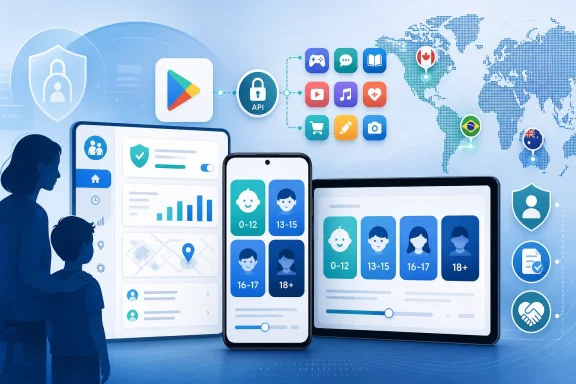 Family Link becomes the control point
For children using supervised Google Accounts, age-sharing choices will be managed in Family Link rather than configured separately inside every participating app. That matters because it centralizes a decision that could otherwise become a repetitive series of app-specific consent prompts.Google already uses Family Link for controls including app-install approvals, Play Store content limits, screen-time rules and app blocking. The age-signal setting adds a different layer: it can inform an app that a user belongs to a particular age range without exposing identifying age data to that developer.
Google’s documentation also indicates that apps can receive a sharing status rather than an age range. A user who declines sharing should not yield an age signal, while jurisdictions with mandatory age-assurance rules may produce a verification-required result. Developers will need to handle all three paths rather than assume a simple yes-or-no check.
A developer tool shaped by new regulation
Brazil was an early deployment market as its Digital Child and Adolescent Statute created new obligations around age assurance and access to age-appropriate services. The expansion to Australia and Canada puts Google Play’s implementation in markets where policymakers are also focused on child safety, online harms and age-gated experiences.For Android developers, the practical change is that age-sensitive features can be adjusted using a Play-provided signal instead of building separate date-of-birth collection and parental-consent systems. That does not remove their compliance burden: Google’s terms still require developers to follow Play policies and applicable local law, and an age band is not a blanket license to collect more data.
The API is in beta and supports Android phones, foldables and tablets running Android 6.0 or later. Its success will depend less on the API call itself than on whether developers treat a missing or unshared signal conservatively—particularly in social, chat, dating, gambling-adjacent and mature-content apps.
For IT teams that manage Android alongside Windows endpoints, the immediate effect is limited, but the direction is clear: app stores are becoming an enforcement layer for age assurance, not merely a distribution channel.
References
- Primary source: Sharjah24
Published: 2026-07-31T20:23:14+00:00
Google expands child safety tools on Android
Google is expanding its age assurance technology to Android app developers worldwide to help create safer digital experiences for children and teenagers. The ...sharjah24.ae
- Related coverage: support.google.com
- Related coverage: developer.android.com
- Related coverage: developer.android.google.cn
Request age signals | Play Age Signals | Android Developers
This document describes how to request age signals. developer.android.google.cn