

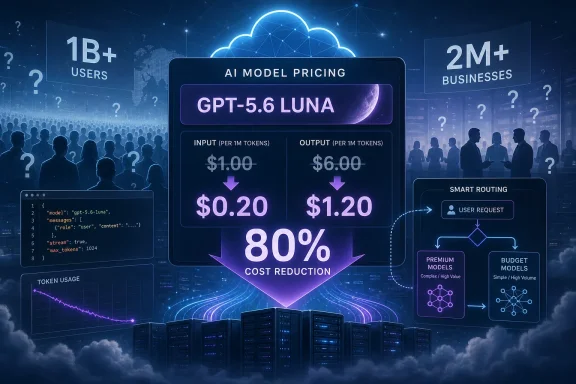
Mezha’s report tied the figures to a broader cost-reduction push, and OpenAI’s July 31 post confirms both the billion-user and two-million-business statements. Axios independently reported the preceding July 30 price change and the new direct API rates. For Windows and Microsoft Foundry administrators, the practical takeaway is less about the round-number milestone than a vendor setting up its cheaper model tier for high-volume agent workloads while preserving the premium price on its flagship model.
The company’s claim does not mean one billion people use ChatGPT every week, one billion people pay OpenAI, or two million organizations have deployed ChatGPT Enterprise. OpenAI did not publish the reporting period, counting method, geographic breakdown, paid-versus-free split, or a definition of an “active” user in the announcement. It also did not say whether a business is counted through a direct API account, a ChatGPT Work tenant, a partner-hosted deployment, or some combination of those channels.
The key omission is the definition of “active”
OpenAI’s previous public milestone gives the clearest reason to be careful with the new wording. In November 2025, the company said it had more than 1 million business customers, explicitly defining that number as organizations actively paying for ChatGPT for Work or direct model consumption through its developer platform. It also said ChatGPT had more than 800 million weekly users at the time.
The July 31 disclosure uses different language. OpenAI now says its “models” reach more than 1 billion active users and more than 2 million businesses. That may reflect substantial growth, but it is not an apples-to-apples update because the company has not repeated its earlier definition of a business customer or said whether “active users” means daily, weekly, monthly, or another internal measure.
Sensor Tower estimates, reported by Reuters in June and separately summarized by eWeek, put the ChatGPT mobile app at 1 billion monthly active users in May 2026. That is a credible indication of consumer reach, but it is a different measure: mobile-app activity, not OpenAI’s broader account and platform activity. OpenAI’s newer statement can therefore be consistent with the app estimate without proving that it has one billion distinct, recurring ChatGPT users across all surfaces.
The difference is material for buyers. A company selling API access, desktop tools, web chat, embedded applications, Codex, and workplace subscriptions can legitimately describe broad model reach. But an IT department evaluating vendor maturity needs different numbers: paid tenants, active seats, production workloads, retention, monthly token consumption, service reliability, and the percentage of users operating under enterprise controls.
OpenAI has published none of those underlying figures with this announcement. The scale claim establishes that OpenAI’s software is widely used; it does not establish how deeply the two million businesses depend on it or how much recurring revenue they represent.
Luna is the price cut that changes deployment math
The concrete commercial move is the reduction in GPT-5.6 Luna pricing. OpenAI launched the GPT-5.6 family on July 9 with Luna priced at $1 per million input tokens and $6 per million output tokens. As of July 30, Luna costs $0.20 per million input tokens and $1.20 per million output tokens.
For a workload consuming one million input and one million output tokens, the direct API bill drops from $7 to $1.40. That is a meaningful reduction for document classification, ticket triage, extraction pipelines, automated test generation, knowledge-base processing, and other workloads where the request count is large and the error tolerance is managed through evaluation and review.
GPT-5.6 Terra, OpenAI’s middle tier, fell from $2.50 per million input tokens and $15 per million output tokens to $2 and $12. A one-million-input, one-million-output workload therefore falls from $17.50 to $14. Luna receives the strategic discount; Terra receives a smaller adjustment; GPT-5.6 Sol, the flagship tier, remains at its original price.
That pricing split tells a more useful story than the billion-user milestone. OpenAI is trying to make lower-cost inference cheap enough for workflows that run continuously rather than occasionally. Many enterprise AI projects fail the budget test not because a model call is expensive in isolation, but because an agent loops through tools, repeatedly loads context, retries failures, and produces more output than its designer expected.
OpenAI says Luna and Terra have lower credit consumption in Codex and ChatGPT Work following the price reduction. But the company also says ChatGPT and Codex subscription prices and quota budgets have not changed. Existing Plus, Pro, Business, and Enterprise customers should therefore not interpret the announcement as a lower per-seat invoice. The benefit is potentially more work inside the same usage envelope, not a subscription discount.
Direct OpenAI API prices do not automatically set Azure costs
Microsoft Foundry already lists GPT-5.6 Sol, Terra, and Luna as available Azure OpenAI models, with model availability dependent on regional capacity and quota. That does not make OpenAI’s direct API price announcement an Azure pricing announcement.
OpenAI’s July 30 post says its updated pricing would begin rolling out in AWS later that day. It does not state an Azure OpenAI Service price, a Microsoft Foundry rollout date, or whether Azure’s meter rates will match OpenAI’s $0.20/$1.20 Luna and $2/$12 Terra prices. Microsoft’s documentation confirms model availability, but Azure customers should use the prices visible in their own Foundry deployment and Cost Management data rather than assume parity with OpenAI’s public API.
That distinction is especially important for organizations choosing Azure OpenAI for Entra ID integration, private networking, regional deployment controls, Azure billing, policy enforcement, or existing Microsoft commitments. The economics of the direct OpenAI API may be attractive, but moving a production application between providers changes more than token rates. It can affect model-version availability, capacity quotas, data residency, monitoring, networking, endpoint behavior, and support arrangements.
For teams already using GPT-5.6 through an OpenAI account, the lower Luna rate gives a reason to revisit routing policies. Sol can remain the escalation tier for ambiguous requests, planning, complex code changes, or high-consequence decisions. Luna is now priced for routine steps: extracting fields from forms, producing structured summaries, running first-pass classification, drafting test cases, or handling clearly bounded code transformations.
OpenAI’s own proposed model-routing pattern follows that design: use a stronger model to resolve uncertainty and define the plan, then assign well-specified implementation and validation work to a cheaper model. That can work, but only if teams measure full task success rather than token cost. A cheap model that creates additional retries, weak tests, or review overhead is not cheaper in production.
OpenAI is selling efficiency, not merely lower list prices
OpenAI attributes the cuts to serving-stack improvements, including model routing, GPU kernel work, prompt caching, and speculative decoding. In its engineering post, the company says GPT-5.6 Sol helped optimize production kernels and experiments, reducing end-to-end serving cost by 20% and improving token-generation efficiency by more than 15%.
Those are vendor claims, not independently audited cost figures. Still, the direction is plausible and matches the speed of the pricing decision: OpenAI reduced Luna and Terra prices only three weeks after the GPT-5.6 launch. Axios reported that the move came amid growing pressure to show that proprietary models can justify their cost against cheaper alternatives, including open-weight offerings.
OpenAI’s Fast mode for GPT-5.6 Sol illustrates the same pricing strategy from the other direction. The company says Fast mode replaces Priority Processing, runs up to 2.5 times faster than standard processing, and costs twice as much. Existing API requests using the priority service tier are meant to continue working, now routed to Fast mode.
For administrators, that means performance policy deserves the same attention as model selection. A product team may be able to lower average inference costs with Luna while still paying for Sol Fast on user-facing, latency-sensitive paths. Without per-route cost telemetry, an apparently successful model migration can simply move spend from one meter to another.
What IT teams should verify before changing production routing
The price cuts give organizations a reason to run controlled tests rather than wholesale model swaps.
- Compare complete workflow cost, including tool calls, retries, output review, caching, and human escalation rather than input-token pricing alone.
- Test Luna against production-like structured outputs, retrieval quality, permissions-sensitive tool use, and failure handling before assigning it autonomous actions.
- Confirm the model version, region, quota, and meter rate in the provider actually serving the application, particularly for Azure OpenAI and other hosted routes.
- Keep stronger-model escalation paths for requests with uncertain requirements, sensitive data handling, code changes, or decisions that can create operational risk.
OpenAI’s new figures demonstrate reach, but they do not resolve the questions enterprise customers actually need answered about adoption quality and deployment depth. The verifiable near-term development is cheaper GPT-5.6 Luna inference: $0.20 per million input tokens and $1.20 per million output tokens on OpenAI’s API. Whether that reduction appears on a Windows organization’s bill depends on its provider, its routing design, and whether its cheaper model path can complete work without sending the savings back through retries and review.
Update: Additional details (August 6, 2026)
SitePoint reports that OpenAI’s standard-rate card also separates cache charges: Luna is $0.02 per million cached-input reads and $0.25 per million cache writes, while Terra is $0.20/$2.50 and Sol is $0.50/$6.25. Requests exceeding 272,000 input tokens reportedly move to higher long-context rates; for Luna, that is $0.40 input and $1.80 output per million tokens.
The report also says Luna, Terra, and Sol each have a 1.05-million-token context window and a 128,000-token maximum output. Administrators should also avoid the unqualified gpt-5.6 alias: it maps to the premium gpt-5.6-sol model, rather than selecting a lower-cost family default.