
 A Consumer-Choice Argument at the Center of GTA 6
Speaking during San Diego Comic-Con 2026, Rockstar Games co-founder Dan Houser argued that companies ought to offer physical game releases when players want them, even though he reportedly does not hold a categorical personal preference for discs over downloads. The important distinction is that Houser’s position is not nostalgia for plastic cases; it is a market argument for choice, access, and responding to demonstrated demand. LatestLY’s report, citing IGN India’s Comic-Con coverage, also says Houser recognized the practical benefits that digital distribution has brought to modern game development.
That measured framing matters. The physical-media discussion is often presented as a simplistic contest between collectors who refuse to move on and publishers trying to modernize. In reality, players can value both: digital delivery is convenient, while a disc or cartridge can have practical advantages that a digital license cannot replicate.
For GTA 6, the subject is especially charged. Rockstar is not releasing a routine sequel with a modest audience. It is preparing a major entertainment launch for PlayStation 5 and Xbox Series X|S, with Take-Two’s official announcement setting a $79.99 price for the standard edition and $99.99 for the Ultimate Edition. Take-Two’s pre-order announcement also positions the game as a flagship single-player release centered on Jason and Lucia in Leonida.
A product at that scale establishes consumer expectations. Buyers spending $80 or more may reasonably distinguish between:
- A digital entitlement purchased from a platform storefront;
- A boxed download code, which looks physical but still grants a digital entitlement;
- A disc-based game, which can be installed, shared, loaned, traded, displayed, and in some cases used independently of a storefront;
- A collector’s edition, where packaging and tangible extras are part of the intended value proposition.
These formats do not offer the same experience, even when the game content is identical.
GTA VI’s “Physical” Release Is Not a Disc Release
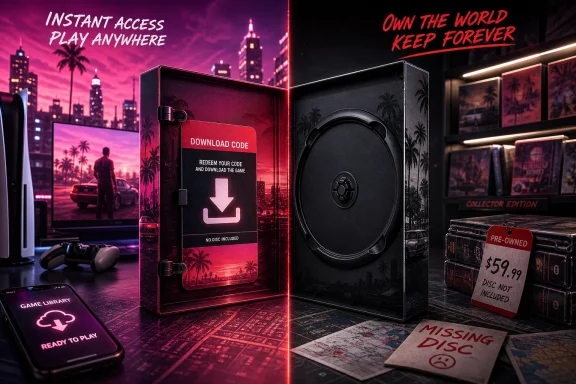
The immediate issue is not hypothetical. Rockstar’s official GTA VI store listing labels its offering a “Physical (Code-in-Box) Version Available,” then clearly states that the box contains only a download code to support pre-loading beginning November 12 and that no disc is included. Rockstar’s GTA VI product page makes the distinction explicit rather than burying it in fine print.
Rockstar Support provides the same clarification: the physical version contains a redeemable code for a digital download, and no disc will be included in the box. The official GTA VI pre-order FAQ further confirms that retail and third-party storefront availability may vary by country, but it does not change the core nature of this boxed product.
This is where industry terminology risks becoming misleading. A retail package is physically delivered, but that does not make it a physical game in the traditional sense. The storage medium that contains the executable game data is absent. What the purchaser receives is packaging plus a key that must be redeemed against a platform-controlled digital distribution system.
Why a code-in-box is meaningfully different
The distinction is more than semantic. A code-in-box package changes what ownership and consumer flexibility look like after checkout.
A game disc may still require online updates, account linking, or periodic authentication. Modern physical games are not always complete archival artifacts, and some require substantial downloads before they can be played. Yet a disc remains a transferable object. It can be loaned to a friend, sold through a used-games market, given away, purchased without access to a digital storefront, and retained as a collectable item with functional game data on it.
A single-use download code has different properties:
- It is usually redeemed once, limiting its resale value sharply.
- It cannot be lent in the same way as a disc.
- It depends on an active platform account and the continued availability of the relevant digital infrastructure.
- It may be useful as a gift, but it does not preserve the familiar second-hand market.
- Its packaging can create the appearance of a traditional boxed release without offering the same rights or utility.
For publishers, the attraction is obvious. Code-in-box products preserve shelf presence at retailers, allow boxed editions and merchandise bundles, and help steer buyers toward pre-loads and connected accounts. They also avoid manufacturing and logistics associated with an optical disc that may no longer be central to how the game is installed or updated.
For consumers, however, a code-in-box should be evaluated as a digital purchase with optional retail packaging, not as a disc-based version of GTA 6. Transparency on that point is essential, particularly for parents buying gifts, collectors expecting a playable disc, and players who deliberately choose physical editions.
Background: Why the Physical Media Debate Has Accelerated
Houser’s remarks arrive as PlayStation has formalized an industry-changing move away from discs. Sony Interactive Entertainment announced that physical disc production for all new games releasing on PlayStation consoles will end in January 2028. From that point, new titles will be made available in digital formats through the PlayStation Store and at retailers. Sony’s July 1 announcement says the policy will not affect games that had already released, or were scheduled to release, in disc form before the cutoff.
Sony describes the decision as a response to consumer preferences moving toward digital media. Its financial reporting provides meaningful context: PlayStation’s full-game software digital download ratio was 76% for fiscal year 2024, and the available fiscal year 2025 quarterly figures were 83% in the first quarter and 72% in the second quarter. Sony’s Game & Network Services supplemental information also shows physical software revenue as a far smaller category than digital software and add-on content.
Those figures explain the commercial logic, but they do not resolve the consumer question. A majority preference for digital purchases does not mean the remaining minority is insignificant, nor does it mean digital and physical buyers are interchangeable. A player who selects a disc because they have unreliable broadband, wish to trade games, or curate a personal collection is not merely choosing different packaging.
Sony’s 2028 policy recognizes that retail itself can persist in a digital-only model: retailers can sell codes, voucher cards, hardware, and boxed download products. What changes is the ability for those stores to sell new PlayStation games as independently usable physical media.
Digital’s growth is real, but it is not neutral
Digital distribution has succeeded for valid reasons. It offers convenience, instant access, pre-loading, automatic patch delivery, cloud-synchronized saves, remote purchases, and the ability to carry a large library without transporting cases. For an enormous game such as Grand Theft Auto VI, where day-one demand will be intense, pre-loading can reduce launch-day congestion and let players begin immediately when servers and platforms unlock access.
Houser’s reported acknowledgement of patches and bug fixes reflects a genuine advance. The reporting on his Comic-Con appearance notes his view that digital distribution enables developers to patch software and remedy bugs quickly. That capability has helped studios respond to technical problems that would have been expensive or impossible to correct in earlier console generations.
But the benefits of patches should not be used to blur a separate issue: the ability to update a game is not the same as the requirement to eliminate physical media. A disc-based release can receive patches. A publisher can support pre-loads, day-one fixes, online services, and digital expansions while still selling a disc that contains a usable version of the base game.
The strongest outcome is not an artificial choice between a frozen disc and a fully digital ecosystem. It is a model in which the player can choose a disc for ownership flexibility while also downloading updates when they want the latest build.
The Tension Between Houser’s Principle and Rockstar’s Product Strategy
The unusual aspect of the GTA 6 conversation is that Houser’s reported position and Rockstar’s current retail model appear to point in different directions. On one side is the idea that publishers should provide physical formats when the audience wants them. On the other is a title whose officially described boxed version substitutes a single-use code for the disc collectors expect.
This should not be read as proof that one person’s convention remarks dictate Rockstar’s operations. A co-founder’s view, a publisher’s launch plans, console-platform rules, manufacturing constraints, retail arrangements, and live-service strategy are all separate forces. Yet the disconnect is still useful because it reveals the industry’s unresolved problem: companies praise consumer choice while redefining a physical release into something less functional than the format consumers are asking for.
GTA 6 is a crucial test case
If any game can demonstrate sustained demand for an actual physical edition, it is GTA 6. Grand Theft Auto is a global brand, and Take-Two says the series has sold more than 470 million units worldwide. Its official GTA VI pre-order release frames Rockstar’s catalog as one of interactive entertainment’s most successful properties, spanning Grand Theft Auto, Red Dead Redemption, Max Payne, Bully, L.A. Noire, Midnight Club, and more.
A game of this stature has several overlapping audiences:
- Players who want immediate digital access at launch;
- Fans who want a premium Ultimate Edition and in-game bonuses;
- Collectors who want shelf presence and a long-term keepsake;
- Families and gift buyers who prefer a tangible item;
- Retail customers who value store promotions, trade-in credit, or local availability;
- Preservation-minded players who regard a disc as an important fallback when storefronts eventually change.
Rockstar’s current code-in-box option serves some of these groups, particularly gift buyers and those who value a physical package. It does not fully serve players who want a disc containing GTA VI. The distinction will become more visible as the release date approaches and consumers compare the available editions.
Ownership, Licensing, and Preservation
The physical-media debate is often described as a debate about “ownership.” That word requires precision. Buying a game disc has never meant acquiring the copyright or unrestricted legal ownership of the game’s intellectual property. Players buy a copy and a license governed by terms of service, and modern releases can still be affected by server closures, licensing disputes, patches, DRM, and platform policy.
Nevertheless, physical media historically gives consumers more practical control over how a purchased game moves through their lives. A disc can remain in a collection, be passed to another household member, resold, and installed on compatible hardware without needing the original buyer’s storefront account to transfer along with it.
Digital storefronts supply a different kind of convenience: libraries follow accounts, purchases can be downloaded again, and no disc must be located or kept in working condition. For many players, that is a better experience. The risk arises when digital becomes mandatory rather than elective, because the user no longer has a practical alternative if platform terms, account access, regional availability, or store operations change.
The service dependency problem
Rockstar’s own product disclosure illustrates the degree of dependency attached to a modern digital release. Its GTA VI store page says purchasing grants a license to the digital product and notes that certain features, content, services, or functions may require an internet connection, account registration, a single-use serial code, or additional fees; it also says availability may change under the publisher’s terms. Rockstar’s GTA VI legal disclosure is standard for the modern industry, but it is important context for buyers deciding what “physical” means.
This does not make digital games inherently undesirable. It does mean players should understand that an account-based license is different from holding a disc. One format centers its value on convenience and an ongoing platform relationship; the other adds a transferable physical object, even if it cannot entirely escape the realities of modern online gaming.
For a sprawling, continually updated title such as GTA 6, no one should assume a launch disc—if Rockstar eventually offers one—would be a complete permanent solution. It could still require patches, and its online components would inevitably depend on servers. But that limitation is an argument for better preservation practices and clearer disclosure, not an argument for pretending that a download code and a game disc are functionally identical.
The Windows and PC Perspective: Digital-First Does Not Have to Mean Consumer-Hostile
Windows gaming has long been predominantly digital. Steam, the Microsoft Store, GOG, the Epic Games Store, PC Game Pass, and publisher launchers have conditioned PC players to download large games, receive constant updates, and maintain account-linked libraries. In that sense, the console market is catching up with patterns Windows users already understand.
There are tangible advantages to the digital-first PC model:
- Game updates are fast and broadly distributed.
- Developers can support evolving hardware and drivers.
- Stores can offer frequent discounts and instant redemptions.
- Large libraries are accessible across compatible devices.
- Accessibility patches, bug fixes, and performance improvements can arrive after launch.
Yet Windows players also understand the trade-offs. PC storefront ecosystems are fragmented. Launchers compete for exclusives. Games can be delisted. Account recovery can become a critical dependency. DRM-free alternatives remain comparatively rare for major releases. In practice, digital convenience works best when platforms deliver reliable access, clear customer support, robust download infrastructure, transparent licensing, and policies that respect existing purchases.
That is the real lesson console makers and publishers should take from the PC transition. The success of digital distribution is not a blank check to reduce consumer rights or obscure product differences. It is a responsibility to make the digital option sufficiently dependable, portable, and clearly described that players feel they are gaining convenience rather than surrendering control.
What Publishers Should Do Instead of Treating Discs as a Binary Choice
Houser’s reported principle points toward a pragmatic compromise. The goal need not be a disc for every game at every retailer forever. The better approach is to recognize that player demand differs by franchise, platform, region, and edition.
For blockbuster releases, publishers have several workable options.
1. Offer a genuine disc edition alongside digital versions
A standard digital edition can coexist with a disc edition, even if the disc version costs slightly more to manufacture or is offered through selected retailers. This preserves a choice for collectors and enables the used-game market without removing pre-loading or digital delivery for everyone else.
2. Describe code-in-box products accurately
Retail listings should plainly say “digital download code in box — no game disc included” near the product title and purchase button. Rockstar’s own GTA VI pages do state this, which is a positive step. The next step is ensuring that third-party retailer listings, marketing images, and promotional materials make the distinction equally visible.
3. Make physical editions functional at launch
A disc does not have to contain every future patch, but publishers should strive to make the base game playable from the media wherever technically feasible. Shipping a disc that is essentially an installer for a mandatory multi-hundred-gigabyte download undermines the reason people buy physical media.
4. Preserve retail choice without using packaging as camouflage
Retailers can continue to sell digital codes, but publishers should not imply that a box automatically equals a physical edition. Packaging, steelbooks, maps, art books, and collectibles have value, but buyers deserve an unambiguous explanation of what they are receiving.
5. Provide durable access for digital buyers
If the industry wants to move fully digital, it should strengthen consumer confidence through long-term re-download policies, transparent delisting procedures, clearer license terms, account recovery protections, and support for future hardware compatibility.
GTA 6’s Release Date Is Clear; Its Physical Future Is the Real Question
The immediate GTA 6 release date picture is straightforward. Rockstar and Microsoft list November 19, 2026 for PlayStation 5 and Xbox Series X|S. Rockstar’s store listing and Xbox’s official game page match on that date, while Take-Two’s June announcement specifies that digital pre-loading begins November 12. Take-Two’s release also confirms that the boxed code product is intended to be available by then to support the same pre-load process.
The more consequential question is what consumers will be able to buy when the game arrives. Under Rockstar’s current published details, the answer is not a disc-based GTA VI edition. It is a digital game sold through stores and platforms, with the option of buying a physical box that contains the code necessary to obtain that digital game.
That may be sufficient for a vast share of the GTA audience. Sony’s own financial reporting demonstrates that digital downloads already dominate PlayStation full-game sales. Sony’s supplemental financial report makes the direction of the market difficult to dispute. But majority behavior should not erase minority needs—especially when those needs involve resale, collection, rural connectivity, gifting, access after storefront change, and a desire to keep a game shelf that is more than a row of empty boxes.
Dan Houser’s reported point is therefore both modest and significant. Physical releases do not need to be everyone’s preferred format to justify their existence. If players want them, and if a franchise as large as Grand Theft Auto VI can sustain demand for them, publishers should provide a real option rather than a symbolic substitute.
