
The more consequential part of the report is what it says about Rockstar’s security posture. According to Schreier’s reporting, the company still has not identified the person or group behind the new leak or established how the material escaped. That leaves the studio dealing with a repeat of the problem it tried to solve after the 2022 intrusion—only now it is doing so after asking employees to absorb major changes to how they work.
Netflix is reportedly frustrated as well, according to Bloomberg’s account, because unauthorized footage surfaced just before its heavily promoted first-access window. Neither Rockstar nor Netflix has publicly detailed the alleged frustration, and Rockstar has not issued a public explanation of the breach. What it has confirmed is the August 27 presentation schedule and Grand Theft Auto VI’s November 19, 2026 release date for PlayStation 5 and Xbox Series X|S.
For IT leaders and development teams, the story is a familiar and uncomfortable one: tightening workplace controls after a breach does not prove the breach vector has been eliminated. It can instead make daily work more rigid while the attacker, insider, third party, or account compromise responsible for the incident remains unidentified.
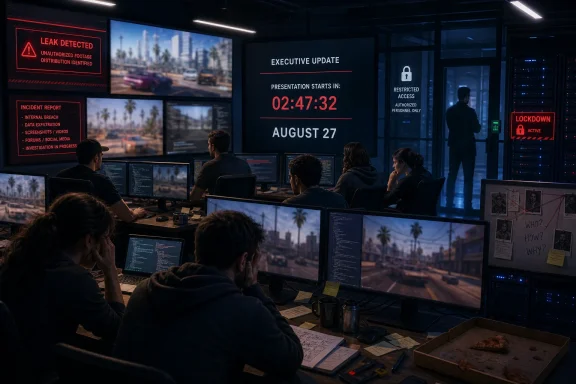 Rockstar’s controls did not stop the new exposure
Schreier’s reporting says Rockstar imposed stricter security measures following the 2022 leak, including ending remote-work flexibility and requiring employees to work from the office five days a week. PC Gamer and GamesRadar, both reporting on Bloomberg’s account, likewise describe staff frustration that such restrictive measures did not prevent another set of gameplay clips from appearing online.
The distinction is important. An office-first mandate controls where work is performed; it does not, on its own, establish who can access a build, whether credentials are secure, how content is logged and watermarked, whether vendors hold equivalent controls, or whether staff can move assets through unmanaged channels. It may reduce some risks, but it cannot substitute for knowing how sensitive material was accessed and exfiltrated.
Rockstar has not publicly said that its office policy was a response solely to the 2022 leak, nor has it released a technical postmortem for the new incident. The company therefore has not provided the details security teams would need to judge whether this was an endpoint compromise, a privileged-access failure, an insider leak, a third-party exposure, or something else.
That missing explanation is more significant than the familiar speculation around the clips themselves. Without it, calls for still harsher restrictions risk becoming a policy response to an unknown problem. Organizations can easily turn a breach investigation into a visibility exercise—more office attendance, less flexible access, more friction for employees—without materially changing the path that allowed data to leave.
A leak during final development carries a different cost
The leaked footage is not merely a marketing inconvenience. Development teams work for years toward a controlled reveal in which unfinished assets, performance limitations, UI experiments, debug behavior and incomplete systems are presented only when they can be judged as a finished product. Unauthorized material strips that control away and makes employees watch in-progress work become public spectacle.
That is why the mood Bloomberg describes matters more than the standard public-relations line that leaks can create buzz. A large entertainment product can survive heightened public curiosity; the people building it still have to investigate the exposure, respond to takedown requests, review access logs, address new management concerns and continue shipping the game. Those tasks arrive on top of the ordinary pressures of the final development push.
A security incident also creates a second-order productivity problem. If employees believe they lost remote-work autonomy or other trusted workflows after the previous leak, only to see another leak happen anyway, confidence in the controls can erode. The outcome is not simply low morale. It can be weaker cooperation with security procedures, more workarounds, and a harder time distinguishing a necessary safeguard from an unproductive compliance burden.
For a studio the size of Rockstar, the pressure will extend beyond the game’s core developers. Build engineers, QA, release teams, marketing, legal, IT operations and external partners all handle different portions of a launch pipeline. A leak investigation that lacks a confirmed source can spread controls across that entire chain. That may be necessary in the short term, but broad restrictions become expensive when they are maintained without evidence that they address the actual failure.
Netflix’s six-hour window is still intact
Rockstar’s August 6 announcement was precise: Grand Theft Auto VI: An Extended Look will premiere on Netflix at 3 p.m. ET on August 27, then go live on the official Rockstar YouTube channel and Grand Theft Auto VI website at 9 p.m. ET. Netflix’s advantage is therefore a six-hour early window, not permanent exclusivity.
GamesRadar and PC Gamer report that the recent leaks have not changed that plan. That matches Rockstar’s current official listing, which continues to advertise the August 27 presentation. The company has not announced a delay to the presentation or its November 19 console release.
That continuity is the clearest public signal available. Rockstar is treating the official reveal as a separate product from the leaked clips: polished, controlled and distributed through an arrangement with Netflix that remains commercially important enough to preserve. The leaks may have spoiled parts of the surprise, but they have not yet forced an observable change in the marketing calendar.
The reported Netflix frustration should be understood in that context. The service is not merely hosting a trailer; it has been granted the first public viewing window for one of the year’s most anticipated game presentations. Leaked gameplay directly competes for attention with that event, especially when it appears close enough to the presentation to fuel a cycle of clip analysis, alleged feature lists and spoiler discussions before the official material arrives.
What Rockstar has—and has not—confirmed
Rockstar has confirmed the presentation date, time and distribution sequence. It has also confirmed the November 19, 2026 launch for PlayStation 5 and Xbox Series X|S. It has not publicly confirmed the identity of the leaker, the method used to obtain the footage, the exact age of every leaked build, or a connection between the leak and any particular employee, contractor, platform or former staff member.
That last point deserves care. Reporting around game leaks can rapidly turn workplace disputes, former employees and rumor accounts into implied suspects. PC Gamer notes there is no public evidence connecting recently dismissed Rockstar employees to the current leak. The absence of a named culprit from Rockstar is not proof of any theory circulating online; it is a sign that the investigation has not produced a public attribution.
There is also no PC release date in Rockstar’s official Grand Theft Auto VI announcement. Windows players should avoid reading leaked development footage or the Netflix event as evidence that a PC edition will launch alongside the November console release. Rockstar’s current public platform list remains PlayStation 5 and Xbox Series X|S.
The August 27 presentation will show whether Rockstar can reclaim the public narrative. Internally, the harder task is identifying how the footage escaped before it responds with another round of controls that employees—not the leaker—will have to live with.