
Windows Central’s August 5 hands-on with GUNNAR’s $130 Novato glasses found that the reviewer could work later without the usual eye discomfort, even after Windows 11 Night Light and f.lux had failed to deliver the same relief. That experience is plausible as a personal comfort result, but it does not establish that blue-light filtering solved the underlying eye strain—and it leaves out an important fact about the supplied pair: the Novato changes more than the color of a monitor.
The writer disclosed that GUNNAR sent the glasses for testing and described an immediate sensation of facial relaxation after putting on the amber-tinted frame. Later, the reviewer realized they had worked roughly an hour past their normal stopping point because their eyes did not hurt enough to prompt a break. For desk workers who have already tuned chair height, display placement, keyboards, and mice, that is a familiar appeal: a passive tool that seems to make a long screen day more tolerable.
GUNNAR’s Novato is a new titanium-frame model in its higher-end “Legendary” range, with an official list price of $130. The company offers it with several lens options, including Amber, Clear, Clear Pro, Amber Max, and prescription variants. The model discussed by Windows Central uses the standard Amber option, which GUNNAR says blocks 65% of blue light at 450 nm; the company also specifies a premium anti-reflective, smudge-resistant coating, adjustable nose pads, flexible hinges, and a 24-month warranty.
The reporter’s central observation—that glasses affect the room while Night Light affects only the display—is correct. It is also the point at which the comparison needs more care.
Windows 11’s Night Light warms the display’s white point and lets users schedule the effect around sunset or custom hours. Microsoft positions it chiefly as an evening feature, and it is useful precisely because it is free, adjustable, and can be disabled when accurate colour work matters. It does nothing to light from overhead fixtures, a second unfiltered display, a phone, a window, or reflections from the desk.
Amber lenses physically sit between the wearer and all of those sources. That makes them inherently broader than a software display filter, including f.lux. They also create a constant warmer view regardless of whether the work is happening on a Windows PC, a phone, a console, paper, or no display at all.
That broader coverage can be valuable for a person who finds bright environments, glare, or high-contrast office lighting uncomfortable. It also means the glasses are not a like-for-like replacement for Night Light. Software changes a screen; the Novato changes the visual environment reaching the wearer’s eyes.
There is a practical tradeoff. The same amber tint that may feel easier on the eyes alters colour perception. GUNNAR explicitly markets its Clear Pro lens, which blocks less blue light, to photo editors, video editors, graphic designers, and other users who need more faithful colour rendition. Anyone grading footage, matching a corporate brand colour, soft-proofing a print, or calibrating a display should take the amber glasses off for that work rather than assume the apparent image remains colour accurate.
GUNNAR’s own product page packages the Novato as “patented lens technology” that is “clinically proven” to reduce digital eye strain, block harmful blue light, and enhance focus. The page lists the product’s materials, coatings, warranty, dimensions, and blue-light percentage, but it does not identify the clinical study, test protocol, comparator lens, participant group, or outcome data behind that broad claim.
That omission matters because the tester’s improvement cannot be assigned to blue-light reduction alone. The amber tint, anti-reflective coating, minor lens power, frame fit, reduced glare, expectation, and simple novelty all changed at once. A one-person hands-on can establish that the glasses felt comfortable for that writer; it cannot isolate which component produced the result.
MeriStation’s separate June review of the Novato reached a similarly positive comfort assessment during work and gaming, while flagging a recurring practical issue: its tester found that the lightweight frame gradually slipped down during longer sessions. That is a subjective observation from one outlet rather than a laboratory result, but it is useful purchasing context for a $130 frame marketed for marathon use.
The review’s limits are important: trials were small, studies varied, and follow-up ranged from under a day to five weeks. It did not test every frame, every tint strength, or the GUNNAR Novato specifically; the Novato arrived years after Cochrane’s final evidence search in March 2022. Still, the review is a major problem for any suggestion that a blue-blocking lens category has clinically settled benefits for routine screen fatigue.
The American Academy of Ophthalmology’s digital eye-strain guidance likewise says there is no scientific evidence that computer-screen light damages eyes and does not recommend special eyewear solely for computer use. That does not mean people are inventing their discomfort. It means the usual causes of screen-related symptoms are broader than blue light and often more actionable.
The American Optometric Association lists glare, poor lighting, improper viewing distance, posture, uncorrected refractive error, dry eyes, focusing difficulty, and binocular-vision issues among the contributors to digital eye strain. A person can get headaches or blurred vision after eight hours at a screen without blue light being the main culprit.
Screen breaks are not merely an annoyance caused by discomfort. The American Optometric Association recommends the familiar 20-20-20 practice: every 20 minutes, look at something about 20 feet away for 20 seconds. It also recommends regular breaks from sustained computer work, frequent complete blinking, suitable screen distance, reduced glare, and an eye examination when recurring symptoms persist.
A lens that makes it easier to keep staring at a display may increase comfort while also removing the body’s cue to pause. That is not a reason to reject the glasses. It is a reason to treat them as a comfort accessory rather than permission to turn a ten-hour screen day into an eleven-hour one.
For Windows users, the first layer remains the workstation: set display brightness to match the room rather than overpower it, position the monitor below eye level and roughly an arm’s length away, remove window and ceiling-light reflections, and use Night Light on a schedule if warmer evening colours help. If symptoms continue, an optometrist can check whether a minor prescription issue, dry eye, accommodation problem, or eye-coordination problem is being exposed by the specific viewing distance of a monitor.
Buyers should separate that use case from medical certainty. The evidence does not show that blue-light glasses broadly cure computer eye strain, prevent screen damage, or eliminate the need for breaks and a proper eye exam. In this case, the most defensible conclusion from Windows Central’s test is smaller and more useful: the Novato made one reviewer feel sufficiently comfortable to keep working, while the reason it did so remains unresolved.
GUNNAR’s Novato is a new titanium-frame model in its higher-end “Legendary” range, with an official list price of $130. The company offers it with several lens options, including Amber, Clear, Clear Pro, Amber Max, and prescription variants. The model discussed by Windows Central uses the standard Amber option, which GUNNAR says blocks 65% of blue light at 450 nm; the company also specifies a premium anti-reflective, smudge-resistant coating, adjustable nose pads, flexible hinges, and a 24-month warranty.
The reporter’s central observation—that glasses affect the room while Night Light affects only the display—is correct. It is also the point at which the comparison needs more care.
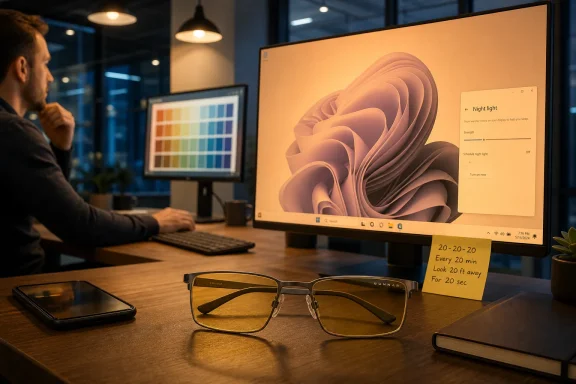 The Novato is doing more than Windows Night Light can do
Windows 11’s Night Light warms the display’s white point and lets users schedule the effect around sunset or custom hours. Microsoft positions it chiefly as an evening feature, and it is useful precisely because it is free, adjustable, and can be disabled when accurate colour work matters. It does nothing to light from overhead fixtures, a second unfiltered display, a phone, a window, or reflections from the desk.Amber lenses physically sit between the wearer and all of those sources. That makes them inherently broader than a software display filter, including f.lux. They also create a constant warmer view regardless of whether the work is happening on a Windows PC, a phone, a console, paper, or no display at all.
That broader coverage can be valuable for a person who finds bright environments, glare, or high-contrast office lighting uncomfortable. It also means the glasses are not a like-for-like replacement for Night Light. Software changes a screen; the Novato changes the visual environment reaching the wearer’s eyes.
There is a practical tradeoff. The same amber tint that may feel easier on the eyes alters colour perception. GUNNAR explicitly markets its Clear Pro lens, which blocks less blue light, to photo editors, video editors, graphic designers, and other users who need more faithful colour rendition. Anyone grading footage, matching a corporate brand colour, soft-proofing a print, or calibrating a display should take the amber glasses off for that work rather than assume the apparent image remains colour accurate.
The lens also introduces optics and glare control
Windows Central calls out the Novato’s slight magnification, while noting that a neutral-focus version is available. That detail should not be buried under the blue-light label. A mild positive lens can make nearby text feel easier to read for some users, particularly as close-range focusing becomes less effortless with age or after a long day. Anti-reflective coatings can also reduce distracting reflections on the lens itself.GUNNAR’s own product page packages the Novato as “patented lens technology” that is “clinically proven” to reduce digital eye strain, block harmful blue light, and enhance focus. The page lists the product’s materials, coatings, warranty, dimensions, and blue-light percentage, but it does not identify the clinical study, test protocol, comparator lens, participant group, or outcome data behind that broad claim.
That omission matters because the tester’s improvement cannot be assigned to blue-light reduction alone. The amber tint, anti-reflective coating, minor lens power, frame fit, reduced glare, expectation, and simple novelty all changed at once. A one-person hands-on can establish that the glasses felt comfortable for that writer; it cannot isolate which component produced the result.
MeriStation’s separate June review of the Novato reached a similarly positive comfort assessment during work and gaming, while flagging a recurring practical issue: its tester found that the lightweight frame gradually slipped down during longer sessions. That is a subjective observation from one outlet rather than a laboratory result, but it is useful purchasing context for a $130 frame marketed for marathon use.
The clinical evidence does not support a blue-light cure
The strongest available evidence remains far less conclusive than the marketing language. A 2023 Cochrane systematic review assessed 17 randomized trials involving 619 participants and found that blue-light-filtering lenses may not reduce short-term computer-related eye strain compared with non-blue-light-filtering lenses. It also found little or no difference in measured visual performance and uncertain effects on sleep quality.The review’s limits are important: trials were small, studies varied, and follow-up ranged from under a day to five weeks. It did not test every frame, every tint strength, or the GUNNAR Novato specifically; the Novato arrived years after Cochrane’s final evidence search in March 2022. Still, the review is a major problem for any suggestion that a blue-blocking lens category has clinically settled benefits for routine screen fatigue.
The American Academy of Ophthalmology’s digital eye-strain guidance likewise says there is no scientific evidence that computer-screen light damages eyes and does not recommend special eyewear solely for computer use. That does not mean people are inventing their discomfort. It means the usual causes of screen-related symptoms are broader than blue light and often more actionable.
The American Optometric Association lists glare, poor lighting, improper viewing distance, posture, uncorrected refractive error, dry eyes, focusing difficulty, and binocular-vision issues among the contributors to digital eye strain. A person can get headaches or blurred vision after eight hours at a screen without blue light being the main culprit.
An extra hour at the desk is a mixed result
The Windows Central reviewer framed working an additional hour as an accidental consequence of feeling better. For a worker trying to finish an urgent task, that may feel like a win. As an eye-strain outcome, it is more ambiguous.Screen breaks are not merely an annoyance caused by discomfort. The American Optometric Association recommends the familiar 20-20-20 practice: every 20 minutes, look at something about 20 feet away for 20 seconds. It also recommends regular breaks from sustained computer work, frequent complete blinking, suitable screen distance, reduced glare, and an eye examination when recurring symptoms persist.
A lens that makes it easier to keep staring at a display may increase comfort while also removing the body’s cue to pause. That is not a reason to reject the glasses. It is a reason to treat them as a comfort accessory rather than permission to turn a ten-hour screen day into an eleven-hour one.
For Windows users, the first layer remains the workstation: set display brightness to match the room rather than overpower it, position the monitor below eye level and roughly an arm’s length away, remove window and ceiling-light reflections, and use Night Light on a schedule if warmer evening colours help. If symptoms continue, an optometrist can check whether a minor prescription issue, dry eye, accommodation problem, or eye-coordination problem is being exposed by the specific viewing distance of a monitor.
A reasonable purchase, with narrower expectations
GUNNAR’s Novato can make sense for someone who already knows they prefer amber-tinted computer eyewear, wants an all-environment filter rather than a screen-only setting, and values a light titanium frame with anti-reflective lenses. The company’s standard Amber lens has a clearly stated filtering figure, and the physical glasses can cover sources that Windows Night Light and f.lux cannot.Buyers should separate that use case from medical certainty. The evidence does not show that blue-light glasses broadly cure computer eye strain, prevent screen damage, or eliminate the need for breaks and a proper eye exam. In this case, the most defensible conclusion from Windows Central’s test is smaller and more useful: the Novato made one reviewer feel sufficiently comfortable to keep working, while the reason it did so remains unresolved.
References
- Primary source: Windows Central
Published: 2026-08-05T14:40:48+00:00
I tried GUNNAR glasses and accidentally ended up working an extra hour because my eyes didn't hurt | Windows Central
Hardware blue-light filtering provided an unexpected productivity boost at my desk.www.windowscentral.com - Related coverage: eyewiki.aao.org
Computer Vision Syndrome (Digital Eye Strain) - EyeWiki
All content on Eyewiki is protected by copyright law and the Terms of Service. This content may not be reproduced, copied, or put into any artificial intelligence program, including large language and generative AI models, without permission from the Academy.eyewiki.aao.org
- Related coverage: pocketgamer.com
Gunnar Novato glasses review - "Sleek and durable!" | Pocket Gamer
The Gunnar Novato is such a durable, well-made pair of glasses. These coming in Sun Shift brings Gunnar style to the next level.www.pocketgamer.com
- Related coverage: gunnar.com
Titanium Blue Light Glasses | Novato - GUNNAR
Crafted from ultra-lightweight titanium, Novato delivers unmatched durability with a geometric silhouette that stands out in any setting. Available in prescription. Free Shipping. gunnar.com
- Related coverage: en.as.com
Gunnar Novato: Stylish, ultra-light design meets premium titanium build - Meristation
Gunnar launches the Novato glasses, an ultra-lightweight titanium aviator frame built to eliminate digital eye strain for gamers and professionals.en.as.com - Related coverage: playstationlifestyle.net
GUNNAR Amber Max Glasses Review - Your Own Personal Sepia Filter
Our GUNNAR Amber Max glasses review looks at the latest in blue light protection for your eyes, with an unprecedented 98% BLPF. But does the sepia tint that comes with them work for gaming?www.playstationlifestyle.net - Related coverage: health.clevelandclinic.org
Do Blue Light Glasses Work?
Blue light-filtering glasses may help some people sleep better, but they don’t prevent eye strain and aren’t needed for eye health.health.clevelandclinic.org - Related coverage: reviews.org
Gunnar Optiks glasses review: I look like a dweeb but I love them | Reviews.org
It's hard to look past the lemony lenses in the mirror, but it is even harder to deny the tangible relief Gunnar Optiks glasses provide.www.reviews.org - Related coverage: bustedwallet.com
Gunnar Optiks Computer Eyewear Review | Busted Wallet
If only there were some magical eyewear technology that could shield you from such chaos… oh wait, that’s where Gunnar Optiks comes in. For the past 30 days I’ve tested the Vinyl computer eyeglasses and although I was a skeptic, I definitely have noticed a change in the way I feel while I am... bustedwallet.com
- Related coverage: sleepwisereviews.com
Best Blue Light Glasses for Sleep (We Tested 12 Pairs) (2026) - SleepWiseReviews
Not all blue light glasses block the wavelength that actually matters for sleep. We tested 12 pairs and explain exactly what to look for in lenses that protect melatonin. sleepwisereviews.com
- Related coverage: eyeyoga.com.au
- Related coverage: androidcentral.com
These Fallout glasses banish blue light — and they look pretty cool | Android Central
They may not protect you from a nuclear winter, but Gunnar's Vault 33-styled glasses make it easier to work at your monitor.www.androidcentral.com - Related coverage: tomsguide.com
I tried blue light blocking glasses for 2 months — they didn't help my headaches, but these 3 remedies did | Tom's Guide
Blue light glasses are made to filter out certain wavelengths to reduce strain on your eyes, but I had better luck with a handful of other methods.www.tomsguide.com - Related coverage: aoa.org
Gaming and Digital Eyestrain | AOA
One of the best ways to take care of our eyes and combat digital eyestrain is by taking frequent screen breaks. Gamers can play a single video game for up to three hours in a single sitting. In that single game play, most gamers take less than a 15-minute break if they even take a break at all...www.aoa.org - Related coverage: support.microsoft.com
Change display brightness and color in Windows | Microsoft Support
Learn how to change display brightness and color in Windows.support.microsoft.com - Related coverage: learn.microsoft.com
Adaptive Color | Microsoft Learn
Document overview for Windows hardware developers implementing adaptive color.learn.microsoft.com - Related coverage: support.microsoft.com
Use color and contrast for accessibility in Microsoft 365 | Microsoft Support
Modify the screen and Microsoft 365 app colors and contrast on your PC to see the items on the screen better and without hurting your eyes.support.microsoft.com - Related coverage: learn.microsoft.com
Reference for Windows 11 and Windows 10 settings - Windows apps | Microsoft Learn
This page lists the settings that are supported by both Windows 10 and Windows 11.learn.microsoft.com