
This is a practical problem for Windows and Microsoft 365 administrators even where the initial breach point is a firewall rather than an endpoint. Gunra’s reported activity shows why a patched Windows fleet alone is not a ransomware defense: once an attacker has a VPN session, SSL-VPN administrator account, or enterprise server credential, the breach becomes an identity and lateral-movement incident. BleepingComputer, The Record, ITPro, and The Hacker News independently reported the advisory’s publication and its central findings.
Gunra emerged in April 2025, according to CISA’s advisory notice, and converted into a formal ransomware-as-a-service operation in January 2026. The group has adopted the name Golden Community while recruiting penetration testers and “ethical hackers” to provide initial access to enterprise networks in exchange for a share of ransom proceeds. That business model matters because it separates intrusion from encryption: the person exploiting a perimeter device may not be the person who deploys the locker, which broadens the pool of attackers an organization must stop.
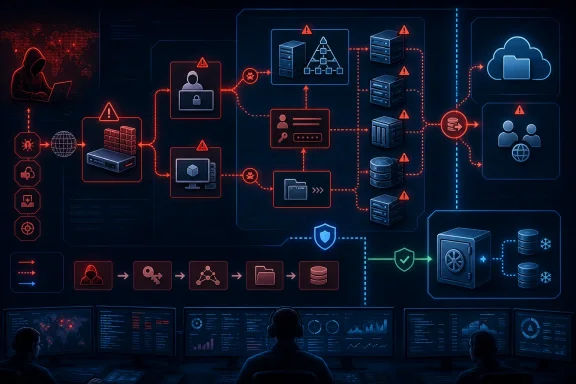 Fortinet exposure is the first incident-response priority
The advisory identifies CVE-2024-55591 and CVE-2025-24472 as vulnerabilities Gunra operators have used against FortiOS and FortiProxy appliances. Both are authentication-bypass issues, and both have already been tied to attacks in the wild. Administrators running affected internet-facing Fortinet gateways should treat this as an exposure review, rather than merely another item in a patching queue.
The first operational question is whether the organization has every relevant appliance inventoried, patched, and removed from direct exposure where possible. That includes appliances managed by a regional office, a subsidiary, a contractor, or a separate network team. Ransomware incidents repeatedly expose the gap between “the patch was released” and “every externally reachable box was updated and its configuration reviewed.”
The reporting also describes additional Gunra access routes: default credentials, compromised administrator accounts, exposed or mismanaged SSH access, and session theft. In one incident examined by South Korea’s National Police Agency, attackers reportedly manipulated an SSL-VPN appliance to capture credentials and session data from users authenticating to a corporate virtual desktop infrastructure portal. They then used stolen session cookies to impersonate users on the internal network.
This is the important distinction: multi-factor authentication can stop a password-only intrusion, but it cannot rescue an organization after an attacker steals a valid authenticated session or modifies the authentication system itself. The advisory further describes a case where attackers altered authentication-processing files on a VDI portal to accept a Gunra-controlled one-time-password value. Security teams should therefore review the integrity of the appliance and its authentication components, not simply reset passwords and assume the incident is contained.
The Windows estate is where the intrusion becomes destructive
Once inside, Gunra relies on a familiar enterprise attack chain. The joint advisory and coverage from The Hacker News describe use of Impacket’s psexec.py and smbclient.py for movement over SMB, while secretsdump.py is used to extract password hashes from Active Directory domain controllers. The operator then has the means to turn one perimeter compromise into a much wider Windows domain incident.
Impacket itself is a legitimate administrative and testing toolkit, so a detection rule that flags its presence alone will create noise. The meaningful signal is context: a nonstandard host initiating remote service execution over SMB; a privileged account accessing a domain controller outside its usual administrative path; or a newly created remote process followed by archive creation, credential dumping, and bulk file movement. Those are the sequences defenders need to hunt.
Gunra has reportedly used Impacket alongside Mimikatz, Rclone, FileZilla, 7-Zip, AnyDesk, and Sliver. Several of those tools have legitimate uses, especially 7-Zip and remote-support software, but their combination in an unusual administrative session should be treated as suspicious. A Windows environment that lets any local administrator run remote-service execution, read directory-service secrets, and reach broad file shares gives a ransomware affiliate everything needed to accelerate from access to impact.
The advisory also describes attackers obtaining credentials from a system access-control server and using them to encrypt database servers and network-attached storage. This illustrates another often-missed recovery problem: Windows administrators may have protected domain controllers and core file servers while overlooking privileged credentials held by building-access, VPN, VDI, backup, monitoring, or identity-adjacent systems.
Segmenting networks means more than dividing workstations from servers. Privileged administration paths, backup infrastructure, virtualization management, storage consoles, identity systems, and remote-access appliances should not all be reachable from the same compromised administrator session.
OneDrive and SharePoint require their own exfiltration review
One of Gunra’s reported tools is a malicious executable named main.exe, used to collect files from Microsoft OneDrive and SharePoint before exfiltration to the MEGA file-sharing service. That detail changes how Microsoft 365 administrators should frame their response. The ransomware payload may land on a Windows host, but the stolen-data problem can extend well beyond the volumes encrypted by the payload.
A OneDrive or SharePoint investigation should begin with the identities that accessed the data, the client applications and devices used, unusual download or synchronization volume, unexpected sharing changes, and anomalous access to high-value sites. The goal is to find the collection stage before focusing only on the final archive transfer. If the attacker obtained a user session or a privileged account with broad Microsoft 365 access, restoring encrypted Windows files does not resolve the disclosure risk.
The same applies to virtual desktop environments. CISA’s advisory says Gunra actors accessed IT personnel’s VDI sessions in at least one case and collected system and network configuration documents. Those documents can make a second-stage attack easier by revealing server names, addressing plans, trust relationships, backup locations, and administrative workflows. They should be classified as sensitive operational data, even if they do not contain customer records.
Microsoft Defender detects the Windows threat under the name Ransom:Win64/Gunra, but Microsoft’s public malware entry provides little behavioral detail beyond detection and removal. That makes endpoint protection useful but insufficient as a primary control. A defender that blocks the encryptor after a domain credential dump and multi-terabyte exfiltration has prevented the visible outage, not necessarily the extortion.
Backup resilience is the point Gunra is designed to test
Gunra follows the now-standard double-extortion pattern: data theft before encryption, a Tor-hosted negotiation portal, and a threat to publish stolen information if the ransom is not paid within five to seven days. CISA says some demands exceeded $10 million. The deadline is designed to compress decision-making after the attackers have already damaged recovery options.
In one case, according to the joint advisory, Gunra operators deleted backup and archived data at both the primary data center and the disaster-recovery site before and after ransomware deployment. That is why “we replicate backups to DR” is not the same as resilience. If the backup system accepts the same identities, trusts the same management plane, or is visible from the same network as production, an attacker who reaches it can turn replication into synchronized destruction.
CISA, the FBI, and their partners recommend offline, immutable backups kept in a physically separate and segmented location. The meaningful test is a restoration exercise: can the organization recover a critical Windows server, a core database, and the configuration information needed to operate them, using backup credentials and infrastructure that an attacker with domain-admin-level access could not alter?
Gunra’s Linux payload deserves a narrow but important caveat. AhnLab reported in October 2025 that an analyzed ELF version used weak random-number generation for its ChaCha20 encryption keys, making recovery possible in many cases. That does not translate into a general Gunra decryptor, and it does not apply to the Windows EXE version AhnLab examined. Its analysis found the Windows payload used a cryptographically secure Windows API for key generation, making practical decryption unavailable without attacker cooperation or a clean backup.
Actions to take before the next access-broker sale
The immediate task is to eliminate the access Gunra’s affiliates are buying and using. That means verifying FortiOS and FortiProxy remediation for CVE-2024-55591 and CVE-2025-24472, reviewing appliance administrator accounts and VPN logs, and invalidating sessions where compromise is suspected. A password reset should be paired with a hunt for altered authentication files, rogue accounts, unexpected SSH configuration, and device-level persistence.
For Windows environments, defenders should prioritize telemetry around domain controllers, VDI infrastructure, backup servers, storage administration, and remote-management hosts. Investigate unusual use of Impacket components, secretsdump.py, remote service creation, bulk 7-Zip archives, Rclone or FileZilla transfers, sudden VSS deletion, and new R3ADM3.txt ransom notes or .ENCRT file extensions. Wazuh has published detection logic specifically keyed to repeated creation of Gunra’s ransom note, although that is a last-stage signal rather than an early warning.
The enduring lesson from this advisory is that Gunra does not need to defeat every Windows endpoint individually. A vulnerable edge appliance or hijacked authenticated session can provide the bridge to Active Directory credentials, cloud collaboration data, backups, and the Windows servers that run the business. Closing that bridge—and proving that backup recovery survives a privileged compromise—is the work that determines whether Gunra becomes a contained intrusion or a company-wide outage.
