
Public Radio of Armenia reported that the event was supported by Armenia’s Ministry of High-Tech Industry and the Agency of Digital Government, and that teams of three or four spent the event developing, testing and presenting LLM-based solutions. AI9 Startup Campus and YerevaNN had separately advertised the August 8–9 event in advance, confirming that Hack Armenia followed the Armenia LLM Summer School held at the same venue during the preceding week.
But the post-event announcement leaves out the facts that would determine whether the exercise produced deployable work: it names no winning teams, projects, source code, evaluation results, datasets, challenge prompt, licensing terms or plan to maintain the prototypes. For an event built around the theme “Evaluate. Reason. Generalize.,” those omissions are material. A demo can show an LLM responding plausibly; it does not show that the system is reliable, affordable, safe with sensitive inputs, or capable of surviving real users and changing data.
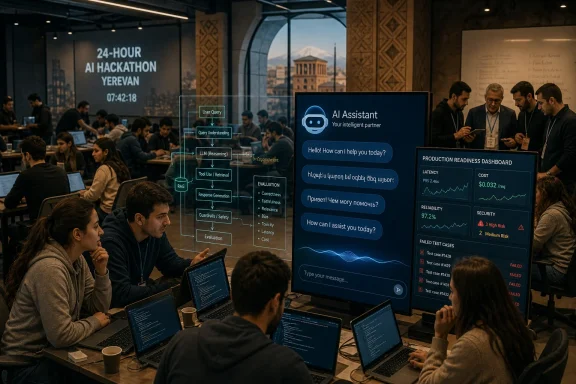 A build sprint attached to an LLM curriculum
Hack Armenia was not advertised as an open-ended startup weekend. In pre-event descriptions, AI9 Startup Campus said the competition would present one real-world LLM challenge at kickoff, with an expected 60 to 80 participants forming 15 to 20 teams and receiving guidance from eight to 15 senior mentors. The public schedule listed a Saturday, August 8 start at 10 a.m. and a Sunday, August 9 finish at 1 p.m.
That schedule creates a small but revealing discrepancy in the event’s branding. It spans 27 clock hours, while organizers and Public Radio of Armenia call it a 24-hour hackathon. The most plausible reading is that teams were given 24 hours to build, with remaining time reserved for setup, judging or demos. Organizers have not published a detailed timetable to settle it. The difference is minor, but it illustrates why results and rules matter when a hackathon is presented as evidence of practical AI capability.
The Summer School connection is more consequential. YerevaNN’s published agenda for the school covered pre-training, scaling laws and mixture-of-experts models; supervised fine-tuning and reinforcement learning; test-time scaling; agents and reasoning; and advanced topics including context management, vision-language-action systems, robotics and world models. A hackathon immediately afterward gives participants a chance to turn those concepts into a workflow rather than treating them as lecture material.
For working IT teams, the useful output from that kind of program would not necessarily be a new foundational model. It would be a narrowly scoped application with an evaluation harness: a retrieval system tested against a known document set, an agent whose tool calls can be audited, a multilingual support workflow with measurable accuracy, or an offline-ready model that works under defined compute limits. The most valuable proof would be the test set and failure analysis, not the presentation deck.
“Evaluate. Reason. Generalize.” sets a higher bar than a chatbot demo
The organizers’ stated theme — “Evaluate. Reason. Generalize.” — points toward a problem that has become central to enterprise LLM deployment. Teams can assemble a polished interface over a hosted model quickly. The difficult work is establishing what the system gets right, what it gets wrong, when it should abstain, and whether its performance holds outside the examples selected for a live demonstration.
Evaluation means creating a repeatable way to test outputs against expected results. For a government-facing assistant, that could mean checking whether answers cite the right policy documents and refuse to invent eligibility rules. For a developer tool, it could mean validating generated code against unit tests and checking whether the agent changes files it was not authorized to touch.
Reasoning is more complicated than asking a model to expose a chain of thought. In production, organizations need observable intermediate work: tool invocations, retrieved records, state changes, approval steps and final outputs. An agent that produces the right answer for the wrong reason is a liability when it can access internal systems, submit forms or alter cloud resources.
Generalization is the most neglected part of short-form AI contests. A solution trained, prompted or demonstrated on a small set of known examples may fail when the language changes, source documents are stale, queries are ambiguous, or a user deliberately tries to bypass instructions. Armenia’s multilingual environment makes this especially relevant: a system that behaves acceptably in English can fall apart across Armenian, Russian and mixed-language prompts unless that variation is part of the evaluation plan.
Hack Armenia’s organizers said judges would consider relevance, technical implementation, measurable results and potential for real-world use. Those are the right categories, but they are categories rather than published evidence. No benchmark scores, latency figures, cost estimates, security assessments or acceptance criteria have been released. Until they are, the public record supports the conclusion that teams completed a rapid prototyping exercise — not that a particular solution is ready for public-sector or commercial deployment.
The prize pool rewards access, not a finished company
Public Radio of Armenia said OpenAI sponsored the principal prizes: $12,000 in API credits for first place, $7,500 for second and $5,000 for third. Eleveight AI added a special prize worth $5,000 in GPU computing resources. The stated pool therefore totals $29,500 in service credits and compute, rather than $29,500 in cash.
That distinction matters for founders and infrastructure teams. API credits can remove the first cost barrier to experimenting with frontier models, while GPU credits can fund fine-tuning, inference tests or self-hosted model evaluation. Neither pays salaries, funds security reviews, covers data labeling, purchases legal advice or sustains a service after promotional credits run out.
Credit-based prizes also steer the kinds of projects teams can sensibly pursue. OpenAI API credit encourages applications built on hosted models and makes it easier to prototype with high-capability systems without procuring hardware. Eleveight AI’s GPU prize supports a different path: model training, local inference, open-weight experimentation or benchmark workloads. The two prizes are complementary, but they create different long-term dependencies.
For a team using hosted APIs, a winning prototype still needs a plan for rate limits, regional data handling, vendor changes, prompt-injection defenses, logging and ongoing token costs. For a team using GPU capacity, the equivalent questions concern model weights, quantization, serving stacks, power and cooling, hardware availability, monitoring and the cost of keeping an endpoint live after the prize allocation is exhausted.
Public Radio of Armenia identified David Zohrabyan of OpenAI as one of the jurors, alongside Acting First Deputy Minister of High-Tech Industry Gevorg Mantashyan, Eleveight AI’s David Arakelyan, AI9’s Ara Hakhverdyan, Magical Labs’ Vazgen Hakobjanyan, Async’s Artavazd Yeritsyan and Evidenso’s Vazgen Badalyan. That mix gives the event representation from government, infrastructure and local startups. It does not, by itself, create a procurement path, incubator placement or investment commitment for winners.
The missing follow-through is now the story
Mantashyan framed the event as an effort to make AI development in Armenia produce working solutions, products and companies rather than remain confined to research and education. The event structure follows that ambition: first teach advanced LLM topics, then put mixed teams under a deadline, give them mentorship, and reward the most compelling demos with compute and model-access credits.
The unresolved issue is what happens after the jury leaves. A 24-hour prototype generally carries accumulated technical debt: hard-coded credentials, unreviewed dependencies, synthetic test cases, missing observability, uncertain data rights and architecture choices made for speed. Those are normal hackathon compromises. They become a problem only when a prototype is presented as a finished solution without an explicit transition into engineering, pilot testing and operations.
The first useful post-event publication would be a project list that names the problem each team addressed, the model or models used, whether private or public data was involved, the evaluation methodology, measured results, costs, known failure modes and the repository or demo status. If the challenge involved public services, the organizers should also say whether any government agency has agreed to trial a winning tool and under what safeguards.
As of August 10, organizers have publicized the participants, jury and prizes, but not the winners or the work itself. Hack Armenia has demonstrated that there is a coordinated venue for LLM talent, mentors, government officials and compute sponsors to meet in Yerevan. Whether it has produced the practical solutions promised in its name will depend on what the teams publish and maintain after the 24-hour clock has run out.