
HackerNoon’s Learn Repo has published a list of 74 “most read” full-stack development posts, but its August 3, 2026 collection is a popularity-ranked archive rather than a maintained learning path. The distinction is important for developers who arrive expecting a current curriculum: the first-ranked entry is a 2022 services-company pitch about hiring developers, while several later entries point to technology choices, APIs, and frameworks whose instructions need independent verification before use.
HackerNoon says the selection is ordered by reader engagement data. Its own Learn profile describes the ordering as reading time, while HackerNoon’s GitHub organization describes Learn Repo paths as ordered by reading time and editor ranking. Those are materially different methods, and the new full-stack list does not disclose the measurement window, the weighting of editorial decisions, the minimum engagement needed to qualify, or whether old articles receive any freshness adjustment.
That leaves a useful discovery index — and a poor substitute for documentation, version-tested tutorials, or a sequence designed to take someone from HTML to deployment.
The top-ranked post, “Choosing Between Front-End, Back-End & Full Stack Developers,” was published by software-services firm Systango on September 26, 2022. Its purpose is evident in the source material: it frames a comparison of staffing models around a call to hire Systango’s developers, with repeated invitations to contact the company.
There is nothing inherently improper about a company explaining how it sells development services. The problem is placement and labeling. A learner opening a collection billed as 74 free blog posts “to learn about Full Stack Development” sees this sales-led article at No. 1, ahead of practical pieces on testing, authentication, databases, debugging, version control, and application setup.
The underlying Systango article does include some usable baseline distinctions between front-end, back-end, and full-stack work. But it also shows why engagement is not equivalent to technical currency or instructional value. Its skills lists lean on AngularJS, jQuery, CMS products, and framework groupings that require much more context in 2026 than the article supplies. It describes “Ruby on Rails” as a stack consisting of “Ruby, SQLite, PHP,” an obvious category error: Rails is a Ruby web framework, while PHP is a separate language.
For a manager choosing staff augmentation, the post may still be a starting point for a conversation about project scope. For a developer learning to build software, it should not be the starting point.
Those subjects belong around full-stack development. They do not form a coherent course.
The ranking also includes job-description explainers, course reviews, workplace-culture advice, freelancer-hiring guidance, personal career narratives, an executive profile, and opinion pieces about whether developers are really full stack. A beginner could work through posts on CSS gradients, a “checkerboard” Rails assignment, and a Git “unrelated histories” fix without ever receiving a structured explanation of threat modeling, secrets management, database migrations, accessibility, observability, deployment, backups, or production incident response.
Those omissions are not a criticism of any one contributor. They are the consequence of the product design. HackerNoon’s own Help Center describes Learn as a way to surface stories favored by readers through tag pages, and says new scan-friendly listicles are produced daily. That is a content-retrieval system. It has not been presented as a versioned syllabus with prerequisites, labs, review dates, or an accountable maintainer for each recommendation.
A reader should treat the 74 entries as search leads. Pick a subject, locate the original publication date, check package and platform documentation, and build a small current project around the idea. Reading from No. 1 to No. 74 would create a distorted picture of what “full stack” means.
That is more than cosmetic. Authentication is one of the few topics where a learning collection should make the destination unambiguous. Instead, the reader gets an orphaned description and no visible title in the list itself. HackerNoon has not explained whether the original post was removed, de-indexed, or simply failed to render.
The issue undercuts the premise that the page is a dependable map of the tag. A ranked catalog needs stable identifiers, working links, dates, and a way to distinguish removed or superseded material. This one gives readers a numbered sequence, then leaves a hole in it.
The page also makes no distinction between tutorial code, product-backed guides, and sponsored or interested parties. That information can exist on individual story pages but is not carried into the ranking. The result is that readers must perform their own provenance check after clicking through — precisely when a curated learning list should be doing more of that work upfront.
Its inclusion is not a reason to dismiss the article. Product-specific guides can be valuable, especially when they provide a working reference implementation. But the code displayed in the article contains problems that a learner cannot safely ignore. One handler returns
This is the central consequence of HackerNoon’s approach: engagement can surface an interesting idea, but it cannot certify that code still compiles, dependencies still resolve, a hosted service still exists, or a security-sensitive implementation remains sound.
The same applies to the list’s older explicitly dated material. “10 Best Courses To Learn Spring Boot for Full Stack Java Developers” says it is about Spring Boot in 2020. “10 Static Site Generators to Watch in 2020” is also carried into the 2026 collection. “How to Transition from Full-Stack Developer to Web3 Pioneer in 2022” and a course review framed around 2023 remain part of the result set. Historical posts can offer useful concepts; they should be visibly marked as historical before they are presented beside newer subjects such as RAG applications and AI coding tools.
It would also need three metadata fields HackerNoon’s list does not expose:
For anyone building software on Windows, the operational takeaway is simple: use the 74-post list to find topics, then validate every command, package, cloud integration, authentication pattern, and code sample in a current local project. The collection can help decide what to investigate; it cannot be allowed to decide what reaches production.
That leaves a useful discovery index — and a poor substitute for documentation, version-tested tutorials, or a sequence designed to take someone from HTML to deployment.
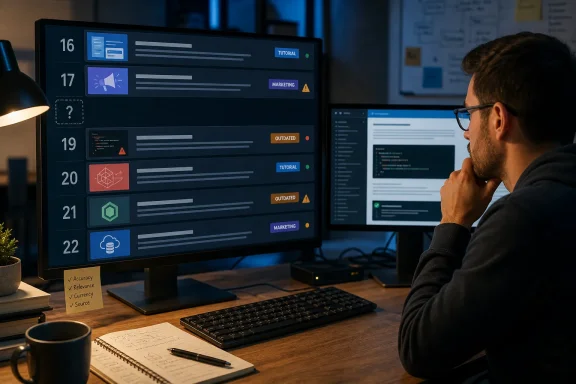 The No. 1 Result Is a Vendor’s Hiring Pitch
The top-ranked post, “Choosing Between Front-End, Back-End & Full Stack Developers,” was published by software-services firm Systango on September 26, 2022. Its purpose is evident in the source material: it frames a comparison of staffing models around a call to hire Systango’s developers, with repeated invitations to contact the company.There is nothing inherently improper about a company explaining how it sells development services. The problem is placement and labeling. A learner opening a collection billed as 74 free blog posts “to learn about Full Stack Development” sees this sales-led article at No. 1, ahead of practical pieces on testing, authentication, databases, debugging, version control, and application setup.
The underlying Systango article does include some usable baseline distinctions between front-end, back-end, and full-stack work. But it also shows why engagement is not equivalent to technical currency or instructional value. Its skills lists lean on AngularJS, jQuery, CMS products, and framework groupings that require much more context in 2026 than the article supplies. It describes “Ruby on Rails” as a stack consisting of “Ruby, SQLite, PHP,” an obvious category error: Rails is a Ruby web framework, while PHP is a separate language.
For a manager choosing staff augmentation, the post may still be a starting point for a conversation about project scope. For a developer learning to build software, it should not be the starting point.
The List Mixes Tutorials, Career Posts, Product Marketing, and Biography
HackerNoon’s list has genuine technical range. The early entries include React Native map performance, a Node.js-and-Angular password-reset tutorial, Google Sign-In for Flutter Web, Postgres connectivity, Rails database seeding, MERN testing, React/Redux with Rails, static-site generators, GraphQL, and PostgreSQL versus MySQL. Later entries span AWS Cognito authentication, full-stack debugging, React Hooks, Git troubleshooting, Laravel Livewire, Django versus Laravel, and a Next.js retrieval-augmented generation chatbot.Those subjects belong around full-stack development. They do not form a coherent course.
The ranking also includes job-description explainers, course reviews, workplace-culture advice, freelancer-hiring guidance, personal career narratives, an executive profile, and opinion pieces about whether developers are really full stack. A beginner could work through posts on CSS gradients, a “checkerboard” Rails assignment, and a Git “unrelated histories” fix without ever receiving a structured explanation of threat modeling, secrets management, database migrations, accessibility, observability, deployment, backups, or production incident response.
Those omissions are not a criticism of any one contributor. They are the consequence of the product design. HackerNoon’s own Help Center describes Learn as a way to surface stories favored by readers through tag pages, and says new scan-friendly listicles are produced daily. That is a content-retrieval system. It has not been presented as a versioned syllabus with prerequisites, labs, review dates, or an accountable maintainer for each recommendation.
A reader should treat the 74 entries as search leads. Pick a subject, locate the original publication date, check package and platform documentation, and build a small current project around the idea. Reading from No. 1 to No. 74 would create a distorted picture of what “full stack” means.
The Ranking Has a Visible Data-Quality Gap
There is a smaller but revealing defect in the published page. The numbering moves from No. 17, “Developers Should Drive Their E2E Tests to Cypress,” to No. 19, a Next.js Amazon clone. Between them, the page displays the description “Cookies-Based Authentication Vs. Session-Based Authentication: All You Should Know!” but does not render the No. 18 heading or article link alongside it.That is more than cosmetic. Authentication is one of the few topics where a learning collection should make the destination unambiguous. Instead, the reader gets an orphaned description and no visible title in the list itself. HackerNoon has not explained whether the original post was removed, de-indexed, or simply failed to render.
The issue undercuts the premise that the page is a dependable map of the tag. A ranked catalog needs stable identifiers, working links, dates, and a way to distinguish removed or superseded material. This one gives readers a numbered sequence, then leaves a hole in it.
The page also makes no distinction between tutorial code, product-backed guides, and sponsored or interested parties. That information can exist on individual story pages but is not carried into the ranking. The result is that readers must perform their own provenance check after clicking through — precisely when a curated learning list should be doing more of that work upfront.
A 2024 RAG Tutorial Shows Why Click-Through Verification Is Mandatory
The collection’s No. 56 entry, “Creating a RAG chatbot with NextJS, OpenAI & Dewy,” illustrates the practical risk. HackerNoon identifies it as a February 2024 guide by a contributor to Dewy KB and Kaskada; its individual page carries a “Vested Interest” indicator as well as an “AI-assisted” label. Neither disclosure appears in the 74-post index.Its inclusion is not a reason to dismiss the article. Product-specific guides can be valuable, especially when they provide a working reference implementation. But the code displayed in the article contains problems that a learner cannot safely ignore. One handler returns
NextResponse.json without showing an import for NextResponse; it references result.id even though the variable created is named document; and its chat-message example contains malformed JavaScript syntax. The guide also specifies a particular OpenAI model and an older API style, which demands a check against current vendor documentation before a new application is built around it.This is the central consequence of HackerNoon’s approach: engagement can surface an interesting idea, but it cannot certify that code still compiles, dependencies still resolve, a hosted service still exists, or a security-sensitive implementation remains sound.
The same applies to the list’s older explicitly dated material. “10 Best Courses To Learn Spring Boot for Full Stack Java Developers” says it is about Spring Boot in 2020. “10 Static Site Generators to Watch in 2020” is also carried into the 2026 collection. “How to Transition from Full-Stack Developer to Web3 Pioneer in 2022” and a course review framed around 2023 remain part of the result set. Historical posts can offer useful concepts; they should be visibly marked as historical before they are presented beside newer subjects such as RAG applications and AI coding tools.
What a Usable Full-Stack Reading Plan Would Add
A practical collection for developers would organize material by dependency rather than popularity: browser fundamentals; HTTP and API design; server-side programming; relational data modeling; identity and authorization; automated testing; source control; CI/CD; deployment; monitoring; and security maintenance. It would then identify one current stack per track — for example, .NET with ASP.NET Core, Node.js with a maintained framework, Java with Spring Boot, Python with Django or FastAPI, or PHP with Laravel — instead of moving indiscriminately between every stack readers have engaged with over several years.It would also need three metadata fields HackerNoon’s list does not expose:
- Each post should show its publication date, last technical review date, and the language or framework versions it was tested against.
- Posts written by vendors, product contributors, or companies seeking development business should be labeled in the index, rather than only on destination pages.
- Broken, unlinked, or removed entries should preserve their number and status instead of leaving an unexplained gap in a sequential list.
For anyone building software on Windows, the operational takeaway is simple: use the 74-post list to find topics, then validate every command, package, cloud integration, authentication pattern, and code sample in a current local project. The collection can help decide what to investigate; it cannot be allowed to decide what reaches production.
References
- Primary source: HackerNoon
Published: 2026-08-03T00:00:00+00:00
Loading…
hackernoon.com - Related coverage: hackernoon.com
465 Blog Posts To Learn About Education | HackerNoon
Learn everything you need to know about Education via these 465 free HackerNoon blog posts.hackernoon.com - Related coverage: learnrepo.com
89 Stories To Learn About Tech
 www.learnrepo.com
- Related coverage: learntoearnlabs.com
Loading…
learntoearnlabs.com