
Half-Life 2: VR Mod has received a Steam Frame Verified rating after an update that targets the difficult part of Valve’s new headset proposition: running a Windows-era, x86 VR game on the headset itself, rather than merely streaming it from a gaming PC. The patch is live now for the free Steam mod, although players still must own Half-Life 2 on Steam; Family Sharing does not meet that entitlement requirement.
GamingOnLinux first reported the upgrade, citing the Source VR Mod Team’s account of a long testing cycle that began with the mod failing to launch on Steam Frame, progressed through poor performance and bugs, and ended with controller work, frame-timing optimization, and eye-tracked foveated rendering. SteamDB’s current compatibility record independently shows Valve tested build 24475922 on August 3 and assigned the game the Verified category, including passing controller, text-legibility, and default-performance checks.
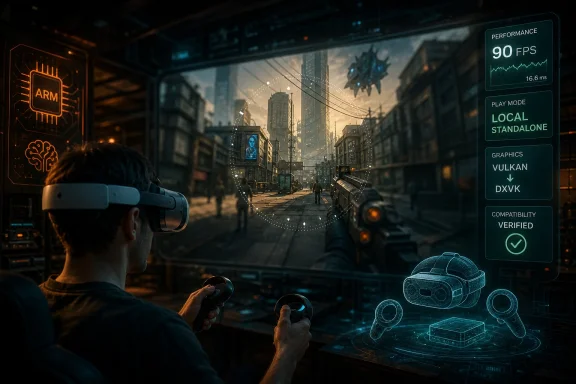
The key qualification is easy to miss: Steam Frame Verified is a standalone certification, not a statement about PC streaming. Valve’s Steamworks documentation says Steam Frame has no separate Verified program for streamed games; if a title runs properly on the host PC, streaming it to the headset does not require special integration.
For Half-Life 2: VR Mod, the badge therefore says more than “this works with a new headset.” Valve’s published target for standalone VR verification is 90 frames per second, with working Steam Frame controller input and readable interface elements. The mod has cleared that bar on a headset built around a Snapdragon 8-series ARM processor with 16GB of memory, according to Valve’s Steam Frame product information.
That turns a useful older PCVR title into an early proof point for the platform’s local-game strategy. Half-Life 2 was never designed around mobile-class ARM hardware, and the VR mod adds tracked hands, physical reloading, two-handed weapon handling, room-scale interaction, and more demanding presentation requirements than the original keyboard-and-mouse game. The team’s reported need to optimize frame timing is precisely what certification is meant to expose: average frame rate is not enough in VR when intermittent missed frames can make the headset view uncomfortable.
The distinction also changes the buying calculation. Existing SteamVR users who plan to stream from a capable Windows or Linux PC do not need this patch specifically to make Half-Life 2: VR Mod usable on Steam Frame. Those who want the headset to run the game without a PC host are the people who benefit directly.
Foveated rendering reduces rendering work outside the point where the player is looking, preserving the highest detail in the foveal region while lowering the cost of peripheral pixels. In a game based on Valve’s older Source engine, that can be more practical than attempting a wholesale rewrite of rendering code or aggressively cutting image quality everywhere. It also depends on the Steam Frame’s eye tracking functioning correctly and on the mod’s gaze-driven rendering behavior holding up across its varied outdoor maps, combat scenes, vehicle sequences, and loading transitions.
The team did not publish a preset-by-preset performance table, resolution target, battery-life estimate, or comparison against a streamed PC version. So Verified should be read as Valve’s compatibility determination under the tested default configuration, not a guarantee that every enthusiast setting, texture pack, Workshop mod, or custom launch option will retain the same performance margin.
That limitation is especially relevant for Half-Life 2: VR Mod because it has an active modding community of its own. The Steam listing exposes Workshop support, while the mod’s official help pages warn that users can encounter rough edges inherent to a fan-made project. Steam Frame Verified validates the shipped build, not every altered installation a player can assemble afterward.
Valve’s Steam Frame developer documentation explicitly supports Windows and Linux PC titles alongside native ARM64 and Android applications. Its technical material also describes FEX as the component that enables x86 games to run on the Steam Frame’s ARM chip. In that context, updating DXVK is not a minor maintenance item: it is part of the graphics path that determines whether a legacy Direct3D game starts cleanly and renders acceptably on the standalone device.
The patch also claims significantly improved performance on lower-end CPUs. That can help conventional PCVR users, but its more consequential role is likely on Steam Frame, where CPU overhead from game logic, VR tracking, graphics translation, and frame delivery must all fit within a much tighter power envelope than a desktop. The team’s account makes clear that optimizing the GPU side alone was not sufficient.
Linux players get a more direct fix as well. The update includes a potential startup fix for the Episodes on Linux, while GamingOnLinux noted the base mod has historically been used through Proton rather than offered as a native Linux build. SteamDB still lists Half-Life 2: VR Mod as a Windows-supported title and recommends Proton Stable in its compatibility metadata.
That is the practical discrepancy behind this release: the game is Steam Frame Verified without becoming a native Linux or ARM port. Valve’s compatibility stack is doing substantial work beneath it. For users, the result may feel native enough—a local install, headset controllers, and no desktop PC streaming requirement—but it remains a compatibility-tested Windows game rather than a newly compiled SteamOS edition.
The new Steam Frame controller bindings are the most obvious device-specific addition, but the patch also improves the general interaction model. Controller poses have been smoothed, the gravity gun can display a weapon laser when that option is enabled, and the crossbow now has a sniper scope plus stabilization when held with both hands. Those are meaningful refinements for existing PCVR headsets as well, particularly for a game whose weapon design predates motion controls by more than a decade.
There is no sign that the update changes the mod’s commercial model or ownership requirement. Half-Life 2: VR Mod remains free, is published by Flat2VR Studios and developed by the Source VR Mod Team, and requires a separately owned copy of Half-Life 2. Valve’s store page also makes clear that the mod was not created by Valve.
The immediate consequence is simple: Steam Frame owners can now install Half-Life 2: VR Mod locally with a formal compatibility result behind it, while current SteamVR players receive the same bug fixes and interaction improvements. The more revealing outcome is that a community-made 2022 mod has become one of the early standalone tests of whether Valve’s ARM-based SteamOS VR platform can carry forward the existing PCVR catalog without requiring every developer to produce a native port.
 Steam Frame Verified applies to standalone play
The key qualification is easy to miss: Steam Frame Verified is a standalone certification, not a statement about PC streaming. Valve’s Steamworks documentation says Steam Frame has no separate Verified program for streamed games; if a title runs properly on the host PC, streaming it to the headset does not require special integration.For Half-Life 2: VR Mod, the badge therefore says more than “this works with a new headset.” Valve’s published target for standalone VR verification is 90 frames per second, with working Steam Frame controller input and readable interface elements. The mod has cleared that bar on a headset built around a Snapdragon 8-series ARM processor with 16GB of memory, according to Valve’s Steam Frame product information.
That turns a useful older PCVR title into an early proof point for the platform’s local-game strategy. Half-Life 2 was never designed around mobile-class ARM hardware, and the VR mod adds tracked hands, physical reloading, two-handed weapon handling, room-scale interaction, and more demanding presentation requirements than the original keyboard-and-mouse game. The team’s reported need to optimize frame timing is precisely what certification is meant to expose: average frame rate is not enough in VR when intermittent missed frames can make the headset view uncomfortable.
The distinction also changes the buying calculation. Existing SteamVR users who plan to stream from a capable Windows or Linux PC do not need this patch specifically to make Half-Life 2: VR Mod usable on Steam Frame. Those who want the headset to run the game without a PC host are the people who benefit directly.
Foveated rendering was the final performance lever
The Source VR Mod Team says its testing reached “playable” performance before it consistently met the required frame times, and that eye-tracked foveated rendering helped push the build over the line. That is a material technical detail rather than a fashionable checkbox.Foveated rendering reduces rendering work outside the point where the player is looking, preserving the highest detail in the foveal region while lowering the cost of peripheral pixels. In a game based on Valve’s older Source engine, that can be more practical than attempting a wholesale rewrite of rendering code or aggressively cutting image quality everywhere. It also depends on the Steam Frame’s eye tracking functioning correctly and on the mod’s gaze-driven rendering behavior holding up across its varied outdoor maps, combat scenes, vehicle sequences, and loading transitions.
The team did not publish a preset-by-preset performance table, resolution target, battery-life estimate, or comparison against a streamed PC version. So Verified should be read as Valve’s compatibility determination under the tested default configuration, not a guarantee that every enthusiast setting, texture pack, Workshop mod, or custom launch option will retain the same performance margin.
That limitation is especially relevant for Half-Life 2: VR Mod because it has an active modding community of its own. The Steam listing exposes Workshop support, while the mod’s official help pages warn that users can encounter rough edges inherent to a fan-made project. Steam Frame Verified validates the shipped build, not every altered installation a player can assemble afterward.
DXVK and CPU work explain why the patch matters outside Steam Frame
The release includes an updated built-in DXVK version, a change the team says may solve startup failures. DXVK translates Direct3D calls to Vulkan, making it a strategically important component for Windows games being run through SteamOS compatibility layers rather than on native Windows.Valve’s Steam Frame developer documentation explicitly supports Windows and Linux PC titles alongside native ARM64 and Android applications. Its technical material also describes FEX as the component that enables x86 games to run on the Steam Frame’s ARM chip. In that context, updating DXVK is not a minor maintenance item: it is part of the graphics path that determines whether a legacy Direct3D game starts cleanly and renders acceptably on the standalone device.
The patch also claims significantly improved performance on lower-end CPUs. That can help conventional PCVR users, but its more consequential role is likely on Steam Frame, where CPU overhead from game logic, VR tracking, graphics translation, and frame delivery must all fit within a much tighter power envelope than a desktop. The team’s account makes clear that optimizing the GPU side alone was not sufficient.
Linux players get a more direct fix as well. The update includes a potential startup fix for the Episodes on Linux, while GamingOnLinux noted the base mod has historically been used through Proton rather than offered as a native Linux build. SteamDB still lists Half-Life 2: VR Mod as a Windows-supported title and recommends Proton Stable in its compatibility metadata.
That is the practical discrepancy behind this release: the game is Steam Frame Verified without becoming a native Linux or ARM port. Valve’s compatibility stack is doing substantial work beneath it. For users, the result may feel native enough—a local install, headset controllers, and no desktop PC streaming requirement—but it remains a compatibility-tested Windows game rather than a newly compiled SteamOS edition.
The quality-of-life fixes are aimed at actual VR friction
Several changes address failures that are disproportionately disruptive in VR. Loading screens are now visible in the headset, hands should no longer vanish while holding an object, and the team has added a potential fix for a headset view that shakes while traversing uneven ground. A flat-screen player might dismiss those as small defects; in VR, they can break orientation, conceal game state, or simply make an extended session unpleasant.The new Steam Frame controller bindings are the most obvious device-specific addition, but the patch also improves the general interaction model. Controller poses have been smoothed, the gravity gun can display a weapon laser when that option is enabled, and the crossbow now has a sniper scope plus stabilization when held with both hands. Those are meaningful refinements for existing PCVR headsets as well, particularly for a game whose weapon design predates motion controls by more than a decade.
There is no sign that the update changes the mod’s commercial model or ownership requirement. Half-Life 2: VR Mod remains free, is published by Flat2VR Studios and developed by the Source VR Mod Team, and requires a separately owned copy of Half-Life 2. Valve’s store page also makes clear that the mod was not created by Valve.
The immediate consequence is simple: Steam Frame owners can now install Half-Life 2: VR Mod locally with a formal compatibility result behind it, while current SteamVR players receive the same bug fixes and interaction improvements. The more revealing outcome is that a community-made 2022 mod has become one of the early standalone tests of whether Valve’s ARM-based SteamOS VR platform can carry forward the existing PCVR catalog without requiring every developer to produce a native port.
References
- Primary source: gamingonlinux.com
Published: 2026-08-05T12:23:21+00:00
Loading…
www.gamingonlinux.com - Related coverage: gamingonlinux.com
Loading…
www.gamingonlinux.com - Related coverage: pcgamingwiki.com
Loading…
www.pcgamingwiki.com - Related coverage: neykrusakab.weebly.com
Loading…
neykrusakab.weebly.com - Related coverage: pcgamer.com
Loading…
www.pcgamer.com - Related coverage: gamesradar.com
Valve assures everyone on the Steam Machine reservation list they "will have the option to purchase by the end of this year" | GamesRadar+
Valve has published a blog post saying that everyone currently on the reserve list for its new Steam Machine will have the chance to purchase one before 2027.www.gamesradar.com - Related coverage: t3.com
Loading…
www.t3.com - Related coverage: store.steampowered.com
Loading…
store.steampowered.com - Related coverage: store.steampowered.com
Loading…
store.steampowered.com - Related coverage: tomsguide.com
'My wallet gonna cry': Valve gives official update on Steam Machine and Steam Frame launch, but still won't tell us the price | Tom's Guide
Valve announces a Steam Machine and Steam Frame launch update the week of Summer Games Fest but neglects to mention pricing.www.tomsguide.com - Related coverage: pcgamer.com
Valve announces the Steam Frame: 'a new way to play your entire Steam library' | PC Gamer
Wireless connectivity, improved optics, new controllers and a chip all of its own, the Steam Frame looks to be worth the wait.www.pcgamer.com - Related coverage: tomshardware.com
Valve details new game verification system for upcoming Steam Frame and Steam Machine — 30 FPS at 1080p for Steam Frame Verified, same as Steam Deck | Tom's Hardware
But every game will be retested for the Steam Frame.www.tomshardware.com - Related coverage: windowscentral.com
Valve confirms its Steam Machine PC and Steam Frame VR are still "shipping this summer" — without a whiff of any prices | Windows Central
Valve has reaffirmed its summer launch plans for Steam Machine and Steam Frame, but costs remain a complete mystery.www.windowscentral.com - Related coverage: techradar.com
Steam Frame official – 7 things you need to know about Valve's Quest 3 rival | TechRadar
The Steam Frame has landed to take on the Quest 3www.techradar.com - Related coverage: as.com
Valve rompe su silencio sobre el lanzamiento de Steam Machine, pero sigue sin responder la gran pregunta de los jugadores - Meristation
Valve rompe su silencio sobre Steam Machine y confirma que saldrá en verano, pero sigue sin responder la pregunta más importante de los usuarios.as.com