
Hexaware Technologies says it has joined the Microsoft Intelligent Security Association, or MISA, positioning its Azure and Microsoft 365 security services alongside Microsoft’s partner security ecosystem. But the announcement circulating on August 6 contains a material sourcing problem: the BSE-linked language and the Microsoft quote attached to Hexaware closely track a June 29, 2026 Mphasis MISA announcement, while neither Microsoft’s public MISA material nor Hexaware’s public Marketplace presence currently substantiates the specific security offer described.
For IT buyers, that changes how this should be read. A MISA membership can be commercially meaningful—Microsoft limits the program to nominated partners that meet prescribed marketplace, integration, and security-practice requirements. It does not, by itself, demonstrate that a particular managed security service is available, independently validated, priced, or ready to operate in a customer’s tenant.
Microsoft’s MISA overview says membership is nomination-only. A services partner must hold a Microsoft Security Solutions Partner designation, have at least two security specializations, participate in Microsoft go-to-market programs, and publish a managed-security offer using qualifying Microsoft Security products in the commercial marketplace. Microsoft sets a separate route for software developers, requiring a commercial-marketplace solution integrated with at least two qualifying Microsoft Security products.
The submitted announcement says Hexaware’s offering provides unified XDR, SIEM, cloud security, assessment, attack validation, and compliance analysis for Azure and Microsoft 365, built with Microsoft Security technology and its Tensai Security Ops framework. Those are substantial claims. The public record checked on August 6 does not identify the exact commercial-marketplace listing, the Microsoft products integrated, supported regions, service-level commitments, customer onboarding model, or what security operations responsibility Hexaware is taking on.
The supplied item attributes the announcement to BSE. The relevant exchange filing that can be independently verified is from Mphasis Limited, dated June 29, 2026—not Hexaware—and it is explicit about the company, its BSE code, and the services involved.
Mphasis’ filing says it joined MISA on the back of Managed Security Services, Cyber Fusion Center services, and consulting built around Microsoft Sentinel, Entra, Intune, Purview, Defender, and Microsoft 365 Copilot. Its managed service is described as a marketplace offering covering threat protection, detection, investigation, and response across endpoints, identity, data, cloud applications, and infrastructure.
The strongest warning sign is the Maria Thomson quotation. In the Mphasis exchange filing, Microsoft’s MISA director says: “Our members, like Mphasis, share Microsoft’s commitment” to improving customers’ ability to predict, detect, and respond to threats. The Hexaware item uses the same sentence structure but substitutes “Hexaware” for “Mphasis.”
That does not prove Hexaware is not a MISA member. It does show the circulated report cannot be treated as a clean primary announcement for Hexaware without a matching company filing, Microsoft partner-catalog entry, or a named Marketplace offer. As of August 6, no second outlet has independently reported the claimed Hexaware admission or its stated timing.
This is more than a cosmetic attribution error. Public-company exchange disclosures are formal records. If a security partnership is being presented as a BSE-sourced development, the company name, filing date, offer name, and service description need to match the filing—not a different IT-services company’s June announcement.
The company’s description is service-led: assessments, Zero Trust work, identity and access management, monitoring, security operations automation, compliance support, and implementation. It says it uses Microsoft Sentinel for SIEM and SOAR capabilities, Microsoft Defender XDR for cross-domain detection and response, and Microsoft Security Copilot in security operations scenarios.
Those claims establish that Hexaware has a Microsoft-aligned security services portfolio. They do not establish the particular marketplace-managed security product asserted in the MISA item. There is an important operational difference between a consultancy or systems integrator able to deploy Sentinel and Defender, and an MSSP with a defined, commercialized 24/7 service that has published its scope, response workflow, coverage hours, data-residency terms, and support escalation path.
Hexaware’s public Tensai platform is also broader than security operations. The company presents Tensai as an automation suite spanning IT operations, quality assurance, cloud operations, generative AI, and digital workplace functions. Tensai can be part of a security delivery framework, but calling it “Tensai Security Ops” does not identify a standalone product, licensing model, or Microsoft Marketplace SKU.
It is not presented as the Azure-and-Microsoft-365 managed security service described in the submitted item. The Marketplace page says nothing about Sentinel, Defender XDR, Microsoft Purview, Microsoft Entra, managed detection and response, or a Zero Trust security-operations service.
The timing also matters. The listing was already publicly discoverable months before the August 6 report. So even if Hexaware’s existing Marketplace activity satisfies part of a partner-program requirement, it does not support the claim that its comprehensive security solution is now listed as part of the alleged MISA development.
Microsoft’s MISA rules do require a Marketplace presence, but the published rules do not say that any pre-existing Marketplace offer automatically qualifies a services provider for admission. For the services path, Microsoft specifically calls for a managed-security offering using qualifying Microsoft Security products. Without the actual offer page, customers cannot determine whether Hexaware meets that requirement through a separate private offer, a not-yet-indexed listing, or a service offering not described in the circulated article.
For a Windows, Microsoft 365, or Azure administrator, that is a procurement and operations consideration rather than a new feature landing in the tenant. No policy appears automatically, no Defender capability is unlocked, and no incident-response coverage materializes because a provider carries a MISA badge.
Before treating Hexaware as a potential security-operations provider, organizations should request the evidence missing from the announcement:
Until then, the defensible conclusion is narrow. Hexaware demonstrably markets Microsoft-focused cybersecurity and automation services, and MISA membership is consistent with that direction. But the August 6 report’s claimed BSE origin, offer description, and Microsoft endorsement are undermined by their overlap with Mphasis’ verified June 29 filing.
For prospective customers, do not treat this announcement as proof that a new Hexaware managed security product is available in Microsoft Marketplace. Treat it as a partnership claim awaiting a primary record—and insist on the operational details before handing over Sentinel access, Defender telemetry, identity logs, or incident-response authority.
That is a more direct company-attributed record than the earlier BSE-linked item, but it does not independently resolve the core procurement questions. The release still does not name or link the claimed Microsoft Marketplace security offer, identify its supported Microsoft Security integrations in detail, or publish service scope, coverage hours, regions, pricing, or operational responsibilities.
The Maria Thomson quotation remains materially similar to the wording used in Mphasis’ June 29 announcement, including the company-name substitution. Prospective customers should therefore treat the PRNewswire release as confirmation of Hexaware’s own membership claim—not as proof that a specific managed-security service is publicly purchasable or ready for tenant access.
Microsoft’s MISA overview says membership is nomination-only. A services partner must hold a Microsoft Security Solutions Partner designation, have at least two security specializations, participate in Microsoft go-to-market programs, and publish a managed-security offer using qualifying Microsoft Security products in the commercial marketplace. Microsoft sets a separate route for software developers, requiring a commercial-marketplace solution integrated with at least two qualifying Microsoft Security products.
The submitted announcement says Hexaware’s offering provides unified XDR, SIEM, cloud security, assessment, attack validation, and compliance analysis for Azure and Microsoft 365, built with Microsoft Security technology and its Tensai Security Ops framework. Those are substantial claims. The public record checked on August 6 does not identify the exact commercial-marketplace listing, the Microsoft products integrated, supported regions, service-level commitments, customer onboarding model, or what security operations responsibility Hexaware is taking on.
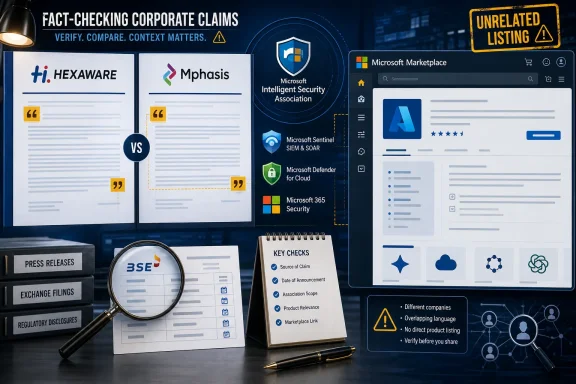 The BSE attribution points to Mphasis, not Hexaware
The supplied item attributes the announcement to BSE. The relevant exchange filing that can be independently verified is from Mphasis Limited, dated June 29, 2026—not Hexaware—and it is explicit about the company, its BSE code, and the services involved.Mphasis’ filing says it joined MISA on the back of Managed Security Services, Cyber Fusion Center services, and consulting built around Microsoft Sentinel, Entra, Intune, Purview, Defender, and Microsoft 365 Copilot. Its managed service is described as a marketplace offering covering threat protection, detection, investigation, and response across endpoints, identity, data, cloud applications, and infrastructure.
The strongest warning sign is the Maria Thomson quotation. In the Mphasis exchange filing, Microsoft’s MISA director says: “Our members, like Mphasis, share Microsoft’s commitment” to improving customers’ ability to predict, detect, and respond to threats. The Hexaware item uses the same sentence structure but substitutes “Hexaware” for “Mphasis.”
That does not prove Hexaware is not a MISA member. It does show the circulated report cannot be treated as a clean primary announcement for Hexaware without a matching company filing, Microsoft partner-catalog entry, or a named Marketplace offer. As of August 6, no second outlet has independently reported the claimed Hexaware admission or its stated timing.
This is more than a cosmetic attribution error. Public-company exchange disclosures are formal records. If a security partnership is being presented as a BSE-sourced development, the company name, filing date, offer name, and service description need to match the filing—not a different IT-services company’s June announcement.
Hexaware already markets Microsoft-oriented security work
Hexaware does have a public Microsoft security practice, so the broader premise is plausible. In a February 2026 article on its own site, Hexaware described deployments and advisory work using Microsoft Sentinel, Microsoft Defender XDR, Defender for Cloud, Entra ID, Purview, Priva, Azure Backup, and Site Recovery. It frames that work around NIST Cybersecurity Framework 2.0 functions and combines Microsoft tooling with its Tensai automation platform.The company’s description is service-led: assessments, Zero Trust work, identity and access management, monitoring, security operations automation, compliance support, and implementation. It says it uses Microsoft Sentinel for SIEM and SOAR capabilities, Microsoft Defender XDR for cross-domain detection and response, and Microsoft Security Copilot in security operations scenarios.
Those claims establish that Hexaware has a Microsoft-aligned security services portfolio. They do not establish the particular marketplace-managed security product asserted in the MISA item. There is an important operational difference between a consultancy or systems integrator able to deploy Sentinel and Defender, and an MSSP with a defined, commercialized 24/7 service that has published its scope, response workflow, coverage hours, data-residency terms, and support escalation path.
Hexaware’s public Tensai platform is also broader than security operations. The company presents Tensai as an automation suite spanning IT operations, quality assurance, cloud operations, generative AI, and digital workplace functions. Tensai can be part of a security delivery framework, but calling it “Tensai Security Ops” does not identify a standalone product, licensing model, or Microsoft Marketplace SKU.
The Marketplace evidence does not match the claimed offer
Microsoft Marketplace does show a Hexaware Technologies listing for tensai GenAI-based Knowledge Ecosystem. That offer is an Azure OpenAI-powered IT knowledge-management product, marketed for content generation, information retrieval, role-based access control, and quality assurance. The listed starting price is $1,000 per month.It is not presented as the Azure-and-Microsoft-365 managed security service described in the submitted item. The Marketplace page says nothing about Sentinel, Defender XDR, Microsoft Purview, Microsoft Entra, managed detection and response, or a Zero Trust security-operations service.
The timing also matters. The listing was already publicly discoverable months before the August 6 report. So even if Hexaware’s existing Marketplace activity satisfies part of a partner-program requirement, it does not support the claim that its comprehensive security solution is now listed as part of the alleged MISA development.
Microsoft’s MISA rules do require a Marketplace presence, but the published rules do not say that any pre-existing Marketplace offer automatically qualifies a services provider for admission. For the services path, Microsoft specifically calls for a managed-security offering using qualifying Microsoft Security products. Without the actual offer page, customers cannot determine whether Hexaware meets that requirement through a separate private offer, a not-yet-indexed listing, or a service offering not described in the circulated article.
Membership is a partner signal, not a security outcome
MISA is useful to Microsoft because it extends the reach of its security stack. Microsoft can offer customers more firms capable of implementing, integrating, and operating Sentinel, Defender, Entra, Intune, Purview, and adjacent products. Partners gain discoverability, access to shared go-to-market activity, and a stronger signal when they pitch Microsoft-centric security programs.For a Windows, Microsoft 365, or Azure administrator, that is a procurement and operations consideration rather than a new feature landing in the tenant. No policy appears automatically, no Defender capability is unlocked, and no incident-response coverage materializes because a provider carries a MISA badge.
Before treating Hexaware as a potential security-operations provider, organizations should request the evidence missing from the announcement:
- Ask for the exact Microsoft Marketplace offer name and whether it is a public, private, or contact-me listing.
- Require a product-by-product matrix showing which Microsoft Security services Hexaware operates, configures, or merely advises on.
- Establish whether monitoring is continuous, which regions and data-residency models are supported, and who owns first-line alert triage.
- Clarify which Sentinel analytics rules, Defender integrations, automation playbooks, and incident-response actions are included versus billed separately.
- Confirm the handoff model for tenant administrators, endpoint teams, identity owners, compliance staff, and external incident-response counsel.
What Hexaware needs to publish next
The straightforward way to resolve this is for Hexaware or Microsoft to publish a primary record: a company newsroom announcement, a stock-exchange disclosure, a MISA partner-catalog profile, or a Marketplace page for the claimed Azure and Microsoft 365 security service. That record should name the service, identify its Microsoft Security integrations, and explain whether customers can buy it directly, through a private marketplace offer, or only through a services engagement.Until then, the defensible conclusion is narrow. Hexaware demonstrably markets Microsoft-focused cybersecurity and automation services, and MISA membership is consistent with that direction. But the August 6 report’s claimed BSE origin, offer description, and Microsoft endorsement are undermined by their overlap with Mphasis’ verified June 29 filing.
For prospective customers, do not treat this announcement as proof that a new Hexaware managed security product is available in Microsoft Marketplace. Treat it as a partnership claim awaiting a primary record—and insist on the operational details before handing over Sentinel access, Defender telemetry, identity logs, or incident-response authority.
Update: PRNewswire release adds a named Hexaware executive statement (August 6, 2026)
ANI has since carried a PRNewswire-distributed Hexaware press release that explicitly announces the company’s MISA membership and attributes a statement to Girish Ravindran, Executive Vice President for Digital IT Ops. The release also says Hexaware’s Azure and Microsoft 365 security solution was validated by Microsoft experts during the membership process.That is a more direct company-attributed record than the earlier BSE-linked item, but it does not independently resolve the core procurement questions. The release still does not name or link the claimed Microsoft Marketplace security offer, identify its supported Microsoft Security integrations in detail, or publish service scope, coverage hours, regions, pricing, or operational responsibilities.
The Maria Thomson quotation remains materially similar to the wording used in Mphasis’ June 29 announcement, including the company-name substitution. Prospective customers should therefore treat the PRNewswire release as confirmation of Hexaware’s own membership claim—not as proof that a specific managed-security service is publicly purchasable or ready for tenant access.
References
- Primary source: InvestyWise
Published: 2026-08-06T05:04:03+00:00
Hexaware Technologies: Joins Microsoft Security Association | InvestyWise
Hexaware Technologies joins the Microsoft Intelligent Security Association (MISA), enhancing its cybersecurity offerings and integration with Microsoft's security ecosystem.www.investywise.com - Related coverage: learn.microsoft.com
Identity Fraud Financial Reimbursement - Summary of Benefits | Microsoft Learn
Assurant - Experian Summary of Benefits w Cash Recovery 5.15.19learn.microsoft.com - Related coverage: learn.microsoft.com
- Related coverage: hexaware.com
IT Automation Platform - Tensai
Explore Hexaware's Tensai platform for AI-powered solutions. Transform your business with intelligent automation and data-driven insights.hexaware.com - Related coverage: hexaware.com
Digital Workplace Services and Solutions
Enhance your workplace transformation with our Digital Workplace Services, offering a digital roadmap to elevate user experience and efficiency.hexaware.com - Related coverage: marketplace.microsoft.com
Empower Your Enterprise with tensai GenAI-based Knowledge Ecosystem
Empower IT with AI articles for secure, efficient ops & better performance.marketplace.microsoft.com
- Related coverage: microsoftpartners.microsoft.com
- Related coverage: microsoft.com
Microsoft Intelligent Security Association (MISA) | Microsoft Security
Explore the Microsoft Intelligent Security Association (MISA), delivering cybersecurity solutions from MSSP and software development partners.www.microsoft.com
- Related coverage: cdn-dynmedia-1.microsoft.com
Microsofts Expanded Horizons in Security licensed INT003 000345
PDF documentcdn-dynmedia-1.microsoft.com
- Related coverage: microsoft.com
Maria Thomson, Author at Microsoft Security Blog
Read the latest posts and insights by Maria Thomson, part of Microsoft's team of experts at Microsoft Security Blog.www.microsoft.com - Related coverage: windowsforum.com
- Related coverage: microsoftsecurityinsights.com
- Related coverage: itbrief.ca
Mphasis joins Microsoft security partner association
The move boosts Mphasis' cybersecurity profile as enterprises seek tighter protection around AI rollouts and Microsoft-based systems. itbrief.ca
- Related coverage: webobjects2.cdw.com
- Related coverage: absec.no
- Related coverage: fintechinshorts.com
Mphasis Joins Microsoft Security Association
Discover how Mphasis joining the Microsoft Security Association enhances cybersecurity, cloud protection, and digital transformation. www.fintechinshorts.com
- Related coverage: softeng.es
Softeng, admitted to Microsoft Intelligent Security Association (MISA)
Softeng has been admitted as a member of the Microsoft Intelligent Security Association (MISA), the global ecosystem of leading cybersecurity partners.www.softeng.es - Primary source: ANI News
Published: 2026-08-06T06:59:08.488180