

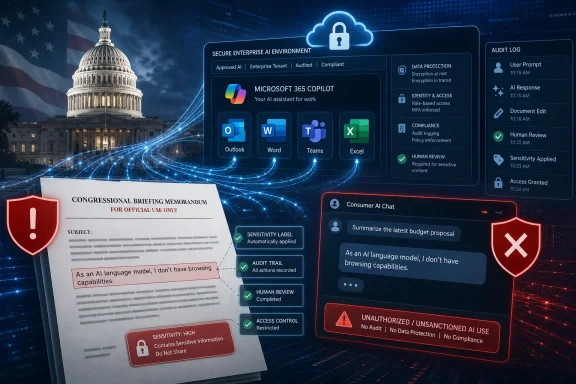
International Business Times reported that staff for Rep. Anna Paulina Luna, the Florida Republican, used Anthropic’s Claude in connection with a summary accompanying an NDAA amendment, and that copied material exposed part of the chatbot exchange. Luna said the tool was used to review the summary’s spelling and grammar rather than write the amendment text. Forbes separately reported her defense of the practice in June, after screenshots of the summary circulated.
The House’s institutional response has moved in the opposite direction of a blanket ban: it is standardizing on Microsoft 365 Copilot, pursuing purpose-built assistants, and framing secure access to House data as the alternative to public AI services. The resulting gap is the part administrators should pay attention to. Security approval answers where information may go; it does not establish who reviewed an output, whether its sources were checked, or whether a generated artifact can be safely published.
From a Copilot ban to 6,000 House licenses
The House’s use of Microsoft Copilot has changed sharply in a little over two years. In March 2024, Axios reported that the House’s cybersecurity office had designated the commercial version of Copilot unauthorized, warning that House information could leak to cloud services not approved by the chamber. The guidance said it would be removed from and blocked on House-managed Windows devices.
That was a data-boundary decision, rather than a judgment that AI assistants had no role in congressional work. By July 2024, the Committee on House Administration said the Chief Administrative Officer was exploring high-security large-language-model options including Microsoft Azure OpenAI and Amazon Bedrock, specifically to secure sensitive House data at the enterprise level.
The House has now committed much more visibly. A Committee on House Administration report says it purchased 6,000 Microsoft Copilot licenses for member, committee, leadership and institutional offices. The report identifies Outlook, Teams, Word and Excel as the main integration points and says Copilot is a House-authorized cloud service that staff can use with sensitive House data.
That official account corroborates the scale of the adoption. It also clarifies a detail that should temper assumptions about the rollout: Axios reported in September 2025 that up to 6,000 licenses would be available for one year, with testing beginning in June and expansion continuing through November. The House report calls the licenses a purchase but does not disclose the price, how many users are active, which Copilot features are enabled, whether the allocation was renewed after its first year, or what audit and retention controls govern prompts and generated content.
Those omissions matter more than the license count. A 6,000-seat Copilot deployment can be a tightly scoped productivity pilot, a broadly available assistant, or the foundation for connected agents accessing email, OneDrive and internal data. Each model has a different exposure profile. Congress has publicly confirmed the procurement and the intended applications; it has not published enough operational detail to determine the actual reach of the system.
The Luna error was a provenance failure
Luna’s explanation may narrow the claim about authorship—her office says Claude reviewed a summary rather than drafted legislative text—but it does not erase the operational failure. A public-facing congressional document carried obvious residue from an AI conversation. The most basic control, a human proofread of the finished artifact, failed.
This is the same failure class that enterprise teams see when users paste unvetted AI output into customer communication, legal drafts, support documentation or code comments. The error is not necessarily a hallucination, the term for a plausible but false model response. It is a provenance breakdown: content arrived in a document without a final owner confirming what it was, where it came from and whether it belonged there.
The stakes in Congress are unusually high because summaries, amendments and speeches can shape public understanding of legislation even when they are not the legally operative bill text. Legislative prose is also a bad place to treat AI-generated fluency as evidence of accuracy. A cleanly written summary can omit a condition, misread a cross-reference or turn a discretionary provision into a mandate.
The Congressional Research Service has made that concern unusually plain. In a June 2026 House Administration Committee hearing, CRS Director Karen Donfried said she was not confident in AI models’ accuracy for producing analysis for members and staff. CRS had tested six large language models for bill summaries and found they were not successful at producing summaries directly; its near-term work instead focuses on narrower workflow assistance, such as identifying bills likely to reach the floor so analysts can prioritize them.
That is a more defensible pattern than asking a general-purpose model to produce finished legislative analysis. Break a process into discrete, lower-risk tasks; preserve expert review for analysis and publication; and retain accountability with a named human rather than an assistant’s polished output.
Congress is building agents before it has shown the guardrails
The House’s plans extend well beyond Copilot’s familiar Word, Excel, Teams and Outlook interfaces. On July 28, 2026, the House Administration Committee requested funding for My Intelligent Assistant, or Mia, described as a secure and customizable AI agent connected to data sources across the House. The committee says Mia is intended to find information, interact with House systems and data, and support custom tools for offices.
House staff are already developing AI tools for schedules, bill summaries and floor-activity monitoring, according to the committee. An earlier account of the House’s AI program described an AI Innovators Pipeline and House AI Center support for staff-built applications. The direction is clear: the House does not merely want staff using a general chatbot. It wants AI connected to internal work systems and tailored to congressional workflows.
Connected agents create a different administrative problem from a chat window. A tool that can summarize a document is largely an output-quality and data-handling issue. An agent that can search across House systems, retrieve information and execute routine tasks introduces permissions, identity, logging, connector governance and potentially action authorization.
The Committee on House Administration describes Mia as secure, but the public material does not specify its model provider, hosting architecture, data classifications, access-control model, audit-log retention, prompt-injection defenses, external connector rules, or whether the agent can perform actions rather than only retrieve information. Those are not minor implementation details. They determine whether an assistant is confined to helping a staffer find work or can compound an existing over-permissioning problem across multiple systems.
For Microsoft 365 administrators, the lesson is familiar: Copilot and agent projects surface the permissions an organization already has. If SharePoint sites, Teams channels, shared mailboxes or OneDrive folders are too broadly accessible, an AI layer can make that content much easier to discover. Deployment planning must therefore include permission cleanup, sensitivity labels, data-loss-prevention policies, approved connector inventories and clear separation between read-only research functions and tasks that modify records or initiate workflows.
Approved AI still needs a publishing control
Congress’s own research institutions have identified legitimate uses for generative AI. The Congressional Research Service says Congress and federal agencies have explored summarization, content creation, speechwriting and bill drafting. The Government Accountability Office found that, across 11 selected agencies with AI inventories, reported generative AI use cases rose from 32 in 2023 to 282 in 2024, while total reported AI use cases increased from 571 to 1,110.
The GAO’s findings also explain why rollout speed cannot be the primary measure of success. Agencies reported risks involving biased outputs, false but convincing answers, weak transparency into model behavior, cybersecurity threats and protection of sensitive information. Most reported generative AI work was in mission-support functions such as information search, writing assistance and report summarization—the same category of tasks now spreading through congressional offices.
The House can legitimately argue that Microsoft Copilot offers a safer route than asking staff to place House material into consumer-facing chatbots. Its authorized-cloud approach is a meaningful improvement over unmanaged tools. But secure AI access and trustworthy published work are separate controls. A data-protected model can still produce a wrong answer; an approved tenant can still be bypassed; and a human can still paste an unreviewed fragment into a public document.
A workable program needs a short but enforceable division between exploratory AI use and publication-ready material:
- Staff should use approved enterprise tools for House data and should be prohibited from entering protected information into consumer AI services.
- Every public legislative summary, constituent communication and policy analysis should have a named human reviewer responsible for factual accuracy, source verification and removal of prompt residue.
- AI systems should be used first for bounded workflow tasks, including triage, document classification and retrieval, before they are trusted with completed legal or policy analysis.
- Agent projects should begin read-only, with least-privilege access, auditable logs and a documented approval process for every connector and action.
Congress is trying to regulate AI while adopting it as part of its own workforce. That tension is not hypocrisy; lawmakers need firsthand knowledge of the technology they are governing. But the Luna document shows why the House’s Copilot rollout cannot be judged by licenses purchased or tools launched. Its practical test is whether the chamber can make approved AI easier to use than unsanctioned alternatives—and make human accountability impossible to skip when AI-generated work becomes public.
References
- AI Is Quietly Becoming Part Of Congress' Workforce While Lawmakers Are Still Figuring Out The Rules International Business Times · 2026-08-13T14:19:41+00:00