
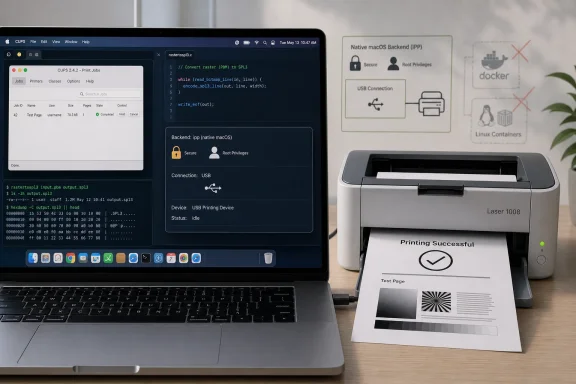
Neowin reported that New Delhi developer Kuber Mehta used Anthropic’s Claude Code to get a macOS driver working for the HP Laser 1008a family after HP supplied Windows and Linux support but no usable macOS path. The Register independently confirmed the project’s origins and the roughly four-hour Claude Code session. But Mehta’s GitHub repository now documents a material change that several early accounts missed: the driver no longer uses HP’s proprietary Linux codec inside Docker or Colima.
The current package is a native macOS implementation built around a patched copy of the open-source SpliX printer engine and a small USB backend using Apple’s IOKit framework. That is a more durable result than a containerized compatibility bridge—but it is not the same as HP officially supporting these devices, and it is not a reason to run an unfamiliar installer casually on a managed Mac.
 The actual fault was a page-header geometry mismatch
The affected printers are host-based devices. Unlike printers that accept standard PCL, PostScript, or AirPrint jobs, they expect the host computer to rasterize the document and send data in Samsung’s proprietary SPL3/QPDL-family format. On Windows, the vendor driver does that work. On an unsupported platform, simply adding the printer produces no useful output.
SpliX was already close. Its 2.0.2 release had support for the HP Laser 10x family, but Mehta’s testing found that output from the unmodified driver was corrupted: it printed a striped region at the top of a page, ejected the sheet, and then repeated the process. MacGeneration also described that failed-output behavior in its reporting on the project.
According to Mehta’s repository, the compressed raster bands produced by SpliX and HP’s Linux-side rastertospl utility were structurally compatible. The critical difference was page geometry in the SPL3 header. HP’s implementation described an A4 page as 2480 by 3507 units, using a 300-dpi coordinate grid; SpliX emitted 4960 by 6912, or 600-dpi values.
The printer interpreted those larger values as a page roughly 16 by 23 inches. It printed the first band, reached the real paper edge, ejected the sheet, and continued as if much of an oversized page remained. The final patch reportedly takes about 10 lines because it changes the header calculation while retaining the higher-resolution raster-band behavior required elsewhere in the conversion chain.
That is the significant engineering finding here. Claude Code did not conjure an entire driver from a blank file. It helped investigate a specific interoperability defect in an existing open-source stack, compare byte streams against HP’s known-good Linux codec, and iteratively test on real hardware until the mismatch was isolated.
Early coverage described an implementation that has already been replaced
This story moved quickly enough that readers will encounter conflicting explanations of how the driver works. Tom’s Hardware and MacGeneration described the project’s earlier form: HP’s proprietary rastertospl codec ran in a small Linux environment through Docker or Colima, then a separate component delivered the completed SPL3 stream to the printer over USB.
That approach worked, but it required a Linux VM or container to remain available and relied on HP’s proprietary Linux binary. Mehta’s current GitHub documentation explicitly says that setup was the first stage, not the released runtime. The present code drops Docker, Colima, HP’s codec, Python, PyUSB, and libusb.
The replacement consists of two compiled components:
- A patched SpliX
rastertoqpdlCUPS filter converts macOS-generated raster output into the printer’s SPL3-compatible stream. - A CUPS backend called
hpl100xuses IOKit and CoreFoundation to send that stream directly over USB.
The distinction is not academic. A package that depends on a vendor binary in a Linux VM is a maintenance workaround; a package whose runtime relies on native macOS frameworks and an open-source filter has fewer moving parts and is easier for other developers to inspect. It also means the reporting phrase “AI built a macOS driver by wrapping a Linux driver” is now out of date for the code Mehta says the repository actually ships.
One repository metadata field still refers to running HP’s codec “in a container,” apparently a stale description from the earlier version. The README’s implementation section, installation notes, and roadmap are clearer: the current path is native, while the older daemon and container-related material remains in the tree as historical fallback work.
Native does not mean low-risk or officially supported
The project is tested, by its own documentation, on macOS 26 on Apple Silicon with USB-connected HP Laser 1003, 1006, and 1008 variants. It does not claim Intel Mac support, network printing, AirPrint, broad HP Laser compatibility, or vendor certification. A Windows PC remains the supported and lower-risk route for organizations that need predictable printer deployment, support escalation, and change control.
The installation script requires Homebrew and Xcode Command Line Tools to compile the two binaries. Homebrew is described as a build-time dependency rather than a runtime one, which is good for keeping the finished stack small. Still, compiling and installing a new CUPS filter and backend is fundamentally different from selecting an inbox driver.
Most importantly, the USB backend runs as root. Mehta’s explanation is technically plausible: macOS’s standard USB CUPS backend reportedly misreads this printer as permanently offline, while raw USB communication needs elevated access on recent macOS releases. The custom backend is therefore installed root-owned with restrictive permissions and uses IOKit to seize the printer interface and write directly to the bulk USB endpoint.
That design fixes two real platform obstacles. It switches the printer away from an IPP-over-USB alternate interface that can silently discard raw SPL3 data, and it bypasses the macOS backend behavior that leaves the device offline. But it also creates the exact condition a security-conscious Mac administrator should pause over: an unsigned community project gets a privileged, persistent place in the printing path.
There is no indication of malicious behavior in the reporting or repository. There is also no published independent security audit, no signed installer package, no Apple notarization claim, and no enterprise deployment guidance. Those omissions are normal for a days-old hobbyist open-source driver, but they should shape how it is used.
The useful lesson for Windows and IT administrators
For Windows users, this is primarily a reminder of what vendor-specific printing protocols cost once a device leaves its intended environment. These HP Laser models work because the operating system has a driver that knows the printer’s private language. When that driver does not exist—or no longer runs on a newer architecture—the printer’s USB connection alone is insufficient.
That scenario is familiar in Windows administration. Legacy printers, scanners, label makers, and specialty peripherals can survive physically for years while their driver chain becomes the actual end-of-life event. A model may appear compatible because Windows enumerates it, but be unusable when its vendor filter, spooler component, or USB transport layer no longer matches the OS, CPU architecture, or security model.
The project also offers a more sober example of AI-assisted development than the viral label vibe coding suggests. The visible breakthrough depended on existing SpliX work, hardware-level print tests, byte-level output comparisons, reverse engineering of a vendor utility, and a small targeted patch. The AI agent accelerated exploration, but the final solution rests on reproducible technical evidence: which header values changed, why the device misread them, and which macOS USB mode it needed.
That is a better standard for applying coding agents to driver and systems work. Treat the generated code as a hypothesis, retain a known-good comparison point, test against physical hardware, and document the assumptions that make the fix model-specific. The smallest patch can be the most valuable outcome, provided it explains the failure instead of merely hiding it behind another compatibility layer.
SpliX upstreaming will determine whether this becomes maintainable
Mehta says the SPL3 header correction is being offered upstream to OpenPrinting’s SpliX project. That is the next milestone that matters more than social-media attention. If the patch is accepted and maintained upstream, future macOS packaging work can track a recognized open-source printer engine rather than carry a permanent local fork.
Until then, the package should be treated as a narrowly scoped solution for USB-attached Apple Silicon Macs with the named HP Laser 1003, 1006, or 1008 models—not a general fix for HP printers lacking macOS drivers. Administrators should test it on a non-production Mac, inspect the installation and uninstall scripts, document the root-owned backend, and keep a Windows fallback for any printer tied to operational workflows.
For a retired or personally owned printer that would otherwise become e-waste, that may be an acceptable bargain. For managed fleets, the important headline is not that Claude Code made an unsupported printer work. It is that a vendor lock-in problem was reduced to a verifiable protocol bug—but the workaround still carries all the lifecycle and privilege concerns that HP’s missing driver left behind.