
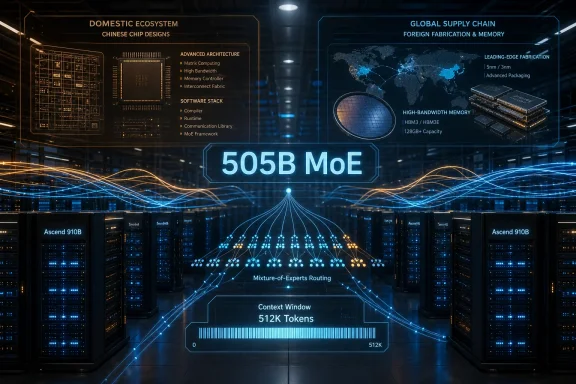
Huawei’s openPangu-2.0-Pro has arrived as a 505-billion-parameter mixture-of-experts model whose technical report says full pretraining ran on Ascend 910B accelerators rather than Nvidia GPUs. The release, reported by TechTimes on August 1 and now appearing in Huawei’s Ascend Tribe community, puts weights and inference code into developers’ hands—but its real significance is the distinction between an Nvidia-free training cluster and a fully domestic semiconductor supply chain.
Huawei announced the Pro model in June alongside its 92B-parameter openPangu-2.0-Flash sibling, promising a July release of Pro weights and basic inference code. Community postings accompanying the newly available technical report identify the larger model as a 505B-total, 18B-active-parameter MoE system with a 512K-token context window and 34 trillion pretraining tokens.
That is a meaningful engineering milestone. It is not, however, proof that China has already replaced every foreign component required to build and operate a frontier AI training system.
Huawei’s claim is straightforward: openPangu-2.0-Pro was trained on its Ascend platform, with Ascend 910B hardware in the training environment rather than Nvidia A100 or H100 GPUs. In practical terms, that demonstrates that Huawei’s software stack, compiler tooling, networking, kernels, distributed-training infrastructure and model design can carry a model beyond the 500B-parameter mark.
For organizations following export controls, that is the immediate point. The model is a concrete reference implementation for an alternative training ecosystem—not simply another Chinese-language model available through an API.
But “trained without Nvidia” should not be read as “trained on components made entirely inside China.” Those are separate propositions, and the latter remains much harder to establish.
Reporting by Bloomberg, Reuters and TechInsights-based coverage over the past two years found TSMC-manufactured silicon inside Huawei Ascend 910B products. Separate reporting by The Business Times, citing TechInsights and SemiAnalysis, said Huawei’s newer Ascend 910C hardware also included foreign-made components, including TSMC-derived dies and Samsung or SK Hynix high-bandwidth memory in examined samples.
That history matters because Ascend 910C is built from two 910B-class dies, while 910B hardware represents the platform named in openPangu’s report. The model may genuinely have avoided Nvidia hardware at the cluster level, but the supply-chain lineage of the Ascend accelerators is more complicated than the marketing shorthand suggests.
SemiAnalysis has estimated that Huawei obtained more than 2.9 million relevant TSMC dies, enough to support a substantial Ascend 910B and 910C ramp through 2024 and 2025. That estimate is not a Huawei disclosure and should be treated accordingly, but it is consistent with the broader picture: Huawei’s ability to ship competitive accelerators has relied in part on inventory acquired before or around tighter restrictions.
High-bandwidth memory is the other constraint. AI accelerators are not useful at frontier-model scale on compute silicon alone; they need huge amounts of fast, closely coupled memory. TechInsights-based reports found foreign HBM in Ascend products, while analysts have continued to flag China’s domestic HBM supply as a bottleneck despite advances by ChangXin Memory Technologies, or CXMT.
That means openPangu-2.0-Pro should be viewed as proof of Ascend-native training viability, not yet as a completed demonstration of a wholly domestic Chinese stack. The next important test will be a comparable training run documented on SMIC-fabricated logic and domestically sourced HBM after foreign-component inventories have been exhausted.
That design changes both the deployment and training equation. A 505B dense model would require every parameter to participate in each forward pass, creating a vastly larger compute and memory burden. An 18B-active MoE model can draw on a much larger pool of learned specialization without paying a 505B dense-model cost for every generated token.
Huawei’s report also describes a 512K context window, which puts the model in the long-context category. That matters for organizations processing source trees, records collections, regulatory filings, support archives, or large internal knowledge bases. It does not mean a Windows workstation can casually host the model: even quantized weights at this scale are a serious infrastructure project, and its intended environment is Ascend hardware or a hosted service.
The model’s technical description points to a hybrid attention design combining Multi-head Latent Attention with Decoupled Sparse Attention and Sliding Window Attention. The underlying objective is familiar: avoid making every token attend directly to every other token across a 512K-token prompt. Sliding-window layers handle nearby context efficiently, while sparse global attention is intended to preserve access to more distant information.
The release also documents post-training built around supervised fine-tuning, specialist reinforcement-learning stages and what Huawei calls Online Policy Distillation. In principle, the approach is meant to fuse specialist capabilities into one model without simply fine-tuning one skill at the expense of another. That is an interesting claim for researchers, but it is too early to treat it as a validated advance over existing distillation and multi-stage RL approaches.
Recent research and implementation work, including a PyTorch/DeepSpeed discussion of Muon deployments, has made the optimizer increasingly visible in large-model training. Its attraction is not magic performance: it can improve optimization efficiency in some settings, potentially reaching a target loss using fewer training steps or tokens. The exact gain depends on architecture, hyperparameters, hardware, data and implementation.
For Huawei, that is strategically relevant. A cluster built around Ascend 910B hardware does not have the same per-accelerator performance profile as an H100- or Blackwell-based Nvidia installation. Better optimization efficiency can therefore compensate for part of the hardware disadvantage, reducing the amount of total compute needed to complete a training run.
It also reinforces why the release deserves more attention than a parameter-count headline. If independent researchers can reproduce the reported optimizer behavior, attention stack and expert-routing efficiency, openPangu may offer useful lessons for any operator working under constrained accelerator supply—not only Huawei customers.
The earlier 92B-total, 6B-active Flash model gives developers some basis for experimenting with the openPangu family, and community work has reportedly begun expanding runtime support beyond Ascend. Still, Pro is a newly released 505B model. It will take time for evaluators to build reproducible environments, work through model-format conversion, determine viable quantization strategies and test whether its 512K context window remains useful under real workloads rather than curated demonstrations.
For Windows-focused infrastructure teams, the practical decision is narrower than the geopolitical debate. ModelArts-hosted inference may let a team test the model quickly, but that introduces data-governance and jurisdiction questions typical of any hosted AI service. Self-hosting weights avoids sending prompts to a vendor API, but it demands compatible hardware, an operational inference stack, large memory pools and a clear plan for updates, logging and access control.
Admins should also be wary of early claims around Nvidia conversion. A successful conversion to a conventional format is not the same thing as an efficient production deployment. Kernel maturity, MoE routing behavior, context-cache memory pressure and long-context throughput will determine whether a port is a useful experiment or a viable service.
The unanswered question is whether the same result can be repeated on a supply chain that no longer benefits from TSMC-made die inventory and foreign HBM stockpiles. Until Huawei or an independent party documents that outcome, the Pro release should be read as a major software-and-systems demonstration—while the semiconductor independence claim remains unfinished.
That is a meaningful engineering milestone. It is not, however, proof that China has already replaced every foreign component required to build and operate a frontier AI training system.
 The Training Claim Is About the Cluster, Not Every Chip Ingredient
Huawei’s claim is straightforward: openPangu-2.0-Pro was trained on its Ascend platform, with Ascend 910B hardware in the training environment rather than Nvidia A100 or H100 GPUs. In practical terms, that demonstrates that Huawei’s software stack, compiler tooling, networking, kernels, distributed-training infrastructure and model design can carry a model beyond the 500B-parameter mark.For organizations following export controls, that is the immediate point. The model is a concrete reference implementation for an alternative training ecosystem—not simply another Chinese-language model available through an API.
But “trained without Nvidia” should not be read as “trained on components made entirely inside China.” Those are separate propositions, and the latter remains much harder to establish.
Reporting by Bloomberg, Reuters and TechInsights-based coverage over the past two years found TSMC-manufactured silicon inside Huawei Ascend 910B products. Separate reporting by The Business Times, citing TechInsights and SemiAnalysis, said Huawei’s newer Ascend 910C hardware also included foreign-made components, including TSMC-derived dies and Samsung or SK Hynix high-bandwidth memory in examined samples.
That history matters because Ascend 910C is built from two 910B-class dies, while 910B hardware represents the platform named in openPangu’s report. The model may genuinely have avoided Nvidia hardware at the cluster level, but the supply-chain lineage of the Ascend accelerators is more complicated than the marketing shorthand suggests.
The TSMC Die Bank Is the Crucial Caveat
The most consequential external dependency is the reported stockpile of TSMC-made logic dies that made their way into Huawei’s Ascend program through Sophgo. TechInsights’ teardown work triggered scrutiny after it found a TSMC-made component in Ascend 910B hardware. TSMC has said it stopped supplying Huawei in September 2020 and reported potential compliance issues to U.S. authorities.SemiAnalysis has estimated that Huawei obtained more than 2.9 million relevant TSMC dies, enough to support a substantial Ascend 910B and 910C ramp through 2024 and 2025. That estimate is not a Huawei disclosure and should be treated accordingly, but it is consistent with the broader picture: Huawei’s ability to ship competitive accelerators has relied in part on inventory acquired before or around tighter restrictions.
High-bandwidth memory is the other constraint. AI accelerators are not useful at frontier-model scale on compute silicon alone; they need huge amounts of fast, closely coupled memory. TechInsights-based reports found foreign HBM in Ascend products, while analysts have continued to flag China’s domestic HBM supply as a bottleneck despite advances by ChangXin Memory Technologies, or CXMT.
That means openPangu-2.0-Pro should be viewed as proof of Ascend-native training viability, not yet as a completed demonstration of a wholly domestic Chinese stack. The next important test will be a comparable training run documented on SMIC-fabricated logic and domestically sourced HBM after foreign-component inventories have been exhausted.
A 505B Model That Does Not Spend 505B Compute on Every Token
The raw parameter count needs a qualifier of its own. openPangu-2.0-Pro uses a mixture-of-experts architecture: it contains 505 billion parameters in total, but activates roughly 18 billion parameters for each token. A routing mechanism chooses a small group of specialized sub-networks, or experts, for a given input while leaving the rest idle.That design changes both the deployment and training equation. A 505B dense model would require every parameter to participate in each forward pass, creating a vastly larger compute and memory burden. An 18B-active MoE model can draw on a much larger pool of learned specialization without paying a 505B dense-model cost for every generated token.
Huawei’s report also describes a 512K context window, which puts the model in the long-context category. That matters for organizations processing source trees, records collections, regulatory filings, support archives, or large internal knowledge bases. It does not mean a Windows workstation can casually host the model: even quantized weights at this scale are a serious infrastructure project, and its intended environment is Ascend hardware or a hosted service.
The model’s technical description points to a hybrid attention design combining Multi-head Latent Attention with Decoupled Sparse Attention and Sliding Window Attention. The underlying objective is familiar: avoid making every token attend directly to every other token across a 512K-token prompt. Sliding-window layers handle nearby context efficiently, while sparse global attention is intended to preserve access to more distant information.
The release also documents post-training built around supervised fine-tuning, specialist reinforcement-learning stages and what Huawei calls Online Policy Distillation. In principle, the approach is meant to fuse specialist capabilities into one model without simply fine-tuning one skill at the expense of another. That is an interesting claim for researchers, but it is too early to treat it as a validated advance over existing distillation and multi-stage RL approaches.
Muon Is Part of the Hardware Story
One of the more interesting details is Huawei’s reported use of the Muon optimizer. Muon—short for MomentUm Orthogonalized by Newton-Schulz iteration—updates matrix weights using an orthogonalized momentum direction rather than following the AdamW pattern used across much of modern LLM training.Recent research and implementation work, including a PyTorch/DeepSpeed discussion of Muon deployments, has made the optimizer increasingly visible in large-model training. Its attraction is not magic performance: it can improve optimization efficiency in some settings, potentially reaching a target loss using fewer training steps or tokens. The exact gain depends on architecture, hyperparameters, hardware, data and implementation.
For Huawei, that is strategically relevant. A cluster built around Ascend 910B hardware does not have the same per-accelerator performance profile as an H100- or Blackwell-based Nvidia installation. Better optimization efficiency can therefore compensate for part of the hardware disadvantage, reducing the amount of total compute needed to complete a training run.
It also reinforces why the release deserves more attention than a parameter-count headline. If independent researchers can reproduce the reported optimizer behavior, attention stack and expert-routing efficiency, openPangu may offer useful lessons for any operator working under constrained accelerator supply—not only Huawei customers.
The Benchmarks Are Still Missing
Huawei’s release has not yet been followed by the independent benchmark coverage needed to position openPangu-2.0-Pro against established open-weight competitors. Huawei can state its own throughput results, but external scoring on coding, multilingual reasoning, tool use, long-context retrieval, safety and agentic workloads is the real test.The earlier 92B-total, 6B-active Flash model gives developers some basis for experimenting with the openPangu family, and community work has reportedly begun expanding runtime support beyond Ascend. Still, Pro is a newly released 505B model. It will take time for evaluators to build reproducible environments, work through model-format conversion, determine viable quantization strategies and test whether its 512K context window remains useful under real workloads rather than curated demonstrations.
For Windows-focused infrastructure teams, the practical decision is narrower than the geopolitical debate. ModelArts-hosted inference may let a team test the model quickly, but that introduces data-governance and jurisdiction questions typical of any hosted AI service. Self-hosting weights avoids sending prompts to a vendor API, but it demands compatible hardware, an operational inference stack, large memory pools and a clear plan for updates, logging and access control.
Admins should also be wary of early claims around Nvidia conversion. A successful conversion to a conventional format is not the same thing as an efficient production deployment. Kernel maturity, MoE routing behavior, context-cache memory pressure and long-context throughput will determine whether a port is a useful experiment or a viable service.
Huawei Has Demonstrated a Path, Not Finished the Race
openPangu-2.0-Pro’s most defensible achievement is that it documents an Ascend-based route to pretraining a very large open-weight MoE model. Huawei has supplied the weights, base inference code and technical details necessary for the outside world to inspect that route rather than merely accept a cloud-model claim.The unanswered question is whether the same result can be repeated on a supply chain that no longer benefits from TSMC-made die inventory and foreign HBM stockpiles. Until Huawei or an independent party documents that outcome, the Pro release should be read as a major software-and-systems demonstration—while the semiconductor independence claim remains unfinished.