
Phoronix first reported the August 21 update’s Crescent Island device-ID additions, shared-memory changes, media-handle work, Nova Lake refinements, and further development of LEO. Intel’s own Compute Runtime release record confirms version 26.31.39395.13 as the current release, packages it with Intel Graphics Compiler 2.40.13 and GmmLib 22.10.0, and raises the advertised Level Zero API support level to 1.17 for listed platforms.
The important distinction is deployment. The GitHub release provides Ubuntu 26.04 .deb packages for Intel’s OpenCL ICD and Level Zero GPU runtime. It does not provide a standalone Windows installer, an Intel Graphics Software package, a Windows Update payload, or release notes saying that the compute changes have landed in Intel’s conventional Windows display-driver channel.
For a Windows workstation, this release matters most to developers using WSL GPU compute and to IT teams tracking how far Intel’s next hardware platforms have progressed before systems ship. It is not a reason for users of Arc, Core Ultra, or existing Intel integrated graphics to manually hunt for a replacement Windows driver.
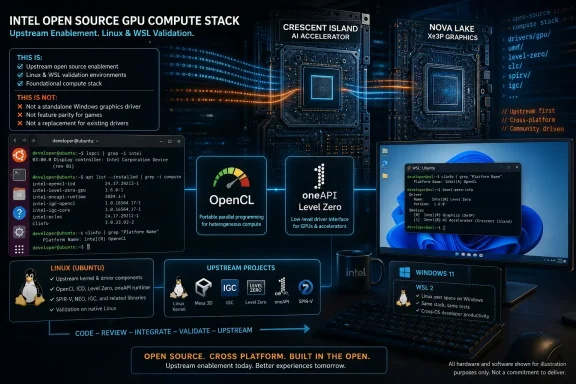 The release is a runtime package, not a Windows driver announcement
Intel’s Compute Runtime, previously often called NEO, implements the software layer that exposes Intel GPU compute capabilities through OpenCL and oneAPI Level Zero. Applications normally interface with an OpenCL ICD loader or a Level Zero loader rather than linking directly to Intel’s runtime library. That makes the project important for developer systems, rendering or media pipelines, AI inference experimentation, and software that uses Intel GPUs for general-purpose compute.
However, the delivery route differs sharply by operating system. In Linux, Intel can publish the compute components as separately installable packages. In Windows, GPU compute functionality is ordinarily bundled and qualified through the broader Intel graphics driver stack, often with OEM packaging and Windows Update in the mix.
Intel’s own Compute Runtime FAQ has long cautioned that a Windows driver can take several weeks to reflect a newer upstream NEO release. The new release record reinforces that gap: it names a Windows host graphics driver, version 101.8864, only as the platform used to test WSL support. That is validation metadata, not evidence that Windows driver 101.8864 contains every feature introduced by Compute Runtime 26.31.39395.13.
That separation has practical consequences. A Windows developer who needs the new code path should verify the WSL distribution, host Intel graphics driver, and actual API capabilities reported by their application. Simply seeing an Intel driver version newer than an earlier release does not establish that LEO, Crescent Island changes, or Nova Lake-specific refinements are exposed to a Windows workload.
Crescent Island remains explicitly outside production support
The most visible forward-looking change is continued work for Crescent Island, Intel’s forthcoming enterprise AI inference accelerator. Phoronix reports that the release synchronizes additional Crescent Island device IDs, adds media-handle support, and enables unified system memory by default for that platform.
Those additions are meaningful as signs that Intel is moving from generic architectural placeholders toward hardware-specific integration. Yet Intel’s own quality table still labels Crescent Island “Early support” and defines that category bluntly: it carries no quality expectations. The table lists OpenCL 3.0 and Level Zero 1.17, but its WSL column for Crescent Island is “N/A.”
In other words, the API labels should not be mistaken for a shipping support commitment. Intel has not announced Crescent Island availability, supported operating-system images, a Windows driver plan, specific accelerator models, or a production-quality date in this Compute Runtime release.
Phoronix separately reported in May that Linux graphics-driver patches expanded Crescent Island’s known PCI device-ID range beyond the original 0x674C identifier, adding 0x674D through 0x6750. That corroborates the broader point that Intel is preparing software for more than one hardware configuration. It does not confirm five retail SKUs; device IDs can represent development silicon, configuration variants, or products that never reach market.
For enterprise buyers, the current release therefore offers a useful procurement signal but no deployable platform promise. The software trail says Crescent Island remains active inside Intel’s driver engineering work. It does not say when a Windows Server, Linux, or cloud deployment can be planned around it.
Nova Lake also carries an early-support label
Intel also lists Nova Lake as “Early support” in 26.31.39395.13, with OpenCL 3.0 and Level Zero 1.17 stated in the quality matrix. Unlike Crescent Island, Nova Lake is positioned as a processor family with Xe3P integrated graphics, so its eventual impact is more likely to reach mainstream PC and workstation software.
The release’s status is still a warning against reading upstream code as a completed client-PC experience. Intel’s table marks neither Nova Lake nor Crescent Island as WSL-supported. Intel also says its validation for the release was performed on Ubuntu 26.04 with the stock 7.0.0-14 kernel, while the listed established platforms—including Tiger Lake through Wildcat Lake, plus DG1, Alchemist, and Battlemage—retain production status and WSL testing.
That leaves a clear dividing line for admins and software teams: existing supported Intel platforms are the practical target for testing the current runtime, while Nova Lake code is a forward-compatibility investment. If a developer is building a compute application intended to survive the next Intel client generation, keeping an eye on these releases is sensible. If the goal is stable deployment today, Intel’s production-status platforms are the appropriate baseline.
The release also shows that Intel is maintaining compatibility across a wide span of hardware. Its regular packages support Gen12 and later platforms, while older Gen8 through Gen11 hardware continues through separately designated legacy1 packages. Intel says those legacy packages will receive critical fixes but no new features, which matters for organizations still operating Skylake, Kaby Lake, Coffee Lake, or Ice Lake fleets.
LEO is a driver-consolidation project, not a finished OpenCL replacement
The more consequential long-term change may be LEO, short for Level Zero Executing OpenCL. Phoronix says Intel has continued adding features to the experimental implementation in this release. LEO reimplements OpenCL on top of Level Zero rather than relying on Intel’s direct, hardware-facing OpenCL driver.
Intel introduced the project publicly in June with Compute Runtime 26.22.38646.4. At the time, Phoronix described the effort as an attempt to reduce the burden of maintaining separate OpenCL and Level Zero driver paths. That architecture could give Intel one core lower-level stack to validate and optimize, while preserving OpenCL compatibility for applications that have not moved to Level Zero or oneAPI-native interfaces.
There is a sizable gap between that goal and production use. LEO is still marked experimental, and Intel’s August release notes do not declare OpenCL conformance through LEO, provide an application-compatibility list, publish performance comparisons against the existing OpenCL driver, or identify which OpenCL extensions remain unavailable.
Developers should therefore avoid treating LEO as a transparent switch for production workloads. An OpenCL application may depend on extension behavior, media sharing, profiling features, compiler behavior, or device-selection details that a newer translation layer has not yet reproduced. The correct approach is targeted testing: enumerate the reported platform and device properties, run representative kernels, validate results, and compare performance and stability against Intel’s established OpenCL path.
The absence of published benchmarks is particularly notable. A consolidated runtime may eventually reduce duplicated driver work, but it does not automatically make OpenCL code faster. Intel has made no performance claim for LEO in this release, and no independent benchmark results were located alongside the announcement.
The smaller additions point toward AI and synchronization work
Phoronix also notes support for cl_intel_bfloat16_conversions, an Intel OpenCL extension related to conversions involving bfloat16 data. Bfloat16 is widely used in machine-learning pipelines because it keeps an eight-bit exponent while reducing precision storage relative to 32-bit floating point. At a software level, such support helps remove conversion friction for workloads that combine CPU-side or GPU-side preprocessing with inference-oriented data types.
The release additionally enables Linux kernel-mode-driver wait-for-event host synchronization. That is primarily a Linux stack improvement, and it should not be generalized into a Windows synchronization feature. Its inclusion does show that 26.31.39395.13 is not solely a bundle of future-product IDs; Intel is also working on behavior in today’s execution and event-handling paths.
Still, this is a release with 263 commits and more than 1,200 changed files compared with version 26.27.39122.11, according to GitHub’s comparison page, but without a readable item-by-item public changelog in the release entry. That makes the package suitable for developers who can test their own workloads, not for broad deployment based on a short feature list.
For Windows and WSL users, the immediate action is modest: retain Intel’s production Windows graphics-driver channel for normal systems, and treat Compute Runtime 26.31.39395.13 as an upstream signal and Linux/WSL testing component. The next concrete milestone worth watching is Intel moving Crescent Island and Nova Lake out of “Early support,” adding WSL coverage to the matrix, and publishing a corresponding Windows driver release that makes the new compute work usable beyond the source tree and Ubuntu packages.