
TechSpot first reported the updated Amazon ranking on August 24, while Tom’s Hardware independently published a screenshot of the same August 24 list. Both identify the same two Intel parts and the same positions. The meaningful development is less “Intel is back” than a change in what builders can afford to buy: current component pricing has made a new DDR5 platform far more expensive, reviving interest in older LGA 1700 and AM4 systems that can keep using DDR4.
The numbers also expose a limit to Amazon bestseller charts. They are a fast-moving retail snapshot, not shipment data or market share, and they can be shifted by a brief price cut, a bundle, or stock availability. Still, the composition of the list is useful as a measure of what individual builders are choosing with their own money. On that measure, AMD remains overwhelmingly ahead—and Intel’s two entries arrived for two very different reasons.
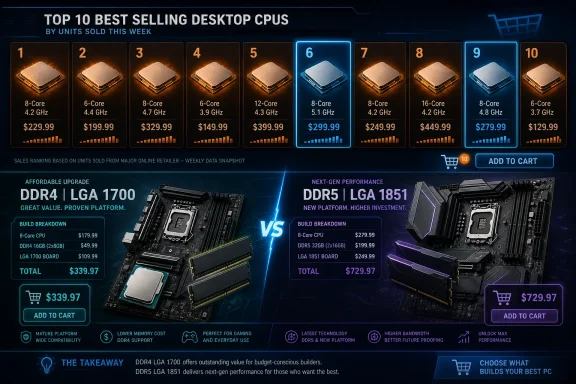 Two Intel chips, two very different buying cases
The Core i7-14700K is the more straightforward explanation. It is a 14th-generation Raptor Lake Refresh processor released in late 2023, compatible with LGA 1700 motherboards and officially supporting either DDR4-3200 or DDR5-5600 memory. For an owner of a Z690, B660, Z790, or B760 DDR4 board, it can be a substantial CPU upgrade without replacing the motherboard and memory.
That upgrade route has become materially more attractive in 2026 because DDR5 prices have risen sharply. Tom’s Hardware’s recent tracking put a 32GB DDR5-6000 kit at roughly $392, versus a lowest-ever price of $72, and its broader comparison showed several 64GB DDR5 configurations costing many times their average price a year earlier. DDR4 has risen too, but it remains the less expensive route in a market where memory is no longer a minor line item in a PC build.
This is the part of TechSpot’s explanation that holds up cleanly. The Core i7-14700K’s return to the top 10 plausibly reflects the appeal of preserving a working DDR4 setup—or deliberately building around an older but still available DDR4 motherboard. Tom’s Hardware reached the same conclusion, describing the chip as a practical fit both for existing LGA 1700 systems and for builders determined to avoid a DDR5 purchase.
The Core Ultra 7 270K Plus is a different story. Intel launched it in March 2026 as part of the Arrow Lake Refresh, branded as the Core Ultra 200S Plus series. The chip has eight performance cores and 16 efficient cores, with 24 cores total, and it was positioned as a lower-cost alternative to the pricier Core Ultra 9 tier. Intel calls it its fastest desktop gaming processor in the roughly 125W class, though that claim depends on Intel’s own selected game tests and, in some titles, its optional Binary Optimization Tool.
What it cannot do is reuse DDR4. Arrow Lake desktop processors use the LGA 1851 platform and DDR5 memory. So the 270K Plus landing at No. 6 cannot be explained by DDR4 compatibility, despite the broader memory-price narrative surrounding the chart. Its appeal is more likely the CPU’s retail price and its unusually high core count for the money, particularly for workloads such as code compilation, video production, multitasking, and content creation.
That distinction matters for anyone interpreting the ranking as platform advice. Intel has one top-10 chip serving a keep your existing platform alive market and another serving a buy a new DDR5 system anyway market. Combining them into a single Intel comeback narrative conceals the central purchasing trade-off.
The price discrepancy is a reminder to check the basket, not the headline
TechSpot listed the Core Ultra 7 270K Plus at $255 when it observed Amazon’s ranking. Tom’s Hardware, reporting from the same date, listed it at $290. The Core i7-14700K was reported at $312 by both outlets.
That $35 gap does not necessarily mean one report is wrong. Amazon’s pricing can move rapidly, especially where coupons, marketplace sellers, inventory changes, and targeted discounts are involved. Intel’s own launch guidance placed the 270K Plus around the $299 level, and Intel explicitly warns that its suggested pricing is not a retail offer. The discrepancy does show why a bestseller position should never be treated as a stable value recommendation without checking the actual checkout price.
At $255, the 270K Plus is an aggressive offer: a 24-core desktop CPU at a price below many gaming-oriented Ryzen 7 alternatives. At $290, it remains competitive, but the total-system math becomes harder because it requires an LGA 1851 motherboard and DDR5. A builder who already owns a DDR4 LGA 1700 platform may find that the apparently older Core i7-14700K delivers the cheaper complete upgrade even if its sticker price is higher.
This is the distinction retailers’ CPU-only rankings cannot capture. The processor may be the least expensive component in a shopping cart, while memory, motherboard, cooler, storage, and graphics card decide whether the build is realistically affordable.
AMD’s presence across Ryzen 5000, 7000, and 9000 series chips reflects the same reality. The Ryzen 5 5500 at No. 2 is not a performance leader; it is an inexpensive AM4 option for a mature DDR4 platform. The Ryzen 7 5800X3D and Ryzen 7 7800X3D remain popular because gaming buyers value their large 3D V-Cache designs, while the Ryzen 7 9800X3D at No. 1 shows that the premium end has not disappeared altogether.
The Core i7-14700K comes with a support obligation
The 14700K’s presence in the chart also carries baggage that a price-driven buying decision should not overlook. Intel continues to list 14th-generation Core i7 desktop processors among the products affected by the company’s Vmin Shift Instability issue, which involved reports of instability on some 13th- and 14th-generation desktop chips.
Intel’s current guidance is specific: affected owners should use Intel Default Settings and update to a motherboard BIOS containing Microcode 0x12F or later. Intel has extended warranty coverage by two years for eligible processors, for up to five years from the original purchase date. That is useful protection, but it also means a new 14700K buyer should not treat a BIOS update as optional housekeeping.
For Windows users, the practical check is simple. Before installing Windows—or before placing a heavy workload on an existing machine—update the motherboard firmware through the board vendor’s supported process, load Intel’s recommended baseline settings, and avoid assuming older “enhanced turbo” presets remain sensible defaults. System builders and IT admins should record the BIOS version alongside the processor serial and purchase record, because warranty eligibility and troubleshooting are easier when the platform history is documented.
The 14700K is still a capable 20-core, 28-thread processor with integrated UHD 770 graphics and Quick Sync Video support. It can make sense for an LGA 1700 upgrade, especially for a workstation that needs media acceleration or heavily threaded performance. But its appearance on an Amazon list does not erase the need to apply Intel’s present support guidance.
AMD still owns the rankings that Intel has only begun to re-enter
The broader pattern remains AMD’s. TechSpot counted eight AMD chips in the top 10 and eight more in positions 11 through 20. The leading Ryzen models span three platform generations, giving shoppers options from low-cost AM4 upgrades to high-end AM5 gaming builds.
That cross-generation range is difficult to overstate. AMD is benefiting from two different forms of platform longevity: AM4 parts such as the Ryzen 5 5500, Ryzen 5 5600X, and Ryzen 7 5800X3D give DDR4 owners a path forward, while AM5 remains the destination for builders who can absorb DDR5’s current cost. Intel’s Core i7-14700K provides a credible answer for LGA 1700 owners, but LGA 1700 itself has reached the end of its CPU upgrade path.
The Core Ultra 7 270K Plus, meanwhile, is a better reflection of Intel’s current desktop strategy. It offers strong multithreaded performance and respectable gaming performance at a price Intel needed to hit after the original Arrow Lake desktop launch failed to gain comparable retail traction. But the LGA 1851 platform does not provide a DDR4 escape hatch, which means its best case depends on whether its CPU discount can offset the cost of building around DDR5.
Amazon’s current top 10 therefore records a narrow but genuine improvement for Intel: two chips are once again competitive enough to enter the conversation. For builders, the more useful conclusion is to price the platform around them. The Core i7-14700K is a DDR4-preserving upgrade that needs current BIOS firmware; the Core Ultra 7 270K Plus is a new-platform CPU whose value rises or falls with DDR5 pricing.
