
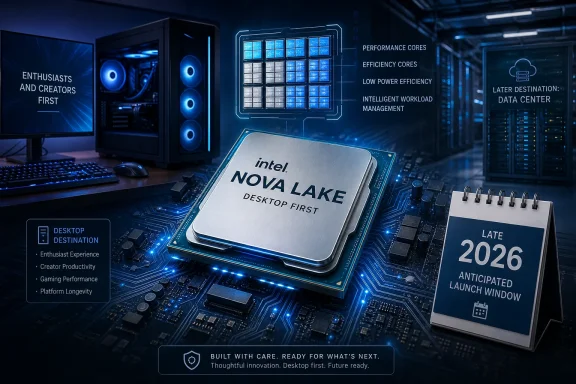
The important part is narrower than the tease suggests. Hallock did not announce Nova Lake specifications, a release date beyond Intel’s previously stated late-2026 target, a socket, a product name, or benchmark results. He also did not identify the core by its widely reported but unconfirmed “Coyote Cove” codename. What Intel has now put on the record, through Hallock’s comments to Tom’s Hardware, is the intended order of introduction: the next desktop architecture is meant to lead its server counterpart rather than follow it.
That is a meaningful message to PC builders after Arrow Lake, but it is still a promise about product direction—not performance proof.
 A direct response to AMD’s Venice strategy
AMD has already made its own priority clear. Its EPYC 9006 server family, formerly known as Venice, introduced Zen 6 and Zen 6c cores to the data-center market first. AMD’s launch materials describe a server lineup aimed at AI host nodes, enterprise systems, and high-density deployments, with up to 256 cores in the range’s top configurations and support for the platform bandwidth expected of a new EPYC generation.
For AMD, that sequencing is structurally straightforward. Its chiplet strategy enables the company to use closely related CPU-core complexes across Ryzen and EPYC products, then vary I/O dies, memory channels, cache configurations, core counts, and platform features for each market. A server-first launch can establish a new core at enormous scale while giving client products time to arrive later on a derivative platform.
Hallock’s remark is Intel’s attempt to turn that difference into an enthusiast-market argument. His implied case is that the desktop group is not waiting for a data-center program to validate, adapt, or release the next major core. If Intel can actually deliver Nova Lake as promised, desktop customers would be treated as a primary launch market instead of an offshoot of an enterprise roadmap.
That matters most to buyers who felt neglected by recent Intel client strategy. Arrow Lake focused heavily on efficiency, packaging, and platform modernization, but its original desktop parts failed to displace Intel’s prior Raptor Lake generation consistently in gaming. AMD’s Ryzen X3D chips retained much of the enthusiast-performance narrative while Intel was left selling a new platform whose practical upgrade case was often workload-specific.
“Desktop first” does not settle the Nova Lake timeline
Intel has previously told investors that Nova Lake is coming at the end of 2026. The company has described it as a next-generation client family serving both notebooks and desktops. That public window remains the only firm timing Intel has provided. Hallock’s newer statement adds desktop priority, but it does not establish whether retail desktop processors will be available in volume in 2026, whether Intel will stage a limited announcement first, or whether the broader family will spill into 2027.
That distinction is not trivial. “Desktop first” can describe several different things:
- Intel could announce a flagship unlocked desktop processor before mobile variants and before any Xeon derivative using related design work.
- Intel could start shipping desktop silicon to motherboard makers and system builders before the wider retail launch.
- Intel could launch only a narrow high-end desktop segment in late 2026, leaving mainstream and mobile SKUs for a later phase.
- Intel could mean the core architecture reaches client desktop products before a related server design, without implying that every Nova Lake processor ships before every future Xeon product.
Intel has not resolved any of those possibilities. The company also has not confirmed the rumored Nova Lake core counts, large-cache variants, integrated graphics configurations, or a new LGA 1954 desktop platform. Reports and leaks around those details should remain exactly that: reports and leaks.
For IT buyers, the restraint is especially important. A late-2026 architecture announcement does not provide a deployment schedule, validation documentation, firmware maturity plan, or business-platform support roadmap. Organizations planning fleets of workstations should not treat Hallock’s enthusiast-channel comments as a procurement milestone.
Intel has a credibility problem to solve on desktop
Hallock’s comments arrive after Intel’s more recent attempt to repair the damage from the original Arrow Lake-S launch. Intel released the Core Ultra 5 250K Plus and Core Ultra 7 270K Plus in March 2026, positioning the pair as lower-cost, adjusted desktop offerings within its Core Ultra 200S family. Intel’s own launch announcement put their suggested starting prices at $199 and $299, respectively.
Those processors improved Intel’s position in the value-oriented desktop conversation, particularly where pricing and general-purpose performance mattered. But they did not erase the underlying issue: enthusiast customers had watched a platform transition from LGA 1700 and DDR4/DDR5 flexibility to a DDR5-only LGA 1851 platform without a decisive gaming-performance win over the previous generation.
According to Tom’s Hardware, Hallock said a largely different team handled Arrow Lake Refresh and will carry work forward into Nova Lake. He described a dedicated organization and budget for the enthusiast segment, instead of a team shared across multiple businesses. That is an organizational claim, not evidence that Nova Lake will outperform its rivals, but it acknowledges a problem Intel previously seemed reluctant to state plainly: desktop gaming cannot be handled as a residual benefit of a broader client roadmap.
The relevant test will be whether that organization has authority over the variables enthusiasts actually notice—launch pricing, product segmentation, platform cost, memory support, BIOS readiness, game performance, and availability. A new core alone does not solve any of them.
The server-first comparison has limits
Intel’s comparison with AMD is politically useful, but it can become misleading if interpreted as an architectural scorecard. AMD launching Zen 6 in EPYC first does not mean Ryzen users receive a lesser core later, nor does Intel’s desktop-first plan guarantee that Nova Lake will be more desktop-focused than a future Ryzen generation.
The two companies have different development models and market pressures. AMD is leaning into a data-center market where AI deployments require large numbers of conventional CPUs for orchestration, memory-heavy processing, storage, networking, and host-side work alongside accelerators. Its EPYC 9006 launch reflects that commercial opportunity. AMD has openly marketed Venice as part of the foundation for agentic AI infrastructure, where server CPUs coordinate work that GPUs and other accelerators do not perform alone.
Intel is simultaneously trying to defend and rebuild its position across client PCs, servers, foundry operations, and AI infrastructure. The company’s earnings materials have emphasized both the opportunity in data-center compute and Nova Lake’s role in strengthening client products. Those priorities can coexist, but Hallock’s statement signals that Intel believes the enthusiast desktop market needs a clearer commitment than it received during the Arrow Lake era.
The practical comparison is therefore not “server first” versus “desktop first.” It is whether the first products built on each company’s new core deliver a credible reason to buy a new platform.
What PC builders should wait to see
Nova Lake’s eventual reception will rest on information Intel has not yet supplied. Before treating Hallock’s remarks as an upgrade signal, builders need official answers on platform longevity, motherboard pricing, memory requirements, PCIe and storage connectivity, core configuration, power limits, and whether any cache-enhanced models are part of the launch.
Gaming results will matter more than architectural messaging. Intel’s desktop audience has already seen why: Arrow Lake’s efficiency gains and new platform features did not consistently translate into a compelling replacement for Raptor Lake in the games enthusiasts actually play. Nova Lake must show repeatable gains at common GPU-limited and CPU-limited resolutions, not merely isolated wins in Intel-selected tests.
The same applies to firmware. A modern desktop CPU launch is inseparable from motherboard BIOS maturity, memory-training behavior, scheduler behavior, power management, and application compatibility. Intel cannot afford a repeat of a launch where later tuning alters the buying case after early reviews have already set the narrative.
Hallock’s statement gives the enthusiast market a clearer place on Intel’s internal roadmap than it had a year ago. It does not yet give builders a chip, a board, a price, or a reason to postpone an existing purchase. Intel’s next concrete obligation is to turn “desktop first” into a named Nova Lake product with an availability date and independently testable performance.
