
The new numbers were published by Notebookcheck, which attributes them to hardware leaker Jaykihn and describes them as preliminary engineering data. The same report puts 20 MB of L2 cache beside the 12Xe3P graphics block, compared with 16 MB for the 12Xe3 configuration Intel has already shown for Panther Lake. Intel has not announced a Nova Lake-S product, its SKU names, its power limits, or this cache configuration.
For Windows desktop buyers, the practical takeaway is straightforward. This looks less like Intel raising the baseline graphics capability of all socketed Nova Lake chips and more like a single, unusually graphics-heavy 65 W-class SKU whose performance could depend on both motherboard support and memory configuration. It should not yet be treated as a substitute for a discrete GPU, nor as proof that every Nova Lake desktop system will offer strong integrated graphics.
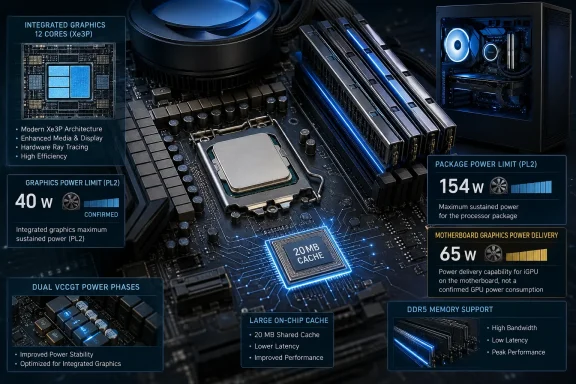 The 40 W figure changes how the 65 W leak should be read
Late-July reporting from Tom’s Hardware, Hardwareluxx, and IT Home relayed Jaykihn’s earlier claim that one Nova Lake-S configuration would need a dedicated “65 W-level” VCCGT power-delivery segment and two VCCGT phases to deliver its full graphics performance. VCCGT is the processor supply rail used for integrated graphics; it is separate from the CPU core voltage rail on desktop motherboards.
Those reports were broadly interpreted as evidence that Intel’s integrated GPU itself would consume 65 W. The reported 40 W iGPU PL2 now points to something more specific: 65 W appears to describe the capacity of the board’s graphics power-delivery design, including transient current headroom, rather than a declared sustained or boost draw for the GPU.
That is an important correction in emphasis. A motherboard rail designed to supply roughly 65 W does not establish that the graphics block regularly uses 65 W, just as a 1,000 W PC power supply does not mean the computer draws 1,000 W. The 40 W graphics PL2 is still only a leaked limit, and the report does not disclose its boost duration, thermal conditions, graphics clock, voltage curve, or whether it applies to every workload. Those omissions prevent a usable estimate of actual gaming power draw.
The claimed 154 W package PL2 also needs careful reading. It is a short-term chip-wide boost ceiling rather than a 154 W rating for the iGPU, and it does not mean CPU and graphics workloads will each sustain their individual maximums at once. Intel’s final firmware can impose additional current, temperature, and time-window limits, while motherboard vendors often expose their own power behavior through BIOS defaults.
The new leak therefore narrows one misconception while creating another question: whether the “65 W-level” requirement is a strict electrical specification for Nova Lake-S motherboards, a design target for selected board tiers, or merely an early validation-board requirement. No public Intel platform guide has answered that yet.
The alleged 20 MB L2 cache is the larger architectural clue
The reported graphics cache figures are arguably more consequential than the power numbers. Notebookcheck says the 12Xe3P block in the Nova Lake-S part has 20 MB of L2 cache, while the 12Xe3 GPU in Panther Lake has 16 MB.
Intel’s Panther Lake announcement confirms that its Arc GPU scales to 12 Xe cores, and Intel’s public material positions Panther Lake as a mobile platform. Independent coverage from PCWorld describes the 12Xe Panther Lake design as having 16 MB of L2 cache, versus 4 MB in the smaller 4Xe configuration. That makes the 16 MB Panther Lake figure well grounded. The alleged 20 MB Nova Lake figure, however, currently rests on the new Jaykihn leak alone.
If accurate, the increase is meaningful because an integrated GPU shares system memory with the CPU. Desktop DDR5 offers plenty of capacity but far less bandwidth than the dedicated GDDR6 or GDDR7 memory attached to a discrete graphics card. A larger L2 cache cannot eliminate that bottleneck, but it can reduce repeat trips across the memory fabric for data the GPU can reuse.
That is precisely the sort of change Intel would need to make a 12-core desktop iGPU viable. More Xe cores alone can increase demand for bandwidth faster than a dual-channel desktop memory subsystem can feed them. Adding 4 MB of L2 cache over Panther Lake’s 12Xe design would not automatically deliver a proportional performance gain, but it would improve the odds that the wider graphics block spends less time waiting on system RAM.
The designation matters, too. Xe3P is not simply a marketing suffix that can be assumed to perform like Panther Lake’s Xe3 graphics. Prior leaks have characterized Xe3P as the graphics variant reserved for the larger 12Xe configurations, while smaller Nova Lake integrated GPUs reportedly retain Xe3. Intel has not publicly defined Xe3P’s cache, rendering, media, display, clock, or feature differences. Until it does, cache size is the only newly reported concrete differentiator—not a performance result.
The 4P+8E+4LP-E configuration is consistent; one report got it wrong
The desktop APU-like SKU is reportedly built from four performance cores, eight efficiency cores, four low-power efficiency cores, and 12 Xe3P graphics cores—a 16-core CPU configuration before counting the graphics hardware.
This configuration has been repeated across the original Jaykihn-based reporting: Hardwareluxx and IT Home both describe it as 4P+8E+4LP-E. Tom’s Hardware, however, wrote in its text that the part had “8 P-cores, 4 E-cores, and 4 LP-E cores,” an inversion that would produce the same 16-core total but a very different processor. Its own Nova Lake-S table directly below lists the 16-core entry as 4+8+4.
That is a reporting error, not evidence of two separate 16-core products. The corroborating descriptions and Tom’s Hardware’s own table favor 4P+8E+4LP-E. It is a useful example of why core counts should not be accepted merely because the total adds up; the P-core/E-core split shapes both CPU behavior and power allocation during combined CPU-and-GPU loads.
The LP-E cores should also not be mistaken for a fourth conventional CPU cluster aimed at heavy desktop work. On Intel’s recent client designs, low-power cores are intended for lower-intensity background and efficiency-oriented tasks. Their presence may help the chip’s idle or light-load behavior, but they do not tell us how the processor will perform while the 12Xe3P graphics block is gaming, encoding, or handling GPU compute.
Motherboard compatibility may become part of the product decision
The strongest practical consequence of the leak is not the quoted 154 W package PL2. It is the possibility that Intel’s highest-integrated-graphics Nova Lake-S part could require board-level VCCGT provisioning that some lower-cost motherboards omit or limit.
Tom’s Hardware notes that one VCCGT phase often serves around 30 W, while Hardwareluxx and IT Home report that this particular 12Xe3P SKU is the only known Nova Lake-S configuration expected to need two VCCGT phases. Those publications are reporting the same leaker-originated claim rather than independently validating board designs, so it remains unconfirmed. Still, it describes a credible problem category: a CPU that physically installs and boots, yet cannot reach the advertised iGPU behavior on a board designed around ordinary display-only integrated graphics.
That would be unfamiliar territory for many desktop Intel buyers. Most recent socketed Intel processors include iGPUs adequate for display output, media acceleration, troubleshooting, and light graphics work, but motherboard purchasing rarely turns on the robustness of the graphics voltage rail. A 12Xe3P Nova Lake-S part would change that calculation. Board vendors may need to identify compatible models explicitly, expose VCCGT telemetry in firmware, and disclose whether lower-end boards reduce graphics clocks or power targets.
Memory will remain the second half of that decision. Even if the 20 MB L2 figure is correct and the board has two VCCGT phases, an integrated GPU still relies on system DDR5. A budget-oriented system with one DIMM or slow memory would undermine the purpose of paying for the unusually large graphics configuration. The chip’s performance will likely depend on the entire platform—firmware, board power delivery, dual-channel memory population, memory speed, and cooling—not merely the CPU model.
Benchmarks, sustained limits, and product positioning remain absent
No benchmark accompanies the leak. There is no disclosed GPU clock, no confirmed memory specification, no test system, no sustained package power limit, no pricing, and no indication whether the 12Xe3P model will ship broadly or remain a narrowly targeted SKU. There is also no evidence that it will be unlocked, whether it will pair with Intel’s rumored large cache variants, or how its media engine and display capabilities compare with Panther Lake.
Intel’s official Panther Lake material claims up to 12 Xe cores and more than 50% faster graphics performance than the previous generation, but those claims cannot be transferred to Nova Lake-S. Panther Lake is mobile silicon with its own package, memory options, power policy, and thermal environment. Nova Lake-S may have more electrical headroom, but a desktop’s dual-channel DDR5 memory design introduces its own constraints.
The reported 40 W iGPU PL2 and 20 MB L2 cache make the rumored 12Xe3P Nova Lake-S model more plausible as a serious compact-PC or entry-level gaming option than Intel’s usual desktop integrated graphics. They do not establish final performance. The next meaningful disclosure needs to be a motherboard compatibility list and sustained gaming measurements with declared DDR5 settings—because those will determine whether Intel has created a useful socketed desktop APU or merely a capable iGPU confined to a handful of carefully provisioned boards.
References
- Primary source: Notebookcheck
Published: August 9, 2026 at 12:45 AM UTC
Loading…
www.notebookcheck.net - Related coverage: tomshardware.com
Intel's upcoming Nova Lake desktop SKU to require 65W of separate power delivery for its iGPU, leaker claims — beefy integrated graphics could require two VCCGT phases for 12 Xe3P cores | Tom's Hardware
One VCCGT phase can usually sustain up to 30W safely.www.tomshardware.com - Related coverage: newsroom.intel.com
Intel Unveils Panther Lake Architecture: First AI PC Platform Built on 18A - Intel Newsroom
Panther Lake will enter high-volume production at Intel’s newest fab in Arizona later this year as the company invests in strengthening U.S. technology and manufacturing leadership.newsroom.intel.com - Related coverage: techtimes.com
Loading…
www.techtimes.com - Related coverage: neowin.net
Loading…
www.neowin.net - Related coverage: techspot.com
Loading…
www.techspot.com - Related coverage: edc.intel.com
Loading…
edc.intel.com - Related coverage: hardwareluxx.de
Loading…
www.hardwareluxx.de - Related coverage: pcworld.com
Intel's 'Panther Lake' laptop CPU explained: all the details | PCWorld
Intel's Panther Lake chip for laptops includes more cores and powerful new AI technologies for graphics and wireless as it readies its flagship processor for early 2026. This is a deep dive on what the next Core Ultra chip contains.www.pcworld.com - Related coverage: edc.intel.com
Loading…
edc.intel.com - Related coverage: marketplace.intel.com
Loading…
marketplace.intel.com - Related coverage: cdrdv2-public.intel.com
Loading…
cdrdv2-public.intel.com - Related coverage: intel.com
Loading…
www.intel.com - Related coverage: discussions.wccftech.com
Loading…
discussions.wccftech.com - Related coverage: tomshardware.com
Loading…
www.tomshardware.com - Related coverage: discussions.wccftech.com
Loading…
discussions.wccftech.com - Related coverage: technerdo.com
Loading…
www.technerdo.com