
That distinction matters. Server CPU buyers do not purchase processors simply by counting cores; they buy a platform’s ability to sustain useful work across virtual machines, databases, web services, analytics jobs, high-performance computing, and AI-adjacent infrastructure. By restoring SMT to a future Xeon P-core generation, Intel is acknowledging that a hardware thread remains a valuable scheduling and utilization tool—even in an era of 128-core, 192-core, and eventually far denser server CPUs.
The announcement also adds important context to Intel’s rapidly evolving Xeon roadmap. The company had already said in its fourth-quarter 2025 earnings materials that Coral Rapids would bring multithreading back to the data-center roadmap, while resources were being concentrated on Diamond Rapids and on accelerating Coral Rapids. The latest earnings-call discussion turns that strategic direction into a clearer competitive message: Intel wants higher single-thread performance and the additional throughput opportunity SMT can create. Intel’s Q4 2025 earnings-call comments
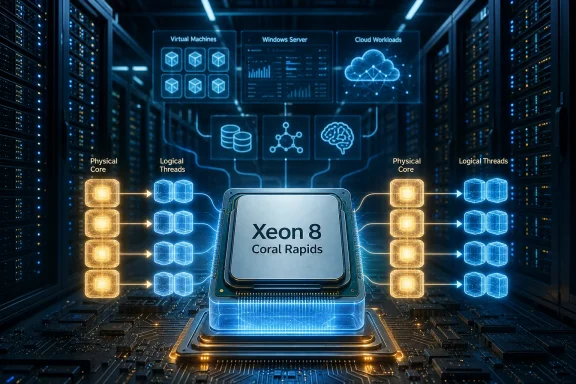 A Return to a Familiar Xeon Formula
For more than two decades, Hyper-Threading was one of the most recognizable elements of Intel’s processor story. Intel formally demonstrated the technology in 2001, describing it as a simultaneous multithreading design that allowed one physical processor to manage instructions as though it were two logical processors. Xeon was at the center of that initial deployment plan, with server systems slated to receive the feature in 2002. Intel’s 2001 Hyper-Threading announcement
The basic idea has remained consistent even as the underlying microarchitectures have changed dramatically. A physical CPU core has finite execution resources: instruction-fetch capability, decoders, execution ports, caches, load/store machinery, and other units. Workloads frequently fail to keep every resource busy at every instant because one thread is waiting on data, encountering a branch, or otherwise leaving an opportunity for another instruction stream to make progress.
SMT attempts to exploit those gaps. Intel’s implementation exposes two architectural states per physical core so the operating system can schedule two logical processors. The two threads do not receive two independent cores; they share major execution resources. Yet, when their demands complement each other, overall throughput can rise without doubling the physical core count, area, or platform footprint. Intel’s Xeon Hyper-Threading tuning guide
That qualifier—when their demands complement each other—is essential. Hyper-Threading is not a universal doubling of performance, and a 128-core CPU with 256 threads is not the practical equivalent of a 256-core CPU. But in server environments built around concurrency, virtualization, and service density, logical threads can be economically meaningful.
Intel’s own current Xeon guidance explains the relationship plainly: Hyper-Threading allows a Xeon core to handle two execution threads by duplicating selected elements such as register files while sharing execution resources. It can improve responsiveness and throughput, particularly for multithreaded workloads, while a virtual CPU can be mapped by the host to a physical core or to a Hyper-Threading logical processor. Intel’s Xeon vCPU, core, and Hyper-Threading documentation
Why Intel Moved Away From Hyper-Threading
The return of SMT is notable precisely because Intel spent several years reducing its role across product lines.
The shift began with the company’s hybrid-core era. Intel’s Alder Lake desktop architecture combined Performance-cores and Efficient-cores, but Hyper-Threading was limited to P-cores. The E-cores were single-threaded by design, reflecting a different trade-off centered on density, efficiency, and simpler core replication. That division made sense in client PCs, where background activity, peak responsiveness, thermals, and power limits must coexist in a compact package.
The logic became still clearer in servers. Intel’s Xeon product strategy increasingly split into two broad execution models:
- P-core Xeons, aimed at workloads needing stronger individual-core performance, including databases, AI-adjacent compute, HPC, and demanding enterprise applications.
- E-core Xeons, aimed at cloud-native services, scale-out workloads, telecom, and scenarios where exceptional core density and performance per watt are the primary objectives.
Intel’s Xeon 6 platform established this bifurcated approach. The P-core version, code-named Granite Rapids, launched in September 2024 and was presented as a processor line for critical workloads such as AI, HPC, and databases. Intel’s Xeon 6 P-core launch material
Granite Rapids retained Hyper-Threading. Intel’s product database lists the flagship Xeon 6980P with 128 physical cores, and the product line supports two threads per P-core—yielding the familiar 256-thread configuration at the top end. Intel’s Granite Rapids Xeon product listing
But Intel’s follow-on E-core strategy took the opposite path. Xeon 6+ “Clearwater Forest”, the 18A-based E-core processor line, scales to as many as 288 E-cores without SMT. Intel has positioned the chip for hyperscalers, cloud providers, and telecom operators, claiming a 17% instructions-per-clock improvement over the preceding Sierra Forest E-core generation alongside substantial density and efficiency gains. Intel’s Clearwater Forest overview
The message behind Clearwater Forest was unmistakable: if a processor can fit enough efficient physical cores into a power envelope, the second logical thread on each core may be less compelling than more actual cores. That approach remains valid for many scale-out server jobs. A cloud operator running vast fleets of lightweight services may value predictable per-core behavior, power efficiency, and physical core density more than SMT’s variable incremental throughput.
However, the future Diamond Rapids P-core generation is expected to move away from SMT, creating a potentially important gap in Intel’s high-performance Xeon story before Coral Rapids arrives. TechSpot
Coral Rapids Changes the Strategic Direction
Coral Rapids is not simply “the Xeon with Hyper-Threading switched back on.” The decision implies a reassessment of where Intel can differentiate its P-core server products.
At the earnings call, Tan framed Intel’s task around regaining competitiveness in retail and enterprise CPUs, with the roadmap encompassing Clearwater Forest, Diamond Rapids, and Coral Rapids. Reporting on the call indicated that Intel’s near-term emphasis was meeting demand rather than chasing market share for its own sake, but the roadmap itself was presented as central to strengthening Intel’s position. Investing.com’s Q2 2026 Intel earnings-call transcript
That is a more nuanced rationale than “Intel changed its mind.” It suggests the company is attempting to optimize different generations for different points in a competitive cycle.
Diamond Rapids appears to represent a design where Intel prioritized high per-thread performance and a substantial physical-core count without the added design, validation, scheduling, and security complexity of SMT. Coral Rapids, by contrast, is being shaped to add another lever: improved single-thread capability combined with the capacity to fill otherwise idle portions of a high-performance core.
For customers, that may make Coral Rapids a more attractive processor for workloads such as:
- Large virtual machine estates with mixed and uneven CPU demand.
- Database servers that combine latency-sensitive query work with background maintenance.
- Java,.NET, and application-server deployments with many runnable software threads.
- Container platforms where thread-level scheduling density affects consolidation ratios.
- Enterprise middleware and web infrastructure with bursty, concurrent requests.
- Select AI inferencing, data preparation, and orchestration services where CPU-side concurrency still matters.
The value proposition will not be identical across all of those workloads. A bandwidth-bound database may gain little if memory channels or cache capacity become the controlling bottleneck. A compute-heavy HPC application may prefer one thread per core if it needs predictable access to the full execution engine. And a poorly scheduled virtualized environment can turn extra logical CPUs into a source of contention rather than efficiency.
Still, Hyper-Threading gives platform operators another configuration choice. That is especially relevant in data centers where CPU licensing, server count, power delivery, rack capacity, cooling, and software topology must all be balanced together.
Core Count Is Not the Whole Performance Story
The industry’s focus on core counts is understandable. Physical cores are tangible, easy to market, and often crucial for workloads with abundant independent work. Intel itself has pursued aggressively higher server core counts, as shown by Granite Rapids at up to 128 P-cores and Clearwater Forest at up to 288 E-cores. Intel’s Granite Rapids product database Intel’s Clearwater Forest preview
But a data center does not run a benchmark chart. It runs a varied and often imperfect workload mix.
A processor core can be underutilized for reasons that have nothing to do with poor software quality. The thread may be waiting for a cache miss, a memory fetch, a branch-resolution outcome, I/O completion, a lock, or another thread. SMT cannot solve every one of those bottlenecks, but it can provide an alternate stream of work for the core’s otherwise unused resources.
This makes throughput per rack, throughput per watt, and virtual-machine density more complicated metrics than raw core counts suggest. A 192-core processor without SMT can be the correct choice for one business, while a lower-core-count processor with strong P-cores and two hardware threads per core can be preferable for another.
The Windows Server angle
For Windows Server administrators, the practical implication is not that Coral Rapids will automatically accelerate every workload. It is that logical processor topology could once again become a more prominent planning factor in future Xeon deployments.
Windows Server, Hyper-V, SQL Server, and enterprise applications frequently operate in environments where thread placement, processor groups, NUMA boundaries, vCPU allocation, and licensing constraints matter. A Coral Rapids system that exposes two logical processors per P-core could offer better consolidation behavior in some mixed-tenant or burst-oriented scenarios, but it will also require administrators to continue treating vCPUs as scheduling resources, not as guaranteed dedicated physical cores.
That distinction is already embedded in Intel’s own explanation of Xeon virtualization: a vCPU can map to either a physical core or a Hyper-Threading logical processor. Intel’s Xeon virtualization documentation
For IT teams, the result is a familiar but important operational rule: benchmark the application stack, not merely the processor specification sheet.
Strengths of Bringing SMT Back
The most compelling argument for Coral Rapids Hyper-Threading is that it restores architectural flexibility to Intel’s P-core Xeon roadmap.
Better opportunity for throughput gains
SMT gives a core more chances to execute useful instructions while another thread is stalled. Intel characterizes Hyper-Threading as a way for a CPU to process more information and run more background work with less disruption, though actual gains depend heavily on software, system configuration, and workload behavior. Intel’s Hyper-Threading explainer
In server workloads with abundant thread-level parallelism, that can be a material advantage. The benefit may be especially relevant where buying more sockets, more servers, or more software licenses is substantially more expensive than extracting better utilization from the cores already installed.
A stronger virtualization proposition
Hypervisors can schedule more logical execution contexts than the physical-core count alone would suggest. This does not mean a host should blindly double every virtual machine allocation, but it can improve flexibility in environments where workloads have different peaks and troughs.
Cloud providers and private-cloud operators have long relied on carefully managed overcommit ratios. Coral Rapids could offer Intel-based platforms a more competitive option for customers who prioritize VM density and broad concurrency alongside strong per-core performance.
A more credible answer to mixed workloads
The server market is increasingly fragmented. A single company might operate traditional databases, virtual desktop infrastructure, container clusters, API gateways, AI pipeline services, Windows Server application stacks, and security tools from the same data centers.
No single CPU design is ideal for every one of those jobs. Intel’s emerging lineup—E-core Xeons for extreme density and P-core Xeons with SMT returning in Coral Rapids—could be more compelling than a one-size-fits-all strategy.
A potential competitive differentiator
Intel’s decision is also a statement about what the company believes will matter in the latter part of the decade. Rather than relying entirely on additional physical cores, Coral Rapids is intended to combine broader thread capacity with stronger single-threaded performance. TechSpot
That does not guarantee leadership against competing x86 and Arm server offerings. It does mean Intel is preserving a design option that can matter in workload categories where utilization of a large, capable P-core is as important as the number of cores on the package.
Risks, Trade-Offs, and the Security Reality
Hyper-Threading’s return should not be read as a declaration that SMT is universally beneficial. Intel’s own technical documentation makes clear that the two logical processors on an SMT-enabled Xeon core share execution resources. Intel’s Xeon Hyper-Threading tuning guide
That creates several risks and trade-offs.
Performance can be inconsistent
Two threads that compete for the same execution ports, cache capacity, bandwidth, or other shared resources can interfere with one another. Depending on the workload, enabling SMT may produce a healthy throughput gain, a negligible improvement, or reduced predictability.
Latency-sensitive applications often care more about tail latency than average throughput. Financial services, real-time analytics, high-performance databases, and certain networking workloads may choose to run one software thread per physical core even when SMT is available.
The right answer will depend on measurements. Coral Rapids should be evaluated with SMT enabled and disabled, with attention to throughput, p99 latency, power, thermals, and application-specific service-level objectives.
Software licensing remains complicated
Some commercial software is licensed per physical core, some per socket, some per VM, and some through other capacity metrics. Hyper-Threading does not usually double the count of physical cores for licensing purposes, but licensing rules vary by vendor and product.
That makes it vital to distinguish between:
- Physical cores
- Logical processors / hardware threads
- Assigned vCPUs
- Licensed cores
- Actual application concurrency
Administrators should not assume that more reported logical CPUs directly translate to a more favorable licensing position—or, conversely, to an unfavorable one. Product-specific licensing documentation will remain the authority.
SMT carries a security-management burden
Shared microarchitectural resources have also been relevant to several side-channel security discussions over the years. Intel’s guidance on the SMoTherSpectre proof of concept, for example, described a side channel exploiting port contention during speculative execution with simultaneous multithreading, while pointing to mitigation approaches such as STIBP rather than recommending a blanket shutdown of Hyper-Threading. Intel’s SMoTherSpectre guidance
Intel’s Gather Data Sampling guidance likewise explains that affected systems could expose stale vector-register data from a sibling thread on the same physical core under specific circumstances. Intel provided microcode mitigation and stated that the threat model should guide decisions about mitigation; it also noted that cross-thread exposure is mitigated when the relevant patch is loaded. Intel’s Gather Data Sampling guidance
The takeaway for future Coral Rapids customers is pragmatic:
- Keep BIOS, firmware, hypervisor, and operating system updates current.
- Review Intel’s platform-specific security guidance once Coral Rapids hardware ships.
- Understand whether a workload involves mutually untrusted tenants or unusually sensitive code.
- Test the performance impact of mitigations rather than assuming they are free.
- Preserve the option to disable SMT in firmware or platform policy where the risk model demands it.
Security is not an argument against SMT by default. It is an argument for making SMT deployment a deliberate platform decision, particularly in multi-tenant and confidential-computing environments.
What Intel Has—and Has Not—Promised
The confirmation is meaningful, but it remains a long-range roadmap commitment. Coral Rapids is scheduled for 2028, leaving several years for Intel to finalize its architecture, manufacturing choices, product segmentation, and launch timing. TechSpot
Intel has also not confirmed a return of Hyper-Threading to client CPUs. That omission is significant. Desktop and laptop processors face different constraints around battery life, power draw, peak responsiveness, die space, hybrid-core design, and product differentiation. Server P-cores may gain from SMT for reasons that do not automatically apply to a consumer Core processor.
Nor has Intel released the specifications that will ultimately determine Coral Rapids’ real-world impact:
- Physical core counts.
- Thread counts per SKU.
- Memory-channel configuration and bandwidth.
- Cache hierarchy.
- Power envelopes.
- Socket and platform compatibility.
- Accelerator blocks and AI features.
- Security architecture and mitigation behavior.
- Launch windows by segment and availability tier.
Any precise performance projection before those details arrive would be speculative. The strategic signal, however, is already clear: Intel sees SMT as a feature worth restoring when the goal is to build a high-performance server CPU that must excel at both individual-thread speed and broad concurrent throughput.
The Bottom Line
Intel’s decision to bring Hyper-Threading back with Xeon 8 Coral Rapids is a notable course correction, but it is better understood as a refinement of the company’s server strategy than a retreat from high-core-count computing. Clearwater Forest shows Intel still believes strongly in massive counts of single-threaded E-cores for scale-out efficiency. Granite Rapids proves that SMT-equipped P-core Xeons remain part of the company’s present portfolio. Coral Rapids suggests that, by 2028, Intel intends to make thread-level flexibility central to its next major P-core data-center push.
For Windows Server shops, virtualization teams, and enterprise infrastructure planners, the most important message is straightforward: logical threads are returning as a first-class Xeon capability, and they may again shape server consolidation, workload placement, and CPU evaluation. Physical core counts will continue to matter. But Intel is betting that, for the next phase of server competition, the best Xeon will need to do more than add cores—it will need to make every core work harder.
