
The most compelling part of the iPhone Ultra story is not its rumored price, its titanium construction, or even the possibility of a nearly invisible display crease. It is the prospect that Apple may finally adapt iOS to make a large, folding display genuinely useful. A book-style foldable only succeeds when software understands the difference between a phone screen and a tablet-like workspace. Apple’s reported iOS 27 changes suggest the company recognizes that challenge.
Yet the iPhone Ultra also appears set to involve meaningful compromises. Reports point to dual rear cameras rather than the full three-camera array expected on Pro models, Touch ID instead of Face ID, and a potential starting price around $1,999. For a first-generation foldable, the questions are obvious: can Apple deliver durability, practical multitasking, strong battery life, and a convincing reason to pay more than for both a conventional iPhone and a capable tablet?
 Overview: Apple’s Foldable iPhone Could Redefine the “Ultra” Label
Apple has used the Ultra label sparingly, reserving it for products positioned above the normal premium tier. The Apple Watch Ultra established the basic formula: more specialized hardware, more durability, a larger physical presence, and a higher price justified by distinct capabilities rather than simple cosmetic upgrades.
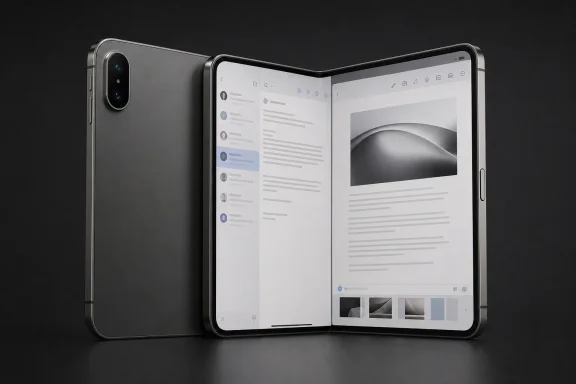
An iPhone Ultra would apply that approach to the company’s most important product. Rather than merely giving buyers a larger screen or a more powerful camera system, Apple’s foldable could introduce an entirely different way to use an iPhone. Closed, it would act as a compact smartphone. Opened, it would provide a display approaching the footprint of an iPad mini.
That distinction matters because foldable phones have often struggled with identity. Some have been excellent phones that become awkward tablets. Others have delivered ambitious multitasking features but retained tall, narrow outer displays that feel compromised for basic everyday use. Apple’s reportedly wider cover screen and near-square internal panel could represent an effort to avoid both extremes.
The device is still unannounced, and every detail should therefore be treated as rumored rather than confirmed. But the consistency of reports around the core concept makes the broad outline increasingly credible: a book-style folding iPhone, a wide external display, an approximately 7.8-inch internal display, a thin titanium body, Apple silicon, and software built around flexible app layouts.
Feature One: A Book-Style Foldable Design Built Around a Wider Shape
The defining feature of the iPhone Ultra is expected to be its book-style folding design. Unlike a flip phone that folds a regular-sized smartphone into a smaller square, the rumored Ultra would open horizontally into a larger tablet-like canvas.
Wider Than Traditional Foldables
Many current foldable phones use unusually tall cover displays. Those designs can be comfortable for scrolling feeds and holding one-handed, but they can also make typing, video playback, web browsing, and ordinary apps feel cramped when the phone is closed.
Apple’s reported approach is notably different. The outer display is expected to be shorter and wider than the screens found on typical iPhones, with estimates placing it in the 5.3-inch to 5.5-inch range. On paper, that sounds comparable to an older compact iPhone. In practice, screen dimensions alone do not tell the full story.
A wider aspect ratio changes how the device feels in the hand and how apps use the panel. A 5.5-inch display with a broad shape can offer considerably more usable width than a narrow, elongated phone display with the same diagonal measurement. It could make the external screen feel less like a compromise and more like a legitimately capable primary phone display.
When opened, the iPhone Ultra is expected to reveal an internal panel measuring around 7.6 inches to 7.8 inches. That would place it close to the small-tablet category, especially if Apple uses a more square layout instead of a cinematic widescreen format.
Titanium, Extreme Thinness, and Mechanical Complexity
Reports suggest the iPhone Ultra will use a titanium border or chassis, echoing Apple’s recent emphasis on lightweight premium materials. Titanium makes sense for a foldable because the device has to meet competing requirements:
- It must be thin enough to avoid feeling like two phones stacked together.
- It must be rigid enough to protect the internal display.
- It must survive repeated opening and closing.
- It must leave enough internal volume for batteries, cameras, antennas, cooling, and processing hardware.
A foldable smartphone is not simply a normal phone divided by a hinge. It is a mechanical system with moving parts, flexible display layers, cable routing, structural reinforcement, and two separate screens. Every millimeter becomes more difficult to engineer.
The suggestion that the Ultra could resemble “two iPhone Airs” when folded is useful as a visual shorthand, but buyers should be cautious about assuming that thinness automatically means effortless portability. Even a very thin foldable becomes thicker when closed because it contains two display halves, a hinge assembly, and structural layers that a normal iPhone does not require.
The Crease-Free Display Ambition
Perhaps the most important hardware claim is that Apple’s inner display may be crease-free or close enough that the fold line is difficult to notice. This would be a major achievement if realized in everyday use.
The crease is one of the most persistent weaknesses in foldable hardware. It can be visible at certain angles, noticeable to the touch, and distracting when reading, drawing, editing photos, or using a bright white interface. Eliminating or substantially reducing it would give Apple a meaningful quality advantage.
However, “crease-free” needs careful interpretation. No folding display is likely to be perfectly flat under every lighting condition and viewing angle. The more practical benchmark is whether the crease remains unobtrusive during normal use after months or years of opening and closing the device. Apple’s reputation will depend less on how the display looks in a launch video and more on how it holds up after real-world ownership.
Feature Two: Two Displays With Two Very Different Jobs
The iPhone Ultra is expected to rely on two displays: a smaller outer screen for quick phone tasks and a larger inner screen for reading, media, creativity, communication, and multitasking.
The Outer Display Must Be a Real Phone Screen
A foldable device becomes frustrating if users need to unfold it for every reply, every map check, every email, or every authentication request. The cover screen must be capable enough that opening the device feels optional rather than mandatory.
The rumored 5.3-inch to 5.5-inch outer display could be especially appealing to users who miss compact iPhones but do not want to sacrifice access to a larger screen entirely. A wide cover panel may make it easier to type, manage notifications, use messaging apps, take calls, and run navigation without repeatedly opening the device.
This design could also solve a common foldable tension. Buyers want a device that is compact in a pocket, but they do not want a narrow or awkward phone when it is closed. Apple’s proposed proportions suggest that usability may have taken precedence over chasing the thinnest possible silhouette.
The Inner Display Is the Product’s Real Reason to Exist
The internal screen is expected to be the iPhone Ultra’s central selling point. A roughly 7.8-inch display could create enough room for experiences that ordinary iPhones cannot comfortably offer:
- Two apps side by side for messaging, research, or planning.
- Larger maps and travel itineraries.
- Expanded timelines for photo and video editing.
- Spreadsheet review and document markup.
- Bigger canvases for note-taking and sketching.
- More immersive reading, gaming, and video playback.
- Better dashboard-style views for smart-home controls and productivity apps.
For Windows users who work across multiple devices, the potential benefit is not that an iPhone Ultra replaces a Windows PC. It will not. Instead, it could reduce the number of moments when a task must wait until a laptop or tablet is available.
Reviewing a shared document, responding to an Outlook email while referencing a Teams conversation, checking a OneDrive file, or comparing web pages could become substantially more practical on a foldable display. That is the difference between a large screen that looks impressive and one that changes daily workflow.
Aspect Ratio Will Shape the Experience
The reported iPad mini-like inner panel may be more important than the diagonal size itself. A square-ish display supports side-by-side apps and document viewing more naturally than a tall, narrow screen. It also gives apps room to use sidebars, multi-column layouts, and wider controls.
The trade-off is video. Most movies and streaming content use wide aspect ratios, which means black bars may be visible above and below the image on a squarer display. Apple will likely emphasize productivity and flexible layouts rather than promise a perfect screen shape for every task.
That is a sensible choice. A foldable phone does not need to be ideal for every type of media. It needs to make a convincing case that it can perform several valuable tasks better than a regular phone without becoming too inconvenient when closed.
Feature Three: A Camera System That May Prioritize Thinness Over Zoom
The iPhone Ultra is rumored to include a dual-camera rear system with a 48MP main camera and a 48MP ultra-wide camera. It may also include two front-facing cameras, one associated with each display.
This would give the device a capable camera setup, but not necessarily the most versatile one in Apple’s lineup.
Two Rear Cameras, No Dedicated Telephoto
The biggest reported omission is a dedicated telephoto camera. If Apple follows through with a two-lens configuration, the iPhone Ultra may lack the optical zoom versatility expected from the Pro and Pro Max models.
That is an understandable compromise from an engineering perspective. A folded device has strict thickness limits, and telephoto modules often require significant internal space. Folding designs also need to allocate room for the hinge, dual battery cells, internal display support layers, and the outer display.
Still, the omission would matter at this price. Buyers spending around $2,000 may reasonably expect the most capable camera system Apple offers. If a cheaper iPhone 18 Pro or iPhone 18 Pro Max provides stronger optical zoom, the Ultra may be positioned as the most innovative iPhone rather than the unequivocally best one.
Dual Front Cameras Could Improve Everyday Use
A foldable iPhone benefits from two front-facing cameras because it has two primary modes. The outer camera supports conventional phone use when the device is closed. The internal camera supports video calls, selfies, conferencing, and other tablet-style uses when the phone is unfolded.
Reports indicate a hole-punch design and suggest Apple may use an 18MP Center Stage camera similar to the front-facing technology introduced on newer iPhone models. If that happens, the key benefit may be framing rather than resolution. Center Stage-style tracking can keep people visible during calls, which is especially useful when a larger foldable is propped up on a desk.
The extra display also opens up a useful camera possibility: using the outer screen as a live preview while taking photos with the rear cameras. That is already a popular feature on competing foldables, and it could make the Ultra a strong tool for group shots, portraits, and self-recorded video.
Camera Quality Cannot Be Judged by Megapixels Alone
The reported 48MP specifications should not be treated as a complete measure of camera quality. Apple’s image processing, sensor size, lens aperture, stabilization, computational photography, and video pipeline will matter more than the number printed on a specification sheet.
The more important question is whether the Ultra’s camera system can meet the expectations created by its price. A dual-camera array may be entirely sufficient for many people. But buyers who regularly photograph sports, wildlife, concerts, travel, or distant subjects may find the lack of dedicated telephoto hardware difficult to accept.
Feature Four: iOS 27 Could Be the Deciding Factor
Hardware will draw attention, but iOS 27 may determine whether the iPhone Ultra succeeds. Apple has historically been cautious about putting iPad-style multitasking on the iPhone, even on the biggest Pro Max models. A foldable changes the equation.
Side-by-Side Apps on a Foldable iPhone
The most consequential reported software feature is support for two apps side by side on the inner display. This is the capability that turns a large screen from a passive viewing surface into a workspace.
Imagine checking a calendar beside an email thread, comparing a shopping list against a browser, keeping Messages open while reviewing a shared document, or following a Microsoft Teams meeting while reading an agenda. Those are not revolutionary desktop workflows, but they are precisely the type of tasks that become far less painful when an iPhone can show two active apps at once.
Apple’s approach appears likely to focus on structured layouts rather than unrestricted desktop-style windowing. That may disappoint users hoping for a miniature macOS experience. But it could also result in a cleaner, more predictable interface better suited to a mobile device.
iPad-Like Layouts Without Becoming an iPad
Reports also point to adapted app layouts, including sidebars and expanded landscape views. Apple has already shown a growing willingness to make iPhone apps behave more flexibly across different orientations and screen sizes.
The foldable challenge is bigger than merely scaling an app up. A blown-up phone interface wastes space. A true tablet interface can feel excessive or cramped if it is simply transplanted to a new form factor. The best iPhone Ultra apps will need to transition smoothly between cover display, partially open use, and the fully unfolded panel.
For Apple, that means ensuring first-party apps are ready from day one. Messages, Mail, Safari, Photos, Files, Notes, Calendar, Maps, Music, Freeform, and FaceTime all need thoughtful layouts. For developers, it means supporting dynamic resizing, rotation, state restoration, and responsive interface design.
A Major Test for App Developers
The iPhone Ultra could become an unexpected test of the iOS ecosystem. Developers have long optimized for a relatively predictable set of iPhone screen shapes. A foldable introduces new sizes, transitions, and orientations that require more deliberate design work.
That is not necessarily a problem. Modern iOS development tools increasingly support adaptive interfaces, and Apple has experience guiding developers through display transitions. But compatibility is not the same as optimization.
A banking app may technically fill the large display. A truly optimized banking app might show transaction details and account navigation side by side. A news app may technically enlarge text and images. A well-designed version may place sections, saved stories, and article content into a more useful multi-column layout.
The iPhone Ultra’s value will rise or fall with these details.
Feature Five: A20 Pro, More Memory, and Apple’s C2 Modem
The iPhone Ultra is expected to use Apple’s next-generation A20 Pro chip alongside an Apple-designed C2 cellular modem. If accurate, that combination would make the foldable a showcase for Apple’s silicon ambitions.
Why a 2-Nanometer Process Matters
The A20 Pro is widely expected to use a 2-nanometer manufacturing process, representing a significant step beyond earlier generations. In practical terms, a smaller process can improve performance efficiency, allowing more computing power or lower energy use within a similar thermal envelope.
That matters especially for a foldable. The device may need to power two high-quality displays, manage advanced multitasking, run demanding games and creative apps, process camera data, and maintain strong cellular performance—all while remaining thin.
Reports also point to Wafer-Level Multi-Chip Module packaging, or WMCM, which could improve component integration and efficiency. Although such technical advances rarely make for an exciting marketing slogan, they are essential to delivering a premium experience without compromising battery life or creating excess heat.
12GB of RAM Is a Practical Requirement
The iPhone Ultra is expected to include 12GB of RAM, matching the rumored Pro-tier configuration. That would be particularly important for multitasking.
Running two apps side by side requires more memory than keeping a single foreground app active. The device needs to preserve app states, support rapid transitions between display modes, and avoid aggressively reloading apps whenever the user unfolds or refolds the phone.
More memory will not magically make all apps more capable. But it can help the Ultra feel consistent, responsive, and less constrained when the large internal display encourages users to do more at once.
C2 Modem: More Control, More Responsibility
Apple’s reported C2 modem would be the company’s next-generation in-house cellular solution. Moving modem development in-house gives Apple more control over power efficiency, radio integration, and long-term product planning.
The potential advantages are meaningful:
- Improved energy efficiency during cellular use.
- Tighter integration with Apple silicon and system software.
- More flexibility in future device design.
- Reduced dependence on external modem suppliers.
- Better opportunities to tailor connectivity behavior to specific hardware.
However, cellular modems are among the most difficult components in a smartphone. They must work reliably across carriers, frequency bands, roaming conditions, and network generations. The C2 modem will need to prove that it can match or exceed the reliability users expect from established modem platforms.
For a premium foldable, weak reception or inconsistent data performance would be a serious problem. A $2,000 device cannot afford to feel like a technology experiment when making a basic call or maintaining a connection on the move.
Feature Six: The Return of Touch ID, Not Face ID
One of the more surprising iPhone Ultra rumors is that Apple may use Touch ID integrated into the power button instead of Face ID. This would mark a notable departure from Apple’s modern flagship iPhone strategy.
Why Apple May Skip Face ID
The likely explanation is physical space. A foldable with two primary displays may need two front-facing authentication systems if Face ID is expected to work naturally in both closed and unfolded modes. Integrating the required sensors into two extremely thin display assemblies could be difficult, expensive, and space-intensive.
A side-mounted fingerprint sensor offers a simpler solution. It works regardless of how the phone is held, does not require a large front sensor cutout, and is already familiar from Apple’s iPad Air and iPad mini families.
This may also help Apple preserve the reported thinness of the device. In a foldable, every internal component competes for limited space. Choosing Touch ID could free room for batteries, display components, cameras, and the hinge.
Touch ID Is Not Necessarily a Downgrade
Some users may view the absence of Face ID as a compromise, especially given the iPhone Ultra’s expected cost. But Touch ID in the power button has real strengths.
It is fast, familiar, and works when the device is lying flat, partially folded, or positioned at an awkward angle. It can also be convenient when wearing a mask, sunglasses, or certain protective gear. On a device designed to shift between several physical configurations, a fingerprint sensor may prove more adaptable than it initially appears.
The drawback is that users accustomed to simply glancing at their iPhone may miss the near-invisible convenience of Face ID. Apple will need to make the side button placement and sensor responsiveness feel effortless, particularly when the device is folded closed.
Pricing, Risks, and the First-Generation Reality
The iPhone Ultra is widely expected to begin at approximately $1,999 for 256GB of storage, though the final configuration, price, and availability remain uncertain. That price would make it the most expensive mainstream iPhone Apple has released.
The Value Proposition Is Ambitious
Apple’s likely argument is straightforward: the iPhone Ultra combines a high-end phone and a compact tablet in one device. For users who already own both an iPhone Pro and an iPad mini, the consolidation argument may be attractive.
But combining two device categories does not automatically mean replacing two devices. Some people prefer the durability and ergonomics of a standard phone for everyday use. Others want a larger iPad for media, work, and creativity. A foldable could occupy an appealing middle ground without fully replacing either product.
The strongest target audience may be people who travel frequently, work from mobile devices, manage complex communication across multiple apps, or want a large screen without carrying a separate tablet.
Durability Will Be Scrutinized
Apple’s first foldable will face extraordinary scrutiny around durability. Buyers will ask difficult but necessary questions:
- How many fold cycles can the hinge withstand?
- How does the internal display handle pressure, scratches, and debris?
- Is water resistance comparable to conventional iPhones?
- How expensive is a screen or hinge repair?
- Does the crease become more visible over time?
- Will third-party cases add excessive thickness?
- How does the phone perform in heat, cold, and heavy daily use?
The company’s reputation for hardware refinement will create high expectations. A foldable cannot be judged solely by its launch-day elegance. It must survive the unglamorous realities of pockets, bags, accidental drops, uneven surfaces, charging cables, and years of repeated opening and closing.
The Camera Trade-Off Could Be a Deal Breaker for Some
The absence of a dedicated telephoto camera, if confirmed, may be the most visible feature compromise. Apple could offset that through superior main-camera cropping, strong digital zoom processing, and exceptional video quality. But there are limits to what computational methods can replace.
Consumers who want the best Apple camera system may still be better served by a Pro Max model. The iPhone Ultra appears likely to be a different kind of flagship—one focused on display flexibility and software productivity rather than winning every camera comparison.
Conclusion: The iPhone Ultra Could Be Apple’s Most Important iPhone in Years
The rumored iPhone Ultra has the potential to be far more significant than another annual flagship refresh. Its book-style fold, wide cover display, approximately 7.8-inch internal panel, titanium construction, advanced Apple silicon, C2 modem, side-mounted Touch ID, and iOS 27 multitasking features could create a genuinely new category within the iPhone lineup.
Its success will depend on execution. Apple must deliver a hinge that feels durable, a display crease that stays unobtrusive, a cover screen that works as a real phone, and multitasking software that feels intentionally designed rather than merely enabled. It must also persuade buyers that a $1,999 starting price is justified despite possible camera compromises and the inherent uncertainty of first-generation folding hardware.
If Apple gets those fundamentals right, the iPhone Ultra could become the most compelling foldable yet for users who want a device that shifts naturally between communication, entertainment, and serious mobile productivity. If it does not, it may remain a remarkable engineering achievement aimed at a narrow audience. Either way, the arrival of a foldable iPhone would force a long-overdue rethinking of what an iPhone can be.
