
Kanerika says it has been named a Major Contender in Everest Group’s Microsoft Azure Services PEAK Matrix Assessment 2026, a designation the Austin-based data and AI consultancy is using to strengthen its pitch for Azure migration, Microsoft Fabric, analytics, governance, and AI implementation work. The practical takeaway for enterprise buyers is narrower than the announcement suggests: the recognition may be a useful shortlist signal, but Everest Group has not yet published a public 2026 Azure assessment page or a provider matrix that independently confirms Kanerika’s placement.
The August 4 announcement, distributed through EIN Presswire, says Everest Group placed Kanerika in the middle tier of its three-tier PEAK Matrix framework: Leaders, Major Contenders, and Aspirants. Kanerika frames the result as evidence of repeatable enterprise outcomes rather than technical capability “on paper,” citing its Azure-focused Microsoft credentials and experience across Fabric, Power BI, Azure Data Factory, Microsoft Purview, migration, and AI applications.
That framing omits the part procurement teams need most: the actual 2026 report, the assessed provider list, Kanerika’s profile, named strengths and limitations, the number of vendors evaluated, and the period of performance behind the assessment. Everest Group’s public research portal currently exposes the prior Microsoft Azure Services PEAK Matrix Assessment 2024, but not a corresponding 2026 Azure report. The 2024 edition evaluated 29 providers and placed vendors into the same three categories, but Kanerika was not among the providers listed in the public report materials.
This does not disprove Kanerika’s 2026 recognition. PEAK Matrix reports are frequently member-only products, and service providers commonly license extracts for their own announcements. It does mean the company’s claim is, for now, supported by its own press release rather than a publicly inspectable Everest Group record.
Everest Group describes PEAK Matrix as a comparative assessment framework built around two dimensions: market impact and vision and capability. Its published methodology says market impact includes revenue, client count, and year-over-year growth, while delivery capability includes operational scale, portfolio scope, innovation, delivery footprint, and buyer satisfaction. Everest also says it uses provider RFIs, market analysis, interactions with provider leadership, and client-reference interviews.
That makes the designation more meaningful than a partner badge awarded solely on technical exams or a vendor’s sales volume. But it also makes the label easy to overread. Major Contender is not the top PEAK Matrix category; it denotes a provider Everest sees as competitively credible in that particular market assessment, below the firms designated Leaders.
Kanerika’s release correctly identifies the three broad tiers. It does not disclose where it ranked relative to other Major Contenders, whether it received a Star Performer distinction for year-over-year movement, or which specific Azure service segments drove the result. It also does not provide Everest Group analyst commentary identifying limitations, which is often the most valuable part of a PEAK Matrix profile for an organization deciding whether a specialist can operate at the scale and complexity of its estate.
For IT leaders, that missing detail changes how the designation should be used. It is evidence that Kanerika participated in, and says it was recognized by, a known analyst framework. It is not sufficient evidence by itself that the firm is the right operator for a large Azure landing-zone program, a regulated-data migration, a Fabric consolidation, or a production Azure AI deployment.
Kanerika’s own Microsoft partnership materials support the broad credential claim. The company publicly lists Microsoft Solutions Partner designations across Data & AI, Infrastructure, and Digital & App Innovation, plus its Data Warehouse Migration to Microsoft Azure specialization and a Microsoft Fabric Featured Partner designation. Its December 2025 announcement says Microsoft awarded the warehouse-migration specialization after the company demonstrated customer success, technical skills, and migration capability.
There is a naming issue worth noting. Kanerika’s current materials refer to an Analytics on Microsoft Azure specialization, while the press release calls it an “Advanced Specialization in Azure Data & Analytics.” That may be a shorthand description rather than a different credential, but buyers should ask for the exact Microsoft designation and its current validity rather than rely on a marketing paraphrase.
The credentials validate a certain level of Microsoft partner investment and capability. They do not automatically validate every delivery claim in the release. Microsoft’s partner program and Everest Group’s market assessments measure different things: the former is a vendor ecosystem qualification model; the latter purports to compare service providers against peers in a defined market. Neither replaces a review of delivery teams, reference customers, support model, architecture standards, commercial terms, or ownership of the resulting data estate.
Kanerika also emphasizes its proprietary FLIP migration accelerator, which it says automates migration paths involving tools such as Tableau, Cognos, SSRS, Informatica, Azure services, and Microsoft Fabric. That could materially reduce elapsed time on standard conversions. It can also create an operational dependency if an enterprise cannot inspect, maintain, and modify the artifacts produced after the migration. Kanerika itself has acknowledged in its published guidance that migration accelerators do not eliminate manual engineering for complex business logic.
That focus matches a real enterprise problem. Organizations with Azure Synapse, Azure Data Factory, Power BI, SQL Server, legacy reporting tools, and separate governance processes are under pressure to simplify their analytics stack without losing performance, data lineage, access controls, or operational accountability. A provider that knows the boundaries between Fabric, Purview, Data Factory, Power BI, Databricks, and older Azure services can be more useful than a general cloud integrator assigning an inexperienced delivery team.
But the announcement’s description of “legacy systems onto Fabric” conceals the hard work. Moving reports, pipelines, and schemas is not the same as moving a data platform safely. Teams need to establish what happens to existing service accounts, security roles, network constraints, semantic models, capacity planning, data-retention policies, source-system latency, disaster recovery procedures, and automated testing before a cutover. A migration supplier’s claim of faster time to value has little operational meaning unless those controls survive the move.
Kanerika offers public customer-outcome claims around Fabric projects, including reporting-time reductions and better data availability. Those examples demonstrate that the firm has case-study material. They are still vendor-published performance statements, not independently audited benchmarks, and the August 4 release does not identify the customers or provide comparable baseline conditions for its broader claims of time and cost reduction.
This appears likely to be a publishing-system or time-zone metadata issue rather than evidence of a substantive revision. Still, the inconsistency is useful context because this is the only publicly located announcement of the 2026 Azure PEAK Matrix recognition. No Everest Group announcement, downloadable provider extract, or independent outlet report located at publication time supplies the missing report-level detail.
The company could close that verification gap quickly by publishing a licensed Everest Group profile or naming the report’s research period, assessed population, and Kanerika-specific strengths and limitations. Until then, prospective customers should treat the Major Contender result as a credible vendor-reported distinction, then demand the documentation that turns an analyst logo into a defensible sourcing decision.
For Windows and Azure administrators, the immediate consequence is straightforward: Kanerika belongs on the conversation list for Fabric-oriented data modernization work, particularly where Power BI, Azure data services, Purview governance, and legacy-reporting migration intersect. It has not provided enough public evidence to justify skipping a technical proof of concept, reference calls with comparable customers, and a review of what its migration accelerator leaves behind for the internal team to operate.
That framing omits the part procurement teams need most: the actual 2026 report, the assessed provider list, Kanerika’s profile, named strengths and limitations, the number of vendors evaluated, and the period of performance behind the assessment. Everest Group’s public research portal currently exposes the prior Microsoft Azure Services PEAK Matrix Assessment 2024, but not a corresponding 2026 Azure report. The 2024 edition evaluated 29 providers and placed vendors into the same three categories, but Kanerika was not among the providers listed in the public report materials.
This does not disprove Kanerika’s 2026 recognition. PEAK Matrix reports are frequently member-only products, and service providers commonly license extracts for their own announcements. It does mean the company’s claim is, for now, supported by its own press release rather than a publicly inspectable Everest Group record.
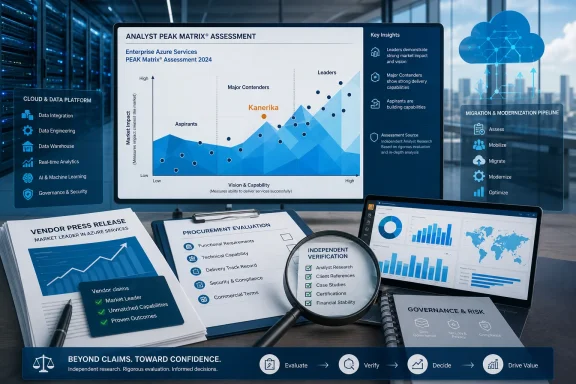 The “Major Contender” label is a comparative tier, not a certification
Everest Group describes PEAK Matrix as a comparative assessment framework built around two dimensions: market impact and vision and capability. Its published methodology says market impact includes revenue, client count, and year-over-year growth, while delivery capability includes operational scale, portfolio scope, innovation, delivery footprint, and buyer satisfaction. Everest also says it uses provider RFIs, market analysis, interactions with provider leadership, and client-reference interviews.That makes the designation more meaningful than a partner badge awarded solely on technical exams or a vendor’s sales volume. But it also makes the label easy to overread. Major Contender is not the top PEAK Matrix category; it denotes a provider Everest sees as competitively credible in that particular market assessment, below the firms designated Leaders.
Kanerika’s release correctly identifies the three broad tiers. It does not disclose where it ranked relative to other Major Contenders, whether it received a Star Performer distinction for year-over-year movement, or which specific Azure service segments drove the result. It also does not provide Everest Group analyst commentary identifying limitations, which is often the most valuable part of a PEAK Matrix profile for an organization deciding whether a specialist can operate at the scale and complexity of its estate.
For IT leaders, that missing detail changes how the designation should be used. It is evidence that Kanerika participated in, and says it was recognized by, a known analyst framework. It is not sufficient evidence by itself that the firm is the right operator for a large Azure landing-zone program, a regulated-data migration, a Fabric consolidation, or a production Azure AI deployment.
Kanerika’s Microsoft credentials are real, but the announcement compresses them
The announcement connects the Everest recognition to Kanerika’s Microsoft Partner standing: Solutions Partner for Data & AI, a Data Warehouse Migration to Microsoft Azure specialization, an Azure data and analytics specialization, and Microsoft Fabric Featured Partner status.Kanerika’s own Microsoft partnership materials support the broad credential claim. The company publicly lists Microsoft Solutions Partner designations across Data & AI, Infrastructure, and Digital & App Innovation, plus its Data Warehouse Migration to Microsoft Azure specialization and a Microsoft Fabric Featured Partner designation. Its December 2025 announcement says Microsoft awarded the warehouse-migration specialization after the company demonstrated customer success, technical skills, and migration capability.
There is a naming issue worth noting. Kanerika’s current materials refer to an Analytics on Microsoft Azure specialization, while the press release calls it an “Advanced Specialization in Azure Data & Analytics.” That may be a shorthand description rather than a different credential, but buyers should ask for the exact Microsoft designation and its current validity rather than rely on a marketing paraphrase.
The credentials validate a certain level of Microsoft partner investment and capability. They do not automatically validate every delivery claim in the release. Microsoft’s partner program and Everest Group’s market assessments measure different things: the former is a vendor ecosystem qualification model; the latter purports to compare service providers against peers in a defined market. Neither replaces a review of delivery teams, reference customers, support model, architecture standards, commercial terms, or ownership of the resulting data estate.
Kanerika also emphasizes its proprietary FLIP migration accelerator, which it says automates migration paths involving tools such as Tableau, Cognos, SSRS, Informatica, Azure services, and Microsoft Fabric. That could materially reduce elapsed time on standard conversions. It can also create an operational dependency if an enterprise cannot inspect, maintain, and modify the artifacts produced after the migration. Kanerika itself has acknowledged in its published guidance that migration accelerators do not eliminate manual engineering for complex business logic.
Fabric expertise is useful, but it narrows the buying question
The more revealing part of Kanerika’s positioning is its focus on Microsoft Fabric. The company has spent the past two years building a public identity around Fabric migrations, Power BI modernization, governed analytics, and data-and-AI delivery. Its public material says it appeared at the 2026 Fabric Community Conference as a Microsoft Fabric Featured Partner and promotes accelerators for Azure-to-Fabric migrations.That focus matches a real enterprise problem. Organizations with Azure Synapse, Azure Data Factory, Power BI, SQL Server, legacy reporting tools, and separate governance processes are under pressure to simplify their analytics stack without losing performance, data lineage, access controls, or operational accountability. A provider that knows the boundaries between Fabric, Purview, Data Factory, Power BI, Databricks, and older Azure services can be more useful than a general cloud integrator assigning an inexperienced delivery team.
But the announcement’s description of “legacy systems onto Fabric” conceals the hard work. Moving reports, pipelines, and schemas is not the same as moving a data platform safely. Teams need to establish what happens to existing service accounts, security roles, network constraints, semantic models, capacity planning, data-retention policies, source-system latency, disaster recovery procedures, and automated testing before a cutover. A migration supplier’s claim of faster time to value has little operational meaning unless those controls survive the move.
Kanerika offers public customer-outcome claims around Fabric projects, including reporting-time reductions and better data availability. Those examples demonstrate that the firm has case-study material. They are still vendor-published performance statements, not independently audited benchmarks, and the August 4 release does not identify the customers or provide comparable baseline conditions for its broader claims of time and cost reduction.
The date record raises a small but avoidable transparency issue
The submitted EIN Presswire record carries two timestamps: it says the item was published at 16:00 UTC on August 4, 2026, while its “modified” time is 10:26:38 UTC the same day. A modification cannot logically precede the stated publication time if both timestamps are recorded in UTC.This appears likely to be a publishing-system or time-zone metadata issue rather than evidence of a substantive revision. Still, the inconsistency is useful context because this is the only publicly located announcement of the 2026 Azure PEAK Matrix recognition. No Everest Group announcement, downloadable provider extract, or independent outlet report located at publication time supplies the missing report-level detail.
The company could close that verification gap quickly by publishing a licensed Everest Group profile or naming the report’s research period, assessed population, and Kanerika-specific strengths and limitations. Until then, prospective customers should treat the Major Contender result as a credible vendor-reported distinction, then demand the documentation that turns an analyst logo into a defensible sourcing decision.
For Windows and Azure administrators, the immediate consequence is straightforward: Kanerika belongs on the conversation list for Fabric-oriented data modernization work, particularly where Power BI, Azure data services, Purview governance, and legacy-reporting migration intersect. It has not provided enough public evidence to justify skipping a technical proof of concept, reference calls with comparable customers, and a review of what its migration accelerator leaves behind for the internal team to operate.
References
- Primary source: EIN Presswire
Published: 2026-08-04T16:00:00+00:00
Loading…
www.einpresswire.com - Related coverage: everestgrp.com
Loading…
www.everestgrp.com - Related coverage: deloitte.com
Loading…
www.deloitte.com - Related coverage: teammatrix.com
Loading…
teammatrix.com - Related coverage: accenture.com
Loading…
www.accenture.com - Related coverage: deloitte.com
Loading…
www.deloitte.com - Related coverage: accenture.cn
Loading…
www.accenture.cn - Related coverage: altimetrik.com
Loading…
www.altimetrik.com - Related coverage: bryq.com
Loading…
www.bryq.com - Related coverage: kanerika.com
Loading…
kanerika.com - Related coverage: kanerika.com
Loading…
kanerika.com