
Solutions Review collected the announcements in its August 21 roundup, but the useful distinction for IT teams is between features available to deploy now and vendor roadmaps or commercial partnerships. Microsoft administrators should pay particular attention to the Keeper and Netwrix releases because they touch Power Platform automation, Entra ID, and Azure storage directly; the other items signal where vendors are investing, rather than delivering an immediate Microsoft platform change.
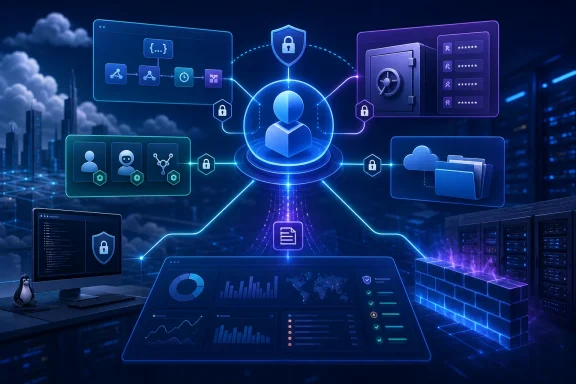 Keeper’s Logic Apps connector adds a secret-management dependency
Keeper Security has released a certified Keeper Secrets Manager connector for Azure Logic Apps and Power Automate. Microsoft’s connector documentation confirms that it can retrieve, create, and update secrets held in a Keeper Vault from automated workflows, avoiding the common practice of embedding credentials directly in a flow definition or its variables.
There is an important implementation detail behind the “connector” label: this is not a fully managed bridge that requires no infrastructure. The design uses a Python middleware service running as an Azure Function App in the customer’s Azure subscription. Keeper’s public deployment repository shows that the setup also provisions or relies on an Azure Key Vault, a storage account, managed identity access, and a Function App host key.
That makes the feature useful for organizations already standardized on Keeper Secrets Manager, but it also means the security boundary has shifted rather than disappeared. The function host key, the Keeper configuration token, the managed identity’s Key Vault permissions, and the workflow connection all become part of the access path. A Power Automate maker who can reuse a broadly scoped connection could inherit access to every Keeper folder shared with the underlying Secrets Manager application.
The practical rollout should therefore begin with a narrowly scoped Keeper application and a dedicated vault folder for each workflow class, rather than pointing all automation at a shared enterprise secret store. Administrators should also treat the Azure Function as production infrastructure: enable diagnostic logging, restrict inbound access where the service model permits it, rotate the Keeper configuration token, and review who can read or modify the connection settings.
The connector addresses a real automation weakness, but it does not make secrets management automatic. It is an additional control plane that needs the same ownership, logging, and least-privilege design as the workflows it serves.
Netwrix puts AI-agent identities into Entra ID assessments
Netwrix has announced updates to PingCastle and Threat Manager that add visibility into AI-agent identities in Microsoft Entra ID, expand Entra ID assessment coverage to more than 100 risk checks, and introduce Azure Files threat detection. The company’s announcement is specific about the intended sequence: identity discovery and risk assessment arrive first, with agent-specific threat detection planned for a later release.
That ordering deserves attention. An AI agent with an Entra ID service principal, managed identity, application registration, delegated permissions, or broad Microsoft Graph consent is an identity with usable authority, even if it has no mailbox, desktop session, or employee owner. Inventory is the prerequisite to governance. A tool that identifies these objects can help teams find unmanaged application identities, but it cannot establish whether their permissions are justified without ownership and business context.
Netwrix’s own PingCastle materials show the product already operates in Active Directory and Entra ID environments. The new coverage is an extension of that posture-assessment role, not a replacement for Microsoft Entra ID’s native identity governance, privileged identity management, Conditional Access, app-consent controls, or Defender telemetry. The vendor’s claim that the release complements Microsoft tooling is the right way to frame it: it supplies another assessment and detection layer, not a unified answer to identity risk.
For administrators, the immediate work is less glamorous than “AI identity security.” Build an inventory that maps each non-human Entra identity to an accountable owner, a workload, a permission set, credential or certificate expiration, and a reviewed retirement date. Then compare PingCastle findings against existing Entra ID reports instead of treating either list as definitive. Duplicate inventories and unowned service principals are usually more dangerous than a lack of dashboards.
Azure Files detection is also relevant in mixed Windows estates, where departmental file shares often survive long after central SharePoint or OneDrive migration plans. The announcement establishes that Netwrix Threat Manager is adding this coverage, but it does not describe event sources, licensing, detection latency, supported deployment models, or specific alert logic. Those omissions matter before a security team counts it as ransomware or insider-threat coverage. Validate the telemetry path and test the product against a controlled file-operation scenario before changing incident-response assumptions.
Tufin’s release is about policy intent, not firewall magic
Tufin released Tufin Orchestration Suite 5.3 and a separate AI-powered Segmentation Intelligence capability on August 19. According to Tufin, the suite expands its Unified Control Plane with additional integrations, automation, and intelligence for multi-vendor hybrid environments, while Segmentation Intelligence continuously analyzes policies, zones, subnets, and objects to identify segmentation intent, gaps, and drift.
For Windows-focused infrastructure teams, that becomes relevant where Active Directory, Windows Server workloads, Azure virtual networks, network virtual appliances, and on-premises firewalls have accumulated policy exceptions over years of changes. Segmentation failures frequently emerge not because a firewall lacks a rule, but because nobody can explain which legacy exception still permits an unnecessary route between a user subnet, a management network, and a server tier.
The product’s promise is analysis and recommendation. It does not mean the platform can infer business-critical application dependencies flawlessly, nor does it turn a proposed policy cleanup into a safe enforcement change. Tufin’s release materials cite persistent complexity across cloud, firewall, SASE, SD-WAN, microsegmentation, and distributed networking tools, but they do not publish performance data for Segmentation Intelligence or identify a benchmark set for its recommendations.
That leaves a clear deployment rule: use the product first to establish a reviewable candidate policy model, then validate proposed blocks against actual traffic, application owners, and disaster-recovery requirements. Any system that classifies a connection as unnecessary can be valuable; any system allowed to remove it without a tested rollback path can create the outage it was meant to prevent.
Teleport extends identity-aware access to Linux desktops
Teleport has announced Linux Desktop as a protected resource in its Infrastructure Identity Platform. Teleport’s upcoming-release documentation says Linux Desktop Access is due in version 18.11.0 during the week of August 3, 2026, after being delayed from 18.10.0, and describes it as support for remote desktop sessions to Linux hosts.
The change matters to enterprises that have already used Teleport for servers, Kubernetes, databases, GitHub, cloud systems, and Windows desktop access. It brings developer workstations into the same cryptographic-identity, session-recording, and least-privilege access model used for infrastructure. In theory, that reduces the blind spot created when privileged engineers administer sensitive systems from unmanaged or weakly monitored Linux endpoints.
But Linux desktop access should not be mistaken for endpoint management. Teleport can govern access to a session and record activity within that access model; it does not independently replace a Linux device-management platform, disk encryption, vulnerability management, local privilege controls, or an endpoint detection and response agent. Teams considering it should identify whether their main problem is privileged-session accountability, workstation configuration drift, or unmanaged developer devices. Only the first of those is directly addressed by this release.
Pathlock, Prevalent AI, and the commercial signals behind the releases
Pathlock’s new strategic partnership with Germany-based mindsquare expands the vendor’s consulting reach in the DACH market, particularly for SAP access governance and GRC work. Pathlock’s partner directory confirms mindsquare is listed as a Germany-based partner with SAP and Salesforce expertise, and that Pathlock positions its platform across SAP, Oracle, Workday, Microsoft Dynamics 365, Salesforce, and Entra ID governance.
For multinational organizations with SAP systems and Windows identity infrastructure, this may make Pathlock services easier to procure locally. It is not, however, a product release or a newly documented Microsoft integration. The partnership gives enterprises another delivery channel; it does not resolve access-risk problems without a scope, implementation plan, and operational ownership model.
Prevalent AI’s $22 million growth investment from Integrity Growth Partners is likewise a business event rather than a security-control change. Prevalent AI says the funding will support U.S. expansion, commercial hiring, and an effort to extend its knowledge graph beyond cybersecurity into broader enterprise-risk uses. Tech Funding News separately reported the investment as the London company’s first major external funding after years of bootstrapped growth.
That investment may help Prevalent expand product development and sales capacity, but customers should not translate a funding announcement into proof of product maturity or support coverage. The relevant diligence remains technical: data connectors, tenancy model, data retention, integration depth with Microsoft security tools, ownership of the knowledge graph, and the quality of audit evidence the platform can produce.
The week’s substantive pattern is clear: non-human identities are becoming a first-class administrative target, whether they belong to a Logic Apps workflow, an Entra ID application, an AI agent, a network automation system, or a developer workstation. The products announced this week can improve visibility or control, but the decisive work remains local: identify the identity, constrain its scope, record its owner, monitor its use, and remove it when the workload ends.