
KnowBe4’s Agent Risk Manager already listed Anthropic Claude as a supported environment when the product launched in April 2026, meaning the company’s reported Claude “addition” appears to be a repackaging of an existing capability rather than a clearly documented new integration. The more important fact for security teams is that Agent Risk Manager remains in technical preview, with KnowBe4 still withholding the operational details that determine whether it can safely govern a production Claude deployment.
SecurityBrief reported on August 3 that KnowBe4 had added Claude oversight to Agent Risk Manager after earlier Microsoft Copilot support. But KnowBe4’s April 14 launch announcement described Agent Risk Manager as a security and governance layer for autonomous agents, while its current product page and an earlier product datasheet explicitly name Microsoft Copilot, Anthropic Claude, Google Gemini, and OpenAI ChatGPT as connected providers.
That creates a material discrepancy: there is no corresponding Claude-specific launch notice in KnowBe4’s public press archive, and the company’s own April materials already position Claude as part of the product’s supported-provider set. If KnowBe4 has expanded the Claude connector in a meaningful way — for example, by adding Claude.ai coverage, a new Claude API integration, more detailed tool-call inspection, or active blocking — it has not publicly separated that change from the original Agent Risk Manager pitch.
For Windows administrators and security leaders evaluating Claude in enterprise workflows, this is not a semantic issue. A product that lists a provider in marketing material can range from a narrow API telemetry connector to a genuinely enforceable control point. KnowBe4 has described the latter ambition, but it has not published enough implementation detail to establish the former as a production-ready reality.
KnowBe4 announced Agent Risk Manager on April 14, 2026, framing it as a new part of its Human Risk Management platform. The company said the product would monitor and govern autonomous agents after deployment, looking for prompt injection, sensitive-information exposure, runaway resource consumption, agent inventories, audit events, and access to tools and permissions.
The original announcement did not position Microsoft Copilot as the sole supported environment. More recent KnowBe4 documentation goes further: the Agent Risk Manager product page says customers can connect Microsoft Copilot, ChatGPT, Gemini, and Claude through a guided onboarding process. Its datasheet, published months before the August 3 report, calls the product purpose-built for those same four environments.
The clean reading of the public record is that Claude was already part of the announced platform scope. SecurityBrief may be describing a newly available connector or an incremental expansion in coverage, but neither its report nor KnowBe4’s public technical material identifies a release date, a connector version, or a before-and-after feature matrix.
That omission leaves prospective buyers unable to answer the essential deployment question: what changed for Claude users on August 3 that was not already available in April?
KnowBe4’s public release list provides no separate answer. Its most relevant entry remains the April Agent Risk Manager launch. The product page still carries a “Become an Early Adopter” call to action and labels the offering as being in technical preview rather than generally available.
KnowBe4 says Agent Risk Manager can connect to AI-agent providers without changing the underlying model, monitor tool executions and user interactions, run six detection engines, and either alert on or actively block a risky operation. The advertised detection categories include prompt injection, sensitive information, unbounded consumption, content safety, privilege escalation, and agent overstepping.
Those are useful categories, but the company has not publicly documented the control boundaries that administrators need to assess. The missing details include:
In other words, Agent Risk Manager may reduce a governance blind spot, but it should not be treated as proof that an organization has found every Claude-connected identity, workflow, credential, or tool.
Anthropic documents
Anthropic has also introduced an auto mode that evaluates individual actions before execution, positioned between manual confirmation prompts and full bypass mode. Even that mode does not remove the need for access controls, sandboxing, managed settings, or logging. It changes how an individual Claude Code session handles operational approvals.
For Windows shops, this distinction affects where controls belong. A developer running Claude Code from Windows Terminal, Visual Studio Code, WSL, a remote development container, or a build agent can have access to local source trees, environment variables, cloud credentials, Git repositories, package registries, network resources, and remote execution tools. Monitoring the conversation alone does not establish control over all of those paths.
An external monitoring product can add a useful audit and detection layer, particularly around prompt injection and credentials exposed in requests or outputs. But it cannot substitute for the controls closest to the execution environment: least-privilege service accounts, separate developer and production credentials, protected secrets stores, managed endpoint configuration, network egress restrictions, code-review gates, and isolated build runners.
Agent Risk Manager says it operates from the outside, rather than modifying the AI model itself. That is potentially valuable because security teams do not control Anthropic’s model behavior, its release cadence, or the safeguards embedded in a hosted service. They do control which identities are granted access, which data sources are connected, and which actions are permitted inside their own tenant.
The limitation is equally clear: external enforcement must sit at a point where it can see and interrupt the relevant action. If a Claude-powered application calls tools directly using a credential that bypasses KnowBe4’s integration, the monitoring layer may see little or nothing. If a tool action occurs after a permissive workflow engine has already granted an agent broad rights, an alert may arrive after the effective security decision has been made.
KnowBe4 claims Agent Risk Manager can actively block risky operations. Until the company specifies the Claude actions subject to pre-execution enforcement, buyers should regard that as a capability claim rather than a guarantee for every Claude-connected workflow.
A useful evaluation should include a controlled prompt-injection test delivered through a connected data source, an attempted retrieval of a seeded sensitive record, a blocked request for an unapproved tool, and an agent action using a deliberately overprivileged test identity. Administrators should verify the detection latency, the audit evidence produced, who can view stored content, whether the action was stopped before execution, and whether the event reaches their existing SIEM and incident-response process.
KnowBe4’s claims around Claude oversight may still represent a useful expansion in its agent-security strategy. But the public record shows Claude was already part of Agent Risk Manager’s stated coverage, while the service itself remains a technical-preview offering with no disclosed price, general-availability date, or documented Claude-specific enforcement boundaries. Until those details are published, the sensible position is to treat it as an early-adopter governance layer — not a finished control plane for autonomous Claude workloads.
That creates a material discrepancy: there is no corresponding Claude-specific launch notice in KnowBe4’s public press archive, and the company’s own April materials already position Claude as part of the product’s supported-provider set. If KnowBe4 has expanded the Claude connector in a meaningful way — for example, by adding Claude.ai coverage, a new Claude API integration, more detailed tool-call inspection, or active blocking — it has not publicly separated that change from the original Agent Risk Manager pitch.
For Windows administrators and security leaders evaluating Claude in enterprise workflows, this is not a semantic issue. A product that lists a provider in marketing material can range from a narrow API telemetry connector to a genuinely enforceable control point. KnowBe4 has described the latter ambition, but it has not published enough implementation detail to establish the former as a production-ready reality.
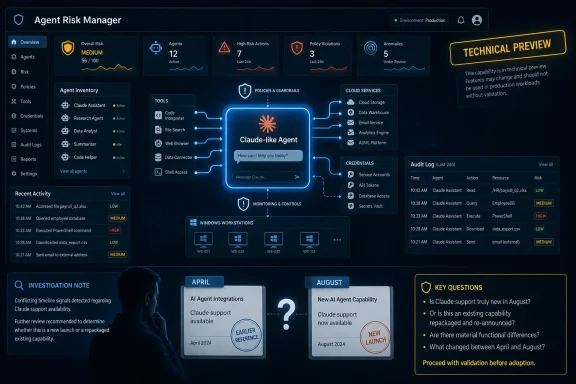 Claude was in the original Agent Risk Manager scope
KnowBe4 announced Agent Risk Manager on April 14, 2026, framing it as a new part of its Human Risk Management platform. The company said the product would monitor and govern autonomous agents after deployment, looking for prompt injection, sensitive-information exposure, runaway resource consumption, agent inventories, audit events, and access to tools and permissions.The original announcement did not position Microsoft Copilot as the sole supported environment. More recent KnowBe4 documentation goes further: the Agent Risk Manager product page says customers can connect Microsoft Copilot, ChatGPT, Gemini, and Claude through a guided onboarding process. Its datasheet, published months before the August 3 report, calls the product purpose-built for those same four environments.
The clean reading of the public record is that Claude was already part of the announced platform scope. SecurityBrief may be describing a newly available connector or an incremental expansion in coverage, but neither its report nor KnowBe4’s public technical material identifies a release date, a connector version, or a before-and-after feature matrix.
That omission leaves prospective buyers unable to answer the essential deployment question: what changed for Claude users on August 3 that was not already available in April?
KnowBe4’s public release list provides no separate answer. Its most relevant entry remains the April Agent Risk Manager launch. The product page still carries a “Become an Early Adopter” call to action and labels the offering as being in technical preview rather than generally available.
Technical preview is the part IT teams should not skip
Technical preview has a practical meaning in enterprise security: the vendor is still testing product behavior, supportability, deployment boundaries, and likely pricing. It is a sharply different buying signal from a released security service with published service-level commitments, supported configurations, and mature operational documentation.KnowBe4 says Agent Risk Manager can connect to AI-agent providers without changing the underlying model, monitor tool executions and user interactions, run six detection engines, and either alert on or actively block a risky operation. The advertised detection categories include prompt injection, sensitive information, unbounded consumption, content safety, privilege escalation, and agent overstepping.
Those are useful categories, but the company has not publicly documented the control boundaries that administrators need to assess. The missing details include:
- KnowBe4 has not published which Claude products are supported, such as Claude Enterprise, Claude.ai business access, Claude API applications, Claude Code, or third-party software using Anthropic models through Amazon Bedrock or Google Cloud.
- KnowBe4 has not disclosed whether monitoring occurs through API proxying, event-log ingestion, browser/session instrumentation, OAuth-based provider access, a Claude connector, or another architecture.
- KnowBe4 has not stated which Claude actions can be blocked before execution, which are only detected afterward, and whether blocking works for third-party tools invoked by an agent.
- KnowBe4 has not published data residency, audit-log retention, encryption, tenant-isolation, or role-based-access-control details for conversations, prompts, tool schemas, credentials, and potentially sensitive model outputs collected by the service.
- KnowBe4 has not published pricing, licensing prerequisites, availability by region, supported Windows management paths, or a target date for general availability.
In other words, Agent Risk Manager may reduce a governance blind spot, but it should not be treated as proof that an organization has found every Claude-connected identity, workflow, credential, or tool.
The “skip permissions” warning is specifically about Claude Code
The reported announcement also quotes KnowBe4 executive Matt Duren warning that employees may use “skip permissions mode,” allowing an LLM to make decisions autonomously without oversight. That language needs more precision than the reported statement provides.Anthropic documents
--dangerously-skip-permissions and bypassPermissions as settings for Claude Code, its agentic coding environment. They are not general-purpose modes for Claude.ai conversations or every application using the Anthropic API. In Claude Code, bypass mode disables permission prompts and safety checks for tool calls; Anthropic explicitly says it should only be used in isolated containers, virtual machines, or similarly constrained environments.Anthropic has also introduced an auto mode that evaluates individual actions before execution, positioned between manual confirmation prompts and full bypass mode. Even that mode does not remove the need for access controls, sandboxing, managed settings, or logging. It changes how an individual Claude Code session handles operational approvals.
For Windows shops, this distinction affects where controls belong. A developer running Claude Code from Windows Terminal, Visual Studio Code, WSL, a remote development container, or a build agent can have access to local source trees, environment variables, cloud credentials, Git repositories, package registries, network resources, and remote execution tools. Monitoring the conversation alone does not establish control over all of those paths.
An external monitoring product can add a useful audit and detection layer, particularly around prompt injection and credentials exposed in requests or outputs. But it cannot substitute for the controls closest to the execution environment: least-privilege service accounts, separate developer and production credentials, protected secrets stores, managed endpoint configuration, network egress restrictions, code-review gates, and isolated build runners.
The real promise is external policy enforcement
KnowBe4’s main product argument is credible in principle. Model makers can put safeguards into their own systems, but enterprises often need policy that reaches across providers and internal use cases. A Claude agent connected to an HR platform, SharePoint repository, GitHub organization, customer database, or Power Platform workflow creates a security problem at the boundary between the model and the tools it can use.Agent Risk Manager says it operates from the outside, rather than modifying the AI model itself. That is potentially valuable because security teams do not control Anthropic’s model behavior, its release cadence, or the safeguards embedded in a hosted service. They do control which identities are granted access, which data sources are connected, and which actions are permitted inside their own tenant.
The limitation is equally clear: external enforcement must sit at a point where it can see and interrupt the relevant action. If a Claude-powered application calls tools directly using a credential that bypasses KnowBe4’s integration, the monitoring layer may see little or nothing. If a tool action occurs after a permissive workflow engine has already granted an agent broad rights, an alert may arrive after the effective security decision has been made.
KnowBe4 claims Agent Risk Manager can actively block risky operations. Until the company specifies the Claude actions subject to pre-execution enforcement, buyers should regard that as a capability claim rather than a guarantee for every Claude-connected workflow.
What enterprises should verify before relying on it
Organizations considering Agent Risk Manager for Claude should insist on a scoped proof of concept rather than accept provider-name support as the whole answer. The relevant test is not whether a dashboard can display a Claude conversation; it is whether the service observes the risky workflow the organization actually intends to authorize.A useful evaluation should include a controlled prompt-injection test delivered through a connected data source, an attempted retrieval of a seeded sensitive record, a blocked request for an unapproved tool, and an agent action using a deliberately overprivileged test identity. Administrators should verify the detection latency, the audit evidence produced, who can view stored content, whether the action was stopped before execution, and whether the event reaches their existing SIEM and incident-response process.
KnowBe4’s claims around Claude oversight may still represent a useful expansion in its agent-security strategy. But the public record shows Claude was already part of Agent Risk Manager’s stated coverage, while the service itself remains a technical-preview offering with no disclosed price, general-availability date, or documented Claude-specific enforcement boundaries. Until those details are published, the sensible position is to treat it as an early-adopter governance layer — not a finished control plane for autonomous Claude workloads.
References
- Primary source: SecurityBrief Australia
Published: 2026-08-03T23:55:00+00:00
Loading…
securitybrief.com.au - Related coverage: code.claude.com
Loading…
code.claude.com - Related coverage: anthropic.com
Loading…
www.anthropic.com - Related coverage: knowbe4.com
Loading…
www.knowbe4.com - Related coverage: github.com
Loading…
github.com - Related coverage: support.claude.com
Claude Code power user tips | Claude Help Center
support.claude.com
- Related coverage: claude.com
Loading…
claude.com - Related coverage: knowbe4.com
Loading…
www.knowbe4.com - Related coverage: mintlify.com
Loading…
www.mintlify.com - Related coverage: cmaven.github.io
Loading…
cmaven.github.io - Related coverage: nikiforovall.blog
Loading…
nikiforovall.blog - Related coverage: github.com
Loading…
github.com - Related coverage: aitmpl.com
Loading…
www.aitmpl.com - Related coverage: ftp.kaist.ac.kr
Loading…
ftp.kaist.ac.kr - Related coverage: pypi.org
Loading…
pypi.org - Related coverage: claude-code-log.com
Loading…
claude-code-log.com - Related coverage: securitybrief.com.au
Loading…
securitybrief.com.au - Related coverage: westerlyri.gov
Loading…
westerlyri.gov