
Manufacturing Dive first reported the August 26 groundbreaking as part of Lam’s planned global R&D expansion for AI-era semiconductors. Lam’s own announcement confirms the new lab will work on advanced deposition and etch processes, materials science, and hardware validation, with engineers collaborating directly with customers from early ideas through fab deployment.
That makes this a supply-chain investment with a longer and less direct path to Windows PCs, workstations and AI servers than the “AI semiconductor lab” shorthand suggests. The building could help Lam and customers such as Intel and Micron qualify manufacturing processes faster, but it does not announce a new Intel processor, a Micron memory product, or any guaranteed increase in finished-chip output.
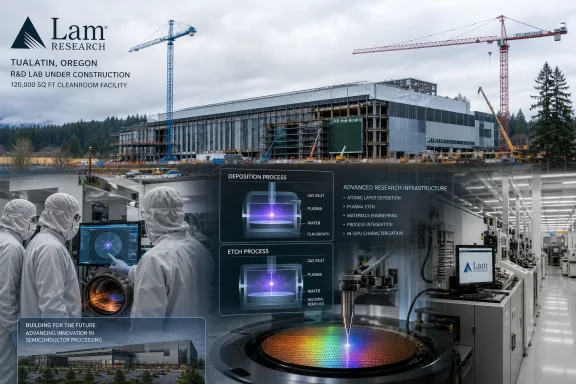 A lab for chipmaking tools, not a new chip factory
Lam sits upstream from the companies that design and manufacture the silicon used in PCs, data centers and consumer devices. Its tools perform critical wafer-fabrication steps: deposition places extremely thin material layers on a wafer, while etch selectively removes material to create the tiny structures that turn a wafer into logic or memory devices.
Those operations become harder as the industry pursues denser memory, advanced packaging, new transistor architectures and increasingly complex AI accelerators. Lam’s pitch is that placing more engineers, cleanroom equipment and customer teams in one location will shorten the time from a process experiment to a manufacturing-ready tool configuration.
The distinction is important because the announcement’s AI framing can easily imply near-term chip capacity. Lam’s Tualatin project is R&D infrastructure. It may influence the equipment available to fabs later this decade, but it will not itself add a production line for CPUs, GPUs, DRAM or NAND flash.
Lam says the Oregon site will become one of its most advanced labs and connect to a worldwide network in the United States, Asia and Europe. The company says that network already supports more than one million experiments a year. Its August 13 global-expansion announcement said the company intends to increase experiment capacity by more than 50% over five years, while claiming some recent customer work shortened process development by as much as 2.5 times.
Those are Lam’s performance claims, not independently audited production commitments. The company has not disclosed which exact equipment platforms will be developed in Tualatin, what customer programs will use the lab, or which chip nodes, memory generations or packaging technologies the work will target.
The $3 billion headline covers a much larger program
The figure attached to the announcement needs careful reading. Lam has said it intends to invest more than $3 billion globally over five years in its lab network, not $3 billion solely in the Oregon building or even solely at the Tualatin campus.
Oregon Public Broadcasting reports that the first new Tualatin lab carries a $620 million price tag. OPB also reported that Lam expects to spend $1.5 billion on major R&D laboratories in Washington County over roughly the next 15 years. Separately, Washington County and the City of Tualatin approved a proposed Strategic Investment Program agreement under which Lam intends to invest up to $1.7 billion in Tualatin through 2041.
These figures describe overlapping but different scopes:
- The $620 million figure, reported by OPB, applies to the newly announced R&D lab that has now begun construction.
- The more than $3 billion figure is Lam’s worldwide, five-year plan for multiple R&D locations.
- The up-to-$1.7-billion figure is the longer-running Tualatin investment commitment associated with the local tax agreement through 2041.
The numbers should not be added together as though each represents separate money. Lam and local officials have described a multi-building campus expansion, meaning the Oregon lab is a first milestone inside a broader local plan, while the local plan is itself only one component of the company’s global program.
The tax agreement remains a material condition
The Tualatin expansion is tied to Oregon’s Strategic Investment Program, which allows alternative property-tax arrangements for very large capital projects. Washington County says firms in the program still pay taxes on an initial assessed-value threshold and a required community service fee, with additional locally negotiated payments possible.
The county and Tualatin City Council approved the Lam proposal on August 11. However, the agreement still requires approval from the Oregon Business Development Commission before it takes effect. Oregon Governor Tina Kotek’s office described the deal as being in the final stages of state approval on August 26, the day of the groundbreaking.
That timing produces an important nuance: construction has started, but the tax arrangement supporting the larger multi-building investment was not yet final in the public records reviewed for this story. The groundbreaking is therefore a concrete project milestone, while the full long-term expansion and its incentive structure still depend on the state-level decision.
Washington County estimated that Lam would make about $84 million in required property-tax payments and fees over the agreement’s life, plus $27 million in negotiated local fees, for roughly $111 million total under then-current models. OPB independently reported the same estimated $111 million figure. The eventual amount can vary with assessed value, the pace of investment and inflation.
Intel and Micron collaboration is real, but no product roadmap was disclosed
Intel Foundry’s chief technology and operations officer, Naga Chandrasekaran, said Intel expects the facility to enable closer work with Lam on chip-scale process development and quicker evaluation of new technologies. Micron’s global-operations executive, Manish Bhatia, similarly connected the project to AI-driven demand for memory and manufacturing capacity.
Those statements confirm that two of the most consequential suppliers in the PC and data-center chain see value in Lam’s expanded Oregon R&D capability. Intel’s processor manufacturing and Micron’s DRAM and NAND roadmaps have immediate relevance to machines running Windows, particularly as local AI features and enterprise AI infrastructure push demand for faster compute and more memory.
But neither company announced a reserved portion of the lab, a specific jointly developed process, or a delivery timeline for a commercial chip. There is no basis yet to tie the Tualatin facility to a particular Intel client CPU, Xeon platform, GPU, Micron memory generation, or Microsoft hardware program.
For enterprise buyers, that means the announcement belongs in the category of strategic capacity and technology-development news rather than product-planning news. It may improve the odds of faster equipment iteration as fabs confront harder manufacturing problems, but it does not change a server-refresh decision, a Windows 11 deployment plan, or an AI-PC procurement schedule today.
Oregon is adding R&D capacity during a manufacturing slowdown
The local context is more complicated than the ceremonial language around the groundbreaking. OPB reported that Oregon lost nearly 8,500 manufacturing jobs over the preceding year, including nearly 2,500 layoffs at Intel during the prior summer. Lam’s planned expansion stands out because it targets engineering, R&D and semiconductor-equipment work rather than a conventional production-line expansion.
Lam projects that the completed campus expansion will create more than 400 direct jobs and support more than 11,000 jobs statewide, along with an annual Oregon economic contribution exceeding $1.8 billion. Those job and economic-impact figures come from a third-party model using Lam-provided inputs, and should be treated as projections rather than completed outcomes.
The more concrete near-term measure will be construction progress on the $620 million building and the Business Development Commission’s decision on the incentive agreement. If the facility opens on Lam’s stated 2028 schedule, the useful signal for the broader PC industry will be subsequent customer tool qualifications and fab deployments—not the groundbreaking itself.