
A Towards Data Science tutorial published August 2 presents a LangGraph-based customer-service agent designed to quote and book cleaning appointments through a conversation, replacing a back-and-forth that its author says took about 15 minutes. The useful part is not the claim that an LLM can chat with a customer; it is the division of labor: the model extracts booking details and asks for missing information, while ordinary code calculates prices, proposes slots, and records the appointment.
That is a sound starting point for businesses trying to automate service intake. But the published demo is a reference architecture, not evidence of a 15-minute process being replaced. It provides no before-and-after timing study, booking-completion rate, handoff rate, customer-satisfaction measure, or comparison against a conventional guided form. The 15 minutes described in the article is the length of one human messaging exchange, not necessarily 15 minutes of employee labor saved.
For Windows administrators and developers evaluating similar projects, that distinction matters. A conversational front end may remove repetitive questions from staff queues, but it also creates a new production system that must preserve state, protect address and image data, prevent double-bookings, and give a human employee a way to correct the record.
The proposed agent keeps a shared
That design is materially different from a free-form chatbot that merely sounds capable of booking a job. The model can interpret a message such as “I need a two-bedroom apartment cleaned, including the refrigerator, and I am available Tuesday or Wednesday,” then fill several fields without forcing the customer through separate form pages. The actual price calculation remains a deterministic function, and the booking workflow advances through named states.
LangChain’s LangGraph documentation supports the central technical premise: a checkpointer can retain a thread’s graph state over multiple interactions, letting an application resume a conversation instead of treating every message as a new request. Its documentation also makes an important limitation explicit: the in-memory saver used for quick tests is for debugging and development, while durable production deployments need persistent storage such as PostgreSQL.
The tutorial acknowledges this path by describing PostgreSQL and real calendar integrations as future work, but those are not optional polish. They are the difference between a convincing command-line demonstration and a booking system that can survive a web-server restart halfway through an appointment confirmation.
A business deploying this pattern should treat the LLM as an untrusted interpreter of customer language, not as the holder of business authority. It can extract “two-bedroom,” “deep clean,” “refrigerator,” and “Tuesday afternoon.” It should not decide whether a service zone is covered, invent a price exception, mark a calendar slot unavailable, or commit an appointment without a database-backed rule and a verified availability check.
That is more than a cosmetic mismatch. The customer’s photo and upholstery material appear to be essential to the original couch quote, while the illustrated data schema cannot preserve them. A price engine cannot reliably price information it was never given in structured form.
The author may have additional code in the GitHub project that handles those details; the article says the source is available there. But the supplied publication does not provide a repository address, and the excerpt does not document a multimodal workflow or a schema that carries image-derived facts into the pricing engine. No independently reported test results or public evaluation set were located for the project.
This is where many agent prototypes fail when moved into a real operation. A broad
The practical answer is to define service-specific schemas rather than force couch cleaning and apartment cleaning into one generalized record. A couch-cleaning request could require upholstery type, seat count, stain category, photo status, and access conditions. An apartment-cleaning request could require square footage or bedrooms, cleaning depth, bathrooms, add-ons, parking and elevator details, and preferred time windows. The model can populate those fields, but code must decide which fields are mandatory before quoting.
A customer may send “yes” twice, refresh a web page, reconnect after a timeout, or receive a delayed response while another customer takes the last slot. An LLM call may also be retried. LangGraph’s own documentation warns that nodes can run again when a graph resumes, and that operations with side effects must be idempotent: repeating them must not create an unintended second record.
For a cleaning company, that means the node that writes an appointment needs a durable idempotency key tied to the customer session and proposed slot. It must recheck calendar availability inside the same transaction that creates the booking. It also needs a clear outcome if the slot is gone: hold the quote, offer new times, and preserve the conversation context rather than silently changing the appointment.
The tutorial’s state graph is well suited to representing this workflow, but a graph does not automatically provide the transaction semantics. A
The safer production pattern is straightforward:
It also means the observability platform may receive the contents of customer conversations. In this example, that can include street addresses, apartment details, availability, phone or contact details if later added, and potentially images of a customer’s home or furniture. Langfuse’s documentation specifically offers masking controls for sensitive fields and recognizes personal-data deletion and retention as operational concerns; those controls should be configured before a test account becomes a production pipeline.
The article’s proposed
That omission is significant because the article’s opening use case requires more sensitive information than many ordinary chat demos. The relevant question is not whether telemetry is useful; it is whether every full prompt and response needs to leave the application. In many deployments, it does not. Redacting addresses and contact details before tracing, using stable internal customer IDs, separating staging from production projects, and setting a short retention policy are baseline measures.
If the system accepts couch photographs, the data path needs an additional review. Images can be forwarded to a vision model, stored by the application, and captured by observability tooling depending on the integration. The tutorial describes asking for a picture, but does not show the handling, storage, deletion, or tracing rules for one.
What it does not yet show is a complete booking product. There is no documented persistent checkpointer, public repository link in the supplied article, real calendar conflict handling, customer-data policy, evaluation suite, or evidence that the agent lowers labor time without reducing quote accuracy. The author labels the release v0, which is the appropriate maturity level.
The immediate consequence for teams copying the pattern is clear: use the graph and state model to prototype the conversation, but do not connect it to a live calendar or dispatch process until pricing inputs, persistence, idempotency, and trace-data controls are designed as first-class parts of the system.
For Windows administrators and developers evaluating similar projects, that distinction matters. A conversational front end may remove repetitive questions from staff queues, but it also creates a new production system that must preserve state, protect address and image data, prevent double-bookings, and give a human employee a way to correct the record.
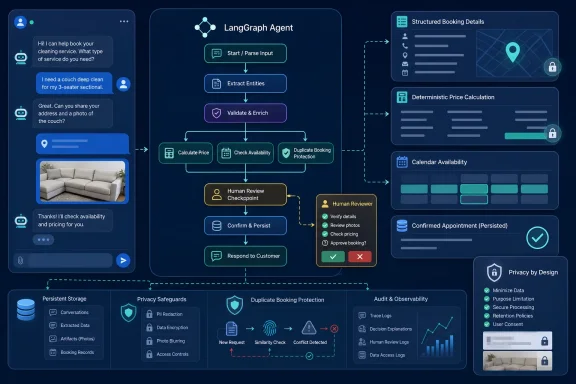 The graph puts the model in the right part of the process
The proposed agent keeps a shared AgentState containing the conversation, extracted BookingDetails, a calculated price, possible appointment times, a selected slot, status, and booking ID. LangGraph nodes consume that state and return partial updates; conditional edges choose whether the system has enough information to continue to pricing or must stop and await the next customer message.That design is materially different from a free-form chatbot that merely sounds capable of booking a job. The model can interpret a message such as “I need a two-bedroom apartment cleaned, including the refrigerator, and I am available Tuesday or Wednesday,” then fill several fields without forcing the customer through separate form pages. The actual price calculation remains a deterministic function, and the booking workflow advances through named states.
LangChain’s LangGraph documentation supports the central technical premise: a checkpointer can retain a thread’s graph state over multiple interactions, letting an application resume a conversation instead of treating every message as a new request. Its documentation also makes an important limitation explicit: the in-memory saver used for quick tests is for debugging and development, while durable production deployments need persistent storage such as PostgreSQL.
The tutorial acknowledges this path by describing PostgreSQL and real calendar integrations as future work, but those are not optional polish. They are the difference between a convincing command-line demonstration and a booking system that can survive a web-server restart halfway through an appointment confirmation.
A business deploying this pattern should treat the LLM as an untrusted interpreter of customer language, not as the holder of business authority. It can extract “two-bedroom,” “deep clean,” “refrigerator,” and “Tuesday afternoon.” It should not decide whether a service zone is covered, invent a price exception, mark a calendar slot unavailable, or commit an appointment without a database-backed rule and a verified availability check.
The couch example exposes a gap in the structured data model
The article opens with a couch-cleaning inquiry in which the provider asks for the couch’s size, material, photo, and address. Yet theBookingDetails model shown in the tutorial includes service type, a generic size field, cleaning depth, add-ons, address, completeness, and the next question. It does not show fields for couch material, stain condition, image attachment, image analysis result, access constraints, or a pricing confidence level.That is more than a cosmetic mismatch. The customer’s photo and upholstery material appear to be essential to the original couch quote, while the illustrated data schema cannot preserve them. A price engine cannot reliably price information it was never given in structured form.
The author may have additional code in the GitHub project that handles those details; the article says the source is available there. But the supplied publication does not provide a repository address, and the excerpt does not document a multimodal workflow or a schema that carries image-derived facts into the pricing engine. No independently reported test results or public evaluation set were located for the project.
This is where many agent prototypes fail when moved into a real operation. A broad
add_ons string list is convenient for a demo, but a production quoting system needs explicit fields and validation rules for every fact that changes cost, staffing, duration, or safety requirements. Otherwise, the system either asks too many questions because it does not trust its extraction, or it quotes prematurely from incomplete information.The practical answer is to define service-specific schemas rather than force couch cleaning and apartment cleaning into one generalized record. A couch-cleaning request could require upholstery type, seat count, stain category, photo status, and access conditions. An apartment-cleaning request could require square footage or bedrooms, cleaning depth, bathrooms, add-ons, parking and elevator details, and preferred time windows. The model can populate those fields, but code must decide which fields are mandatory before quoting.
Booking confirmation is a side effect, not another chat response
The published graph includes price calculation, acceptance or rejection, optimized time-slot selection, and appointment confirmation. Those steps look linear in a diagram, but confirmation is where operational failures become expensive.A customer may send “yes” twice, refresh a web page, reconnect after a timeout, or receive a delayed response while another customer takes the last slot. An LLM call may also be retried. LangGraph’s own documentation warns that nodes can run again when a graph resumes, and that operations with side effects must be idempotent: repeating them must not create an unintended second record.
For a cleaning company, that means the node that writes an appointment needs a durable idempotency key tied to the customer session and proposed slot. It must recheck calendar availability inside the same transaction that creates the booking. It also needs a clear outcome if the slot is gone: hold the quote, offer new times, and preserve the conversation context rather than silently changing the appointment.
The tutorial’s state graph is well suited to representing this workflow, but a graph does not automatically provide the transaction semantics. A
booking_id in state is useful only after the backend has committed a unique record and the calendar integration has succeeded. If calendar creation, payment authorization, employee dispatch, or customer notification are added later, each system boundary needs its own retry and reconciliation plan.The safer production pattern is straightforward:
- The LLM should extract details and generate customer-facing wording, while pricing and slot selection remain controlled services.
- The system should show the customer a final structured summary before a booking write occurs.
- The booking service should atomically reserve the slot and return a durable appointment identifier.
- A human review queue should catch low-confidence extraction, edge-case jobs, and disputes over price or scope.
Observability can become a second customer-data store
The tutorial integrates Langfuse through its LangChain callback handler and describes its ability to display prompts, inputs, outputs, token use, and cost. For debugging agent behavior, that is a real advantage: a team can see why a model asked another question, whether a structured extraction failed, and which prompt or tool call drove cost upward.It also means the observability platform may receive the contents of customer conversations. In this example, that can include street addresses, apartment details, availability, phone or contact details if later added, and potentially images of a customer’s home or furniture. Langfuse’s documentation specifically offers masking controls for sensitive fields and recognizes personal-data deletion and retention as operational concerns; those controls should be configured before a test account becomes a production pipeline.
The article’s proposed
LANGFUSE_BASE_URL points to Langfuse Cloud and its handler is enabled whenever public and secret keys are present. The sample does not show field-level masking, customer consent language, retention settings, access controls, or a deletion workflow. It also does not distinguish test traces from production traces.That omission is significant because the article’s opening use case requires more sensitive information than many ordinary chat demos. The relevant question is not whether telemetry is useful; it is whether every full prompt and response needs to leave the application. In many deployments, it does not. Redacting addresses and contact details before tracing, using stable internal customer IDs, separating staging from production projects, and setting a short retention policy are baseline measures.
If the system accepts couch photographs, the data path needs an additional review. Images can be forwarded to a vision model, stored by the application, and captured by observability tooling depending on the integration. The tutorial describes asking for a picture, but does not show the handling, storage, deletion, or tracing rules for one.
What the demo proves — and what it does not
The tutorial succeeds at showing why LangGraph fits a multi-turn service workflow better than an isolated prompt: customer language can be translated into structured state, and deterministic nodes can drive the job from intake to a proposed appointment. It also correctly treats observability as part of the build rather than something added after customers encounter failures.What it does not yet show is a complete booking product. There is no documented persistent checkpointer, public repository link in the supplied article, real calendar conflict handling, customer-data policy, evaluation suite, or evidence that the agent lowers labor time without reducing quote accuracy. The author labels the release v0, which is the appropriate maturity level.
The immediate consequence for teams copying the pattern is clear: use the graph and state model to prototype the conversation, but do not connect it to a live calendar or dispatch process until pricing inputs, persistence, idempotency, and trace-data controls are designed as first-class parts of the system.
References
- Primary source: towardsdatascience.com
Published: 2026-08-02T13:00:00+00:00
I Replaced a 15-Minute Booking Process with a LangGraph AI Agent | Towards Data Science
A step-by-step guide to building, running, and monitoring a stateful customer support agent using Python, LangGraph, and Langfuse.towardsdatascience.com - Related coverage: langchain-ai.github.io
- Related coverage: langchain-ai.github.io
@langchain/langgraph-checkpoint | LangGraph.js API Reference
Documentation for LangGraph.js API Referencelangchain-ai.github.io - Related coverage: github.com
GitHub - microsoft/multi-modal-customer-service-agent: Multi-modal & multi-domain customer service agent with real time text, voice and soon video · GitHub
Multi-modal & multi-domain customer service agent with real time text, voice and soon video - microsoft/multi-modal-customer-service-agent github.com