
Langley Township has approved an AI-use policy that puts human review, privacy protection and information security ahead of broad deployment, while allowing staff and council members to use approved tools including Microsoft Copilot Chat.
As reported by the Aldergrove Star, Township council adopted the policy at its July 27 meeting after IT director Jim Makela outlined both the productivity potential and the governance risks of generative AI. The policy applies to elected officials as well as staff, chief administrative officer Chan Kooner confirmed during the meeting.
The practical message for municipal IT teams is clear: AI is permitted, but it is not autonomous. Staff can use approved services to assist with routine drafting, summarization and information discovery, while remaining responsible for reviewing output and protecting records and personal data.
Langley Township’s IT department is already using GovAI and Microsoft Copilot Chat, and is conducting limited testing of M365 Copilot Premium. That distinction matters because Microsoft 365 Copilot can draw on organizational data that a user already has permission to access, turning existing SharePoint, Teams, Exchange and OneDrive governance problems into AI-era visibility problems.
Makela’s report said the deeper Microsoft 365 integration brings additional privacy, security, records-management and cost considerations. For Windows administrators, that is the more consequential part of the rollout: deployment is being treated as an information-governance project, not merely a new productivity license.
The Township’s policy also requires suspected AI misuse and privacy breaches associated with AI to be reported immediately. That makes incident handling part of everyday AI operations rather than a contingency to be addressed after wider adoption.
That is a deliberately narrow first workload. Public meeting records are searchable, governed and less sensitive than employee, resident, procurement or legal files, making them a useful test of whether an agent can save staff time without creating a new channel for data exposure.
The approach offers a model for organizations evaluating Copilot agents and Microsoft 365-based retrieval tools: begin with a bounded dataset, define the user task, preserve human verification, and establish reporting requirements before connecting the system to more sensitive repositories.
Langley Township has not framed AI as a replacement for staff judgment. Its July 27 policy instead makes that judgment the control point—a position likely to become more important if the M365 Copilot Premium testing expands beyond its limited pilot.
The practical message for municipal IT teams is clear: AI is permitted, but it is not autonomous. Staff can use approved services to assist with routine drafting, summarization and information discovery, while remaining responsible for reviewing output and protecting records and personal data.
 Microsoft 365 Integration Is Being Tested, Not Assumed Safe
Langley Township’s IT department is already using GovAI and Microsoft Copilot Chat, and is conducting limited testing of M365 Copilot Premium. That distinction matters because Microsoft 365 Copilot can draw on organizational data that a user already has permission to access, turning existing SharePoint, Teams, Exchange and OneDrive governance problems into AI-era visibility problems.Makela’s report said the deeper Microsoft 365 integration brings additional privacy, security, records-management and cost considerations. For Windows administrators, that is the more consequential part of the rollout: deployment is being treated as an information-governance project, not merely a new productivity license.
The Township’s policy also requires suspected AI misuse and privacy breaches associated with AI to be reported immediately. That makes incident handling part of everyday AI operations rather than a contingency to be addressed after wider adoption.
An Agent Starts With Public Meeting Records
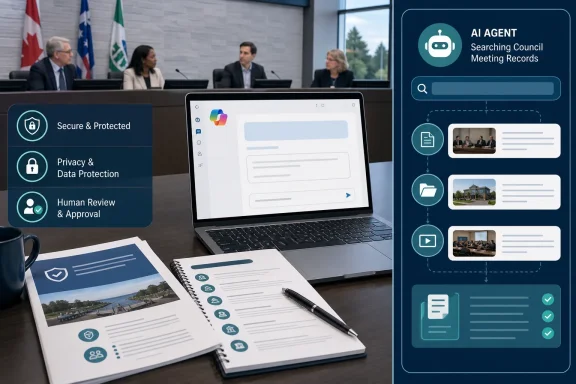
The Township is also testing an agentic AI tool called the Open Meeting Researcher Agent. Rather than giving an AI agent broad access to internal information, the pilot helps staff locate material within a database of publicly accessible council meeting records.That is a deliberately narrow first workload. Public meeting records are searchable, governed and less sensitive than employee, resident, procurement or legal files, making them a useful test of whether an agent can save staff time without creating a new channel for data exposure.
The approach offers a model for organizations evaluating Copilot agents and Microsoft 365-based retrieval tools: begin with a bounded dataset, define the user task, preserve human verification, and establish reporting requirements before connecting the system to more sensitive repositories.
Langley Township has not framed AI as a replacement for staff judgment. Its July 27 policy instead makes that judgment the control point—a position likely to become more important if the M365 Copilot Premium testing expands beyond its limited pilot.