
Notebookcheck first reported the North American retail availability, following Lenovo’s earlier global announcement that placed the Intel version’s arrival in select markets in May 2026. Lenovo’s own U.S. store pages and reseller listings now back up the key U.S. machine configurations, including the $3,669 Core Ultra 7 356H / RTX PRO 500 / 32GB / 1TB model, identified as part number 21XJ0037US.
The meaningful change is less about a thin-and-light ThinkPad acquiring a discrete GPU than about Lenovo bringing a genuinely serviceable high-memory design into the compact P-series workstation range. The P14s i Gen 7 has one LPCAMM2 slot rather than soldered memory, allowing the installed module to be replaced. For engineering, development, virtual-machine, and data-analysis users who have been forced to choose between a 14-inch chassis and 64GB-plus memory, that is the feature that separates this model from most premium ultraportables.
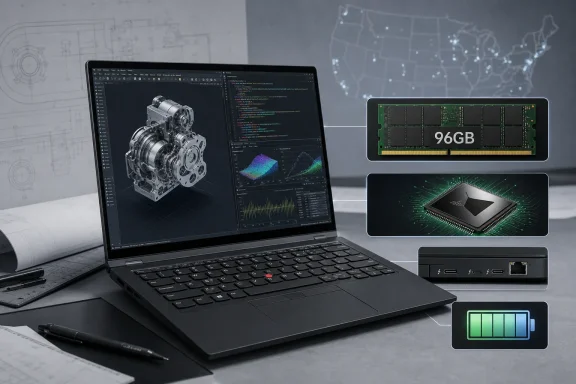 The 96GB claim comes with a speed caveat
Lenovo’s specification sheet confirms support for 16GB, 32GB, 64GB, and 96GB LPCAMM2 modules in a single dual-channel connector. It also confirms the module itself is LPDDR5X-8533. But Lenovo’s more detailed Product Specifications Reference adds an important qualification: the platform runs installed LPDDR5X-8533 memory at up to 7,467 MT/s, citing a platform limitation.
That is not a reason to dismiss the machine. A replaceable 96GB low-power memory module remains unusual in a 3.59-pound mobile workstation, particularly one with an Nvidia professional GPU. It does mean buyers should not interpret “8533” in marketing copy as the effective operating speed they will receive in the P14s i Gen 7.
The distinction also matters for IT procurement. LPCAMM2 gives organizations a path to standardize on a lower-memory configuration and later expand capacity without replacing the laptop or mainboard. Yet the design still provides only one memory connector, so there is no conventional two-SODIMM upgrade path and no opportunity to add a second module later. An upgrade means replacing the whole LPCAMM2 module already installed.
Lenovo has taken a similar serviceability approach to the battery and keyboard. Its data sheet calls both customer-replaceable, and lists 60Wh and 75Wh battery options. The U.S. configurations discussed by Notebookcheck use the 75Wh pack, which is the more sensible pairing for a system carrying a 3K, 120Hz display and a discrete GPU.
Nvidia RTX PRO is the dividing line between configurations
The entry U.S. model pairs a 16-core Core Ultra 7 356H with Nvidia’s RTX PRO 500 Blackwell laptop GPU, 32GB of memory, a 1TB SSD, and a 1,920 × 1,200, 60Hz IPS panel. The RTX PRO 500 has 6GB of GDDR7 memory, according to Lenovo’s PSREF documentation.
Higher configurations move to the RTX PRO 1000 Blackwell laptop GPU with 8GB of GDDR7. Lenovo assigns it a peak 440 AI TOPS figure, versus 294 TOPS for the RTX PRO 500. Those are vendor peak measurements using FP4 with sparsity, and Lenovo explicitly warns that its GPU TOPS figures are produced under different methods and should not be compared directly with Intel’s NPU or integrated-GPU numbers.
For workstation buyers, GPU memory capacity is the more practical specification. The RTX PRO 1000’s 8GB is still a modest allocation for large local AI models, high-resolution GPU rendering, or demanding simulation scenes. But it is a clear step above an integrated GPU for certified CAD, visualization, and accelerated creative applications. Lenovo lists ISV certification coverage that includes software from Autodesk, Dassault, Siemens, PTC, ANSYS, Bentley, Avid, and others.
The system’s GPU ceiling is also a reminder of its intended category. The P14s i Gen 7 is a portable workstation for CAD assemblies, engineering documents, code builds, field visualization, and moderate GPU-accelerated work. Buyers who need more than 8GB of dedicated VRAM, or who need sustained heavy rendering performance, should treat it as the compact option in Lenovo’s workstation catalog rather than an alternative to a ThinkPad P1 or larger P16-class system.
The display upgrade is far more than a refresh-rate bump
The base U.S. model’s 14.5-inch WUXGA panel is rated at 400 nits, 60Hz, and only 45% NTSC color coverage. That is adequate for office work, terminals, remote administration, and many engineering workflows, but it is a weak fit for color-critical content production on a laptop carrying a workstation price tag.
The higher-tier 3K IPS option changes that calculation. Lenovo specifies a 3,072 × 1,920 panel with 500-nit brightness, 100% DCI-P3 coverage, factory color calibration, and variable refresh operation from 30Hz to 120Hz. That screen accompanies the RTX PRO 1000 configurations reported for the U.S. market.
For buyers comparing preconfigured SKUs, the display matters as much as the processor bin. Paying more for a Core Ultra 7 366H or Core Ultra 9 386H package also buys a panel appropriate for design reviews, image work, and high-density application windows. A $3,669 workstation with a narrow-gamut 1200p screen and a $6,789 workstation with a calibrated 3K panel are not the same purchasing proposition, even when both carry the P14s name.
Lenovo’s own documentation conflicts on expansion
The P14s i Gen 7 platform specification presents a better connectivity story than the submitted retail summary suggests. Lenovo lists two Thunderbolt 4 ports, two 5Gbps USB-A ports, HDMI 2.0, a combo audio jack, and gigabit Ethernet. The wired Ethernet port is noteworthy: it removes the need for a dock or adapter for many enterprise deployments, lab networks, and imaging workflows.
There is, however, a documentation discrepancy around card-reader hardware. Lenovo’s product data sheet lists an SD Express 8.0 reader and calls the smart-card reader optional. Its PSREF document, which is normally the more granular configuration record, says “No card reader.” The company has not clearly reconciled those two statements in the material available for this launch.
The safer assumption for a U.S. buyer is that an SD reader should not be treated as guaranteed unless it appears in the exact machine-type specification or checkout configuration. The same caution applies to smart-card and cellular capability. Lenovo lists a Snapdragon X61 5G option with embedded eSIM support, while the PSREF says no physical SIM card is included. The submitted claim that a nano-SIM slot may be present is not supported by Lenovo’s current detailed specification record.
That leaves the P14s i Gen 7 with a fairly familiar business-workstation formula: Wi‑Fi 7, Bluetooth 5.4 hardware, wired Ethernet, Thunderbolt docking, optional 5G, Windows 11 Pro, Intel vPro on the appropriate processor configurations, a fingerprint reader, TPM 2.0, and ThinkPad’s self-healing BIOS features. Lenovo also lists Ubuntu Linux LTS and Red Hat Enterprise Linux 10.2 among the supported operating-system options, although enterprise buyers should validate the exact driver and certification requirements for their image before deployment.
North American availability fills a gap, but not every global option is here
Lenovo had already made the AMD-based ThinkPad P14s Gen 7 available in North America, using Ryzen AI PRO 400-series processors and Radeon integrated graphics. The Intel model establishes the option for buyers who need Nvidia RTX PRO graphics, Intel vPro configurations, or Lenovo’s Intel-specific platform mix.
North American buyers do not receive the full global processor menu as preconfigured retail options. Notebookcheck reports that Lenovo’s U.S. and Canadian lineup starts with the Core Ultra 7 356H rather than the entry Core Ultra 5 336H available in some overseas markets. The choice raises the purchase floor, but it also avoids a low-end SKU that would make little sense beside a $3,000-plus workstation configuration.
The P14s i Gen 7’s arrival gives Windows professionals a rare combination: 96GB-capable replaceable memory, a 75Wh battery option, wired Ethernet, Thunderbolt 4, and up to an 8GB RTX PRO GPU in a 14.5-inch, 3.59-pound chassis. Its limitation is equally clear: U.S. buyers are purchasing expensive fixed configurations, with only one internal SSD slot and a GPU ceiling that remains below the needs of serious local AI and rendering workloads. For teams that need the portability and memory more than maximum graphics throughput, Lenovo has finally put the right kind of 14-inch workstation on sale.
References
- Primary source: Notebookcheck
Published: August 9, 2026 at 8:37 AM UTC
Lenovo releases powerful 14-inch ThinkPad in the US with Nvidia RTX Pro graphics and up to 96GB RAM - Notebookcheck News
Lenovo has started selling the Intel Panther Lake-powered ThinkPad P14s Gen 7 in North America. Starting at $3,669, the 14-inch mobile workstation combines up to RTX Pro 1000 graphics with 96GB of replaceable LPCAMM2 RAM, while display options top out at 3K and 120Hz. www.notebookcheck.net
- Related coverage: lenovo.com
ThinkPad P14s Gen 7 (14” Intel) | Versatile AI-Powered Mobile Workstation | Lenovo US
The 14.5″ Lenovo ThinkPad P14s Gen 7 mobile workstation packs Intel® power into a portable design, with advanced AI features for premium performance.www.lenovo.com - Related coverage: lenovo.com
ThinkPad P14s Gen 7 (14” AMD) | Lightweight AI-Powered Mobile Workstation | Lenovo US
The Lenovo ThinkPad P14s Gen 7 AI-driven mobile workstation offers AMD power, certified performance, and smart features in an ultra-portable design.www.lenovo.com - Related coverage: techtoday.lenovo.com
NVIDIA Power User | Lenovo Tech Today US
techtoday.lenovo.com
- Related coverage: news.lenovo.com
Lenovo Unveils Next-Generation High-Performance Workstations and Announces the World’s First 1,000Wh/L Silicon-Anode Battery for Notebooks and Workstations - Lenovo StoryHub
ThinkPad and ThinkStation P Series workstations powered by NVIDIA RTX PRO Blackwell GPUs bring real-time AI inferencing to professionals.news.lenovo.com - Related coverage: notebookcheck.net
Lenovo releases new 14-inch ThinkPad with up to 96 GB LPCAMM2 RAM, Nvidia graphics and cellular connectivity - Notebookcheck News
Lenovo has finally released its new ThinkPad P14s. Available internationally, the ThinkPad P14s i Gen 7 combines Intel Panther Lake processors with up to 96 GB LPCAMM2 RAM, a 75 Wh battery, a 120 Hz display and 5G cellular connectivity.
www.notebookcheck.net
- Related coverage: psref.lenovo.com
- Related coverage: psref.lenovo.com
- Related coverage: laptopscheck.com
Last Call for 96GB: The Insane ThinkPad P14s Gen 7 is Finally Here (and It’s a RAM Monster)
It feels like just yesterday Lenovo was quietly whispering about updates to its legendary ThinkPad lineup. Between the AMD "Gorgon Point" and Intel "Pwww.laptopscheck.com
- Related coverage: notebookcheck.com
Dieser Lenovo Laptop kommt erstmals mit schnellem LPCAMM2-Speicher: Lenovo ThinkPad P14s Gen 7 Intel angekündigt - Notebookcheck News
Neben den größeren 16-Zoll-Modellen hat Lenovo auf der Nvidia GTC auch ein kleineres 14,5-Zoll-Modell mit RTX Pro GPUs angekündigt. Dabei ist der schnellere und effizientere LPCAMM2-Speicher die bedeutendste Neuerung, sowie die Intel Panther Lake CPUs. www.notebookcheck.com
- Related coverage: plugpcs.com
ThinkPad P14s Gen 7 Intel (14") Mobile Workstation vs ThinkPad P16s i Gen 5 Intel (16") Mobile Workstation: Specs & Price Comparison | Plug PCs
Compare the ThinkPad P14s Gen 7 Intel (14") Mobile Workstation and ThinkPad P16s i Gen 5 Intel (16") Mobile Workstation side by side: CPU, GPU, RAM, storage, display, price and where to buy. A free specs comparison on Plug PCs. plugpcs.com
- Related coverage: shi.com
- Related coverage: galaxus.nl
- Related coverage: yrityksille.elisa.fi
Lenovo ThinkPad P14s Gen 7 (Intel Core Ultra 7 356H) | Elisa Yrityksille
Lenovo ThinkPad P14s Gen 7 (Intel Core Ultra 7 356H) tarjoaa tehokkaan mobiilityöaseman RTX Pro ‑grafiikalla ja kevyellä, kestävällä rakenteella.yrityksille.elisa.fi - Related coverage: nanoreview.info
Lenovo ThinkPad P14s Gen 7 - review, specs, and rating | NanoReview
Comprehensive review of Lenovo ThinkPad P14s Gen 7 (2026): specifications, pros and cons, user ratings, reviews, and competition comparison.nanoreview.info - Related coverage: winprice.co.il
- Related coverage: connection.com
- Related coverage: lenovoshop.sk
- Related coverage: lenovoshop.sk

- Related coverage: thinkstation-specs.com
P14s i Gen 7 - Lenovo ThinkStation
thinkstation-specs.com