
Lenovo is reportedly preparing a Yoga 9n 2-in-1 built around NVIDIA RTX Spark, bringing the company’s new 20-core Arm-and-Blackwell platform into a 360-degree convertible rather than a conventional creator laptop. Images published by Windows Latest show a roughly 14-inch aluminum Yoga with a soundbar hinge, stylus support, IR camera hardware and a port selection that looks unusually broad for a thin Windows-on-Arm design.
That distinction matters. Lenovo has already been tied to the larger Yoga Pro 9n, a creator-oriented RTX Spark notebook, but the leaked Yoga 9n is a different product with a different chassis, cooling approach, speaker layout and use case. Where the Yoga Pro model aims at sustained production work, the Yoga 9n leak points to an attempt to put NVIDIA’s most ambitious Windows-on-Arm silicon into a machine expected to be carried, folded, annotated and used away from a desk.
Windows Latest first reported the Yoga 9n images on July 30. Lenovo has not announced the convertible, its specifications, price or release date, so the hardware details visible in the leak should be treated as preliminary rather than a product sheet.
RTX Spark is not simply a laptop GPU paired with an Arm processor. NVIDIA describes it as a superchip that connects a 20-core Grace CPU to a Blackwell RTX GPU through its NVLink-C2C interconnect, with a unified-memory architecture designed to scale as high as 128GB of LPDDR5X memory.
At the top end, NVIDIA rates the GPU at 6,144 CUDA cores and the whole platform at up to one petaflop of FP4 AI performance. Those figures are significant chiefly because they indicate what NVIDIA is trying to combine: the local AI memory capacity and CUDA software ecosystem normally associated with high-end workstation hardware, and the compact, integrated design expected from an Arm-based portable PC.
NVIDIA has confirmed that RTX Spark systems will arrive in 14- to 16-inch laptop designs, and that Lenovo is among the initial manufacturing partners. The company also lists the Lenovo Yoga Pro 9n among the RTX Spark machines in development. The Yoga 9n 2-in-1 itself, however, has appeared only through the Windows Latest leak; there is no public Lenovo confirmation that its final name, port layout or configuration will match what is pictured.
That is more than a technicality. The difference between a 15- or 16-inch creator notebook and a 14-inch convertible is the difference between designing around sustained thermal headroom and designing around mobility, touch input and flexible physical modes. RTX Spark’s headline specifications may be shared across the platform, but the real laptop experience will come down to its memory allocation, firmware, cooling system and power limits.
The visible design also includes an IR webcam for Windows Hello face sign-in, a physical privacy shutter, active stylus support and an aluminum chassis. These are not exotic features in isolation, but together they suggest Lenovo is positioning the machine as a polished everyday flagship rather than a repackaged developer system.
That could be strategically important for NVIDIA. RTX Spark’s debut messaging is heavy on local AI agents, CUDA, generative workloads, 3D creation and gaming features such as DLSS. A Yoga convertible puts those capabilities in front of people who may primarily want a premium Windows tablet-and-laptop hybrid for note-taking, video calls, media work and general productivity.
The leak does not establish the final display specification. The pictured chassis resembles Lenovo’s Intel-based Yoga 9i family closely enough that observers have inferred a 2.8K PureSight Pro OLED panel, but Windows Latest did not present that as confirmed. A 14-inch OLED would be consistent with NVIDIA’s broader RTX Spark laptop plans, which call for color-accurate tandem OLED displays in systems as thin as 14mm, but Lenovo still has not specified the panel, refresh rate, brightness, touch digitizer or G-SYNC support for this model.
For prospective buyers, that uncertainty is substantial. A convertible’s panel is not a peripheral detail: it determines the usefulness of the device in tablet mode, the quality of pen input and whether the system makes sense as a mobile editing or illustration machine.
HDMI is particularly useful in corporate environments and classrooms where a direct connection to a display or projector is still routine. Dual USB-A ports preserve compatibility with receivers, storage devices and legacy peripherals without an adapter. Two USB-C ports should provide welcome flexibility for charging, docks and modern accessories.
But the visible connectors do not answer the questions that matter most to power users. Windows Latest could not confirm the USB-C ports’ data rates, display support, USB4 or Thunderbolt-class capabilities, or whether both ports will accept charging. On an RTX Spark system intended to support demanding creative and AI workloads, those details determine whether the machine can realistically serve as a one-cable desktop replacement.
The comparison with the Yoga Pro 9n makes the point clearer. Reporting on the larger creator machine has described a more expansive design with a full-size SD card slot, separate cooling provisions and six-speaker audio. The Yoga 9n should not be read as a folding version of that notebook. It is a separate attempt to fit the same platform category into a more versatile, but potentially more thermally constrained, form factor.
For developers, that may mean a machine capable of handling larger local models, CUDA-accelerated development work and GPU-assisted creative tools without stepping up to a bulky workstation. NVIDIA says CUDA runs natively on RTX Spark and is positioning the platform around on-device AI agents, content creation and gaming rather than treating it as another low-power Windows-on-Arm option.
The word “up to” does a great deal of work, though. Lenovo has not said whether the Yoga 9n will ship with 32GB, 64GB, 128GB or another memory tier. It has not disclosed the CPU and GPU power envelope, fan behavior, battery capacity, charging specifications or sustained performance targets. NVIDIA’s one-petaflop claim is based on FP4 low-precision AI computation, which is meaningful for compatible inference workloads but should not be mistaken for a universal performance rating for games, rendering or traditional Windows applications.
A 14-inch convertible also has limited room to dissipate heat compared with Lenovo’s larger Yoga Pro chassis. That does not mean the Yoga 9n cannot be fast; it means benchmark expectations should wait for production hardware. The unanswered question is not whether the Blackwell GPU has 6,144 CUDA cores, but how aggressively Lenovo can power those cores while maintaining surface temperatures, acoustics and battery life appropriate for a tablet-capable machine.
Still, platform maturity cannot be measured only by whether an application launches. Emulated desktop software can have different performance characteristics, drivers and plug-ins may not be Arm-ready, and specialty hardware often has a longer migration path than mainstream productivity software. Microsoft’s own documentation notes that some Prism performance features are tuned for Snapdragon X hardware, a reminder that RTX Spark will be a new processor family entering an ecosystem that has recently centered on Qualcomm-based Windows Arm PCs.
NVIDIA’s contribution is intended to change part of that equation. Its native CUDA stack, RTX technologies and work with Microsoft on Windows security primitives and NVIDIA OpenShell give Spark an explicit software story that previous Windows-on-Arm machines lacked. NVIDIA has also said that Adobe and Blender are rebuilding applications for RTX Spark, although users should wait for the exact release status and feature coverage before assuming their preferred production workflow is native and fully accelerated.
For IT administrators, the arrival of another Arm platform also means validation work. Standard Windows management, Microsoft 365 and browser-based workloads are the easy cases. The harder cases are endpoint agents, VPN clients, smart-card middleware, print drivers, proprietary line-of-business add-ins and kernel-dependent utilities. A premium 2-in-1 is not likely to be the first choice for broad enterprise deployment, but it could quickly appear in executive, creative and developer fleets.
The Yoga 9n leak is therefore more consequential than another unreleased Lenovo convertible. If the images reflect a shipping product, NVIDIA RTX Spark will arrive not only in large creator laptops and compact desktops, but in a form factor where battery life, touch, pen support, thermals and Windows compatibility are tested every day.
Lenovo’s next announcement needs to answer the practical questions the photographs cannot: memory configurations, display specification, port speeds, battery capacity, sustained performance, price and availability. Until then, the Yoga 9n is a compelling outline of what NVIDIA wants Windows-on-Arm to become—provided the final machine can make its Blackwell hardware feel as natural in tablet mode as it does on a specification slide.
Windows Latest first reported the Yoga 9n images on July 30. Lenovo has not announced the convertible, its specifications, price or release date, so the hardware details visible in the leak should be treated as preliminary rather than a product sheet.
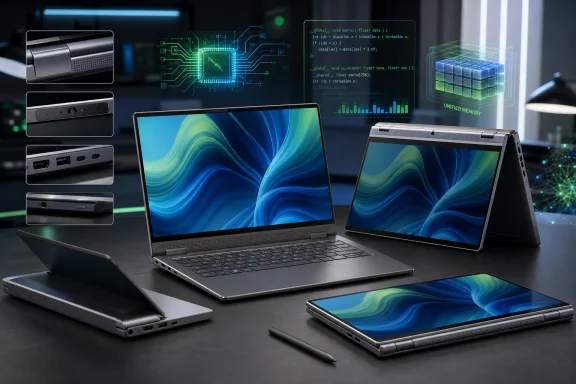 A Full RTX Spark Platform in a Convertible Chassis
RTX Spark is not simply a laptop GPU paired with an Arm processor. NVIDIA describes it as a superchip that connects a 20-core Grace CPU to a Blackwell RTX GPU through its NVLink-C2C interconnect, with a unified-memory architecture designed to scale as high as 128GB of LPDDR5X memory.At the top end, NVIDIA rates the GPU at 6,144 CUDA cores and the whole platform at up to one petaflop of FP4 AI performance. Those figures are significant chiefly because they indicate what NVIDIA is trying to combine: the local AI memory capacity and CUDA software ecosystem normally associated with high-end workstation hardware, and the compact, integrated design expected from an Arm-based portable PC.
NVIDIA has confirmed that RTX Spark systems will arrive in 14- to 16-inch laptop designs, and that Lenovo is among the initial manufacturing partners. The company also lists the Lenovo Yoga Pro 9n among the RTX Spark machines in development. The Yoga 9n 2-in-1 itself, however, has appeared only through the Windows Latest leak; there is no public Lenovo confirmation that its final name, port layout or configuration will match what is pictured.
That is more than a technicality. The difference between a 15- or 16-inch creator notebook and a 14-inch convertible is the difference between designing around sustained thermal headroom and designing around mobility, touch input and flexible physical modes. RTX Spark’s headline specifications may be shared across the platform, but the real laptop experience will come down to its memory allocation, firmware, cooling system and power limits.
The Hinge Turns NVIDIA’s PC Bet Into a Yoga
The leaked Yoga 9n appears to follow Lenovo’s familiar premium convertible formula: laptop, tent, stand and tablet modes enabled by a 360-degree hinge. The hinge also incorporates a soundbar-style speaker system, a hallmark of Lenovo’s higher-end Yoga designs and a practical answer to a problem that tablet mode creates: conventional bottom-firing speakers can easily end up facing the wrong way.The visible design also includes an IR webcam for Windows Hello face sign-in, a physical privacy shutter, active stylus support and an aluminum chassis. These are not exotic features in isolation, but together they suggest Lenovo is positioning the machine as a polished everyday flagship rather than a repackaged developer system.
That could be strategically important for NVIDIA. RTX Spark’s debut messaging is heavy on local AI agents, CUDA, generative workloads, 3D creation and gaming features such as DLSS. A Yoga convertible puts those capabilities in front of people who may primarily want a premium Windows tablet-and-laptop hybrid for note-taking, video calls, media work and general productivity.
The leak does not establish the final display specification. The pictured chassis resembles Lenovo’s Intel-based Yoga 9i family closely enough that observers have inferred a 2.8K PureSight Pro OLED panel, but Windows Latest did not present that as confirmed. A 14-inch OLED would be consistent with NVIDIA’s broader RTX Spark laptop plans, which call for color-accurate tandem OLED displays in systems as thin as 14mm, but Lenovo still has not specified the panel, refresh rate, brightness, touch digitizer or G-SYNC support for this model.
For prospective buyers, that uncertainty is substantial. A convertible’s panel is not a peripheral detail: it determines the usefulness of the device in tablet mode, the quality of pen input and whether the system makes sense as a mobile editing or illustration machine.
Ports Suggest Lenovo Is Avoiding the Thin-PC Trap
The photos show HDMI, two USB-A ports, two USB-C ports and a 3.5mm headphone jack. If that layout survives into production, the Yoga 9n would avoid the minimalist port strategy that has frustrated buyers of many premium thin-and-light machines.HDMI is particularly useful in corporate environments and classrooms where a direct connection to a display or projector is still routine. Dual USB-A ports preserve compatibility with receivers, storage devices and legacy peripherals without an adapter. Two USB-C ports should provide welcome flexibility for charging, docks and modern accessories.
But the visible connectors do not answer the questions that matter most to power users. Windows Latest could not confirm the USB-C ports’ data rates, display support, USB4 or Thunderbolt-class capabilities, or whether both ports will accept charging. On an RTX Spark system intended to support demanding creative and AI workloads, those details determine whether the machine can realistically serve as a one-cable desktop replacement.
The comparison with the Yoga Pro 9n makes the point clearer. Reporting on the larger creator machine has described a more expansive design with a full-size SD card slot, separate cooling provisions and six-speaker audio. The Yoga 9n should not be read as a folding version of that notebook. It is a separate attempt to fit the same platform category into a more versatile, but potentially more thermally constrained, form factor.
Raw AI Numbers Will Not Set the User Experience
NVIDIA’s “up to” figures are impressive, especially the 128GB unified-memory ceiling. In theory, that pool gives local AI workloads access to far more memory than is common in conventional thin laptops, while removing the hard divide between system RAM and a discrete GPU’s VRAM.For developers, that may mean a machine capable of handling larger local models, CUDA-accelerated development work and GPU-assisted creative tools without stepping up to a bulky workstation. NVIDIA says CUDA runs natively on RTX Spark and is positioning the platform around on-device AI agents, content creation and gaming rather than treating it as another low-power Windows-on-Arm option.
The word “up to” does a great deal of work, though. Lenovo has not said whether the Yoga 9n will ship with 32GB, 64GB, 128GB or another memory tier. It has not disclosed the CPU and GPU power envelope, fan behavior, battery capacity, charging specifications or sustained performance targets. NVIDIA’s one-petaflop claim is based on FP4 low-precision AI computation, which is meaningful for compatible inference workloads but should not be mistaken for a universal performance rating for games, rendering or traditional Windows applications.
A 14-inch convertible also has limited room to dissipate heat compared with Lenovo’s larger Yoga Pro chassis. That does not mean the Yoga 9n cannot be fast; it means benchmark expectations should wait for production hardware. The unanswered question is not whether the Blackwell GPU has 6,144 CUDA cores, but how aggressively Lenovo can power those cores while maintaining surface temperatures, acoustics and battery life appropriate for a tablet-capable machine.
Windows on Arm Is Ready Enough—But Not a Blank Check
Microsoft’s Windows 11 on Arm can emulate both x86 and x64 applications through Prism, and Arm-native apps run without translation. That baseline is far better than the early Windows-on-Arm experience, and it makes an RTX Spark Yoga more plausible as a general-purpose PC than earlier Arm laptops.Still, platform maturity cannot be measured only by whether an application launches. Emulated desktop software can have different performance characteristics, drivers and plug-ins may not be Arm-ready, and specialty hardware often has a longer migration path than mainstream productivity software. Microsoft’s own documentation notes that some Prism performance features are tuned for Snapdragon X hardware, a reminder that RTX Spark will be a new processor family entering an ecosystem that has recently centered on Qualcomm-based Windows Arm PCs.
NVIDIA’s contribution is intended to change part of that equation. Its native CUDA stack, RTX technologies and work with Microsoft on Windows security primitives and NVIDIA OpenShell give Spark an explicit software story that previous Windows-on-Arm machines lacked. NVIDIA has also said that Adobe and Blender are rebuilding applications for RTX Spark, although users should wait for the exact release status and feature coverage before assuming their preferred production workflow is native and fully accelerated.
For IT administrators, the arrival of another Arm platform also means validation work. Standard Windows management, Microsoft 365 and browser-based workloads are the easy cases. The harder cases are endpoint agents, VPN clients, smart-card middleware, print drivers, proprietary line-of-business add-ins and kernel-dependent utilities. A premium 2-in-1 is not likely to be the first choice for broad enterprise deployment, but it could quickly appear in executive, creative and developer fleets.
The Yoga 9n leak is therefore more consequential than another unreleased Lenovo convertible. If the images reflect a shipping product, NVIDIA RTX Spark will arrive not only in large creator laptops and compact desktops, but in a form factor where battery life, touch, pen support, thermals and Windows compatibility are tested every day.
Lenovo’s next announcement needs to answer the practical questions the photographs cannot: memory configurations, display specification, port speeds, battery capacity, sustained performance, price and availability. Until then, the Yoga 9n is a compelling outline of what NVIDIA wants Windows-on-Arm to become—provided the final machine can make its Blackwell hardware feel as natural in tablet mode as it does on a specification slide.
References
- Primary source: www.guru3d.com
Published: 2026-07-31T07:03:00+00:00
Loading…
www.guru3d.com - Related coverage: nvidia.com
NVIDIA RTX Spark — Slim Laptops & Small Desktops
The fusion of NVIDIA AI and RTX graphics in slim laptops and small desktops. For creators, developers, and gamers.www.nvidia.com - Related coverage: forums.developer.nvidia.com
Loading…
forums.developer.nvidia.com - Related coverage: gizmochina.com
Loading…
www.gizmochina.com - Related coverage: muycomputer.com
Loading…
www.muycomputer.com - Related coverage: gadgets360.com
Loading…
www.gadgets360.com - Related coverage: tweaktown.com
Loading…
www.tweaktown.com - Related coverage: de.ghacks.net
Loading…
de.ghacks.net - Related coverage: tomsguide.com
All 8 laptops launching with Nvidia RTX Spark this fall — and what they can do | Tom's Guide
Nvidia's first-ever all-in-one laptop silicon chip is coming to machines this fall and laptops from Dell, Asus, HP and others are already confirmed.www.tomsguide.com - Related coverage: tomsguide.com
Loading…
www.tomsguide.com - Related coverage: creativebloq.com
Loading…
www.creativebloq.com - Related coverage: learn.microsoft.com
Loading…
learn.microsoft.com - Related coverage: learn.microsoft.com
Loading…
learn.microsoft.com