
XenoSpectrum’s anniversary report correctly separates two dates that are often blended into one origin story. On August 25, 1991, Torvalds posted to the comp.os.minix Usenet group about an operating system he was developing for 386 and 486 AT-compatible PCs. The first public source package, Linux 0.01, followed on September 17, 1991. Kernel.org’s preserved release material and historical accounts agree that 0.01 was incomplete, hardware-specific, and intended to be compiled under Minix rather than installed as a self-sufficient operating system.
The distinction matters in 2026 because Linux has acquired a mythology of inevitability. It was not a polished alternative to commercial Unix or a ready-made replacement for Minix. It was a narrow, unfinished kernel that became useful precisely because its limits were exposed early enough for other people to work on them.
 August 25 was a call for collaborators
Torvalds’s August 25 message said he had been working since April and had reached the point where Bash and GCC could run. It also described the project as a “hobby” and explicitly warned that it was tied to the 386 architecture. The code was not offered that day, and its author did not claim it was broadly portable.
When Linux 0.01 appeared on September 17, its release notes reinforced that caution. It had been tested on two machines and supported only a subset of AT hardware: hard disks, display, keyboard, and serial lines. Key system calls including mount and umount were absent. The keyboard layout was hard-coded for Finnish use, and users needed Minix to boot it.
Those limitations were not incidental bugs around an otherwise modern operating system. They were the design boundaries of an early kernel built around one developer’s Intel 386 PC. It used x86 paging, segmentation, and task-switching capabilities directly; the portability that now lets Linux power Arm laptops, RISC-V boards, IBM mainframes, routers, cloud hosts, and x86 workstations came later.
The more useful anniversary date depends on what is being measured. August 25 marks the public invitation to participate. September 17 marks the availability of code that others could inspect, compile, and modify. Calling either one Linux’s singular “birthday” is convenient shorthand, but it obscures how quickly the project moved from private experiment to shared engineering work.
Linux 7.2 shows the scale, but not the deployment target
The current mainline kernel is Linux 7.2, released on August 16, 2026. Kernel.org lists it as the latest mainline release, and Linux Journal separately reported the release after a seven-release-candidate cycle. That confirms the immediate premise behind XenoSpectrum’s retrospective: Linux did not pause for its anniversary; a new mainline release had arrived nine days earlier.
XenoSpectrum calculates that Linux 0.01 contained 9,877 physical lines across selected source files, while Linux 7.2 contains 39,815,032 physical lines in C, headers, assembly, Rust, and Device Tree files. By its method, that is roughly a 4,031-fold increase in source lines and an 867-fold increase in the number of source-type files.
The magnitude is credible, but readers should treat the precise multiplier as a method-dependent measurement, not a canonical measure of Linux’s worth or complexity. A count of physical lines changes according to whether blank lines, comments, generated files, documentation, tests, bindings, architecture data, build definitions, and vendored components are included. XenoSpectrum describes the classes it counted, but does not publish the command, exclusions, or full file inventory needed for another researcher to reproduce its exact 9,877 and 39,815,032 totals.
There is also a historical reason to be cautious about comparing line-count figures as if they were fixed. A Linux Foundation symposium presentation from 2011 put Linux 0.01 at 10,239 lines of source, rather than XenoSpectrum’s 9,877. That does not establish that either count is wrong; it demonstrates the point. The number varies with what the counter defines as source and what it includes. XenoSpectrum’s figure remains useful as an illustration of scale, but it should not be read as a productivity score or a measure of code quality.
For Windows users and administrators, the practical comparison is more direct: kernel source growth means a larger hardware and compatibility surface, not an instruction to install the newest version. A modern Linux kernel includes drivers, architecture support, security changes, filesystems, virtualization plumbing, scheduler code, and platform-specific work that may never execute on a particular PC. The maintenance challenge is selecting the code appropriate to a system, then carrying security and stability fixes without importing avoidable regressions.
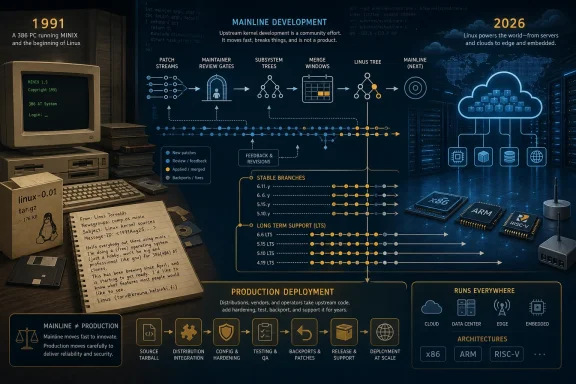
That is why mainline Linux 7.2 is not the version most server fleets, corporate desktops, or embedded products will adopt unchanged. As of August 27, kernel.org lists Linux 7.1.10 as the active stable series and lists 6.18.46, 6.12.105, 6.6.153, 6.1.184, 5.15.217, and 5.10.266 as active long-term-supported branches. Distribution vendors commonly maintain their own kernels and backport selected fixes. A machine reporting a version such as 6.12.x or a vendor-suffixed kernel is not necessarily behind; it may be on the support track chosen for its lifecycle.
The review pipeline is the real scaling mechanism
The kernel’s own development documentation describes a project involving roughly 2,000 developers over a year. That figure should not be mistaken for a current headcount of people all working at once, but it gives a sense of why Torvalds cannot personally inspect every patch sent toward mainline.
The project’s answer is a chain of trust. Contributors post patches to the relevant technical communities; subsystem maintainers select and test work in their own trees; higher-level maintainers aggregate it; Torvalds retains authority over the final mainline tree. The kernel documentation notes that, even in the much smaller Linux 2.6.38 cycle, Torvalds directly selected only 112 of more than 9,500 patches. Delegation was already a necessity, not an optional courtesy.
This is the piece of the Linux story that explains durability better than raw source totals do. The project distributes authority without pretending that all changes deserve equal confidence. A storage change, an AMD graphics driver revision, a RISC-V architecture patch, and a networking fix travel through maintainers who are expected to know their portion of the code well enough to reject, revise, or escalate it.
Linux’s documented release cadence turns that organizational structure into operational discipline. A roughly two-week merge window accepts features that have already been developed and staged. Once it closes, weekly release candidates are intended to stabilize the next version over roughly six to ten weeks. After final release, the stable team backports qualifying fixes into maintenance releases.
The project’s own process guide says a typical major release can contain about 13,000 changesets. XenoSpectrum counted 17,833 commit headers in ChangeLog-7.2. Those figures are not equivalent—a commit header is not automatically a distinct changeset in every analytical sense—but they point in the same direction: Linux 7.2’s development cycle exceeded the already large workload that official documentation uses as a typical example.
GPL adoption made commercial distribution possible, not automatic cooperation
The first Linux release was not distributed under the licensing terms associated with the kernel today. Linux 0.01’s release notes required preservation of source and copyright notices but prohibited distribution for a fee. That restriction was significant: a system that could not be redistributed commercially had a limited path into boxed products, supported deployments, and hardware bundles.
By Linux 0.12, Torvalds had shifted the project to the GNU General Public License. Kernel.org material from the Linux Foundation’s 20-year retrospective identifies 0.12 as the release that switched to the GNU GPL, while the current kernel COPYING file identifies the kernel as GPL-2.0-only, with the separate Linux syscall note covering the user-space interface.
The change cleared a legal barrier to commercial redistribution, but it did not magically create the development model that Linux depends on. Companies can sell systems that include Linux, and they can employ kernel developers, but valuable changes still have to survive public technical review if they are to land upstream. Vendors that maintain broad private patch stacks assume the ongoing cost of rebasing, testing, fixing, and carrying those changes themselves.
For IT teams, that remains the operational value of upstream Linux. Upstream support is not an ideological badge; it reduces the amount of local kernel maintenance a distributor or device maker must perform. The same principle applies to Windows environments using WSL, Hyper-V virtual machines, containers, networking appliances, NAS systems, developer workstations, or cloud services built on Linux hosts: the kernel version and its support path matter more than whether a product advertises the latest mainline number.
The next milestone is maintenance capacity
Linux at 35 is a project with more code, more supported hardware, and more contributors than its creator could have anticipated in 1991. Its success has depended on replacing the assumptions of Linux 0.01 rather than preserving them: it traded a single x86 PC target for broad architecture support, a single author’s direct control for maintainer hierarchies, and a private hobby project for public review.
The pressure point is now clear. Linux can accept tens of thousands of commits in a development cycle only if maintainers have time, authority, test coverage, and enough institutional memory to judge them. The next important Linux release will not be defined by its version number alone. It will be defined by whether the project can keep reviewing and supporting the code it has already invited the world to depend on.
