
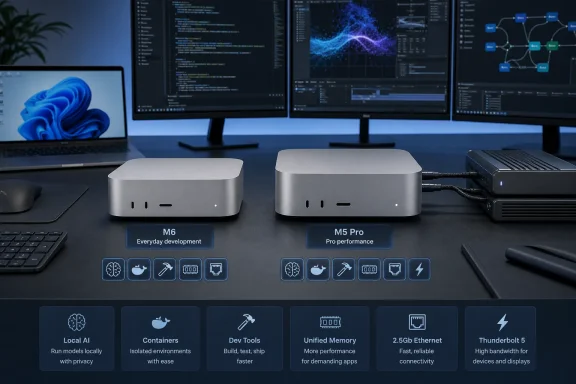
Mashable first highlighted the preorder window and the steep configuration costs. Apple’s August 25 announcement confirms the dates, base pricing, memory ceilings, connectivity changes, and the fact that the two versions are not simple generation-to-generation alternatives. Despite its older-looking name, the M5 Pro Mac mini is the substantially more capable configuration: it has higher memory bandwidth, more memory headroom, more CPU and GPU cores, and Thunderbolt 5.
That distinction is the practical story behind Apple’s new miniature desktop. Buyers who treat “M6” as automatically newer and therefore better could end up with a system that is faster for everyday CPU work but poorly matched to the heavier local-model, virtual-machine, media, or high-speed-storage workloads that prompted them to shop for a Mac mini in the first place.
 The preorder route is straightforward — but retail timing is not
As of August 27, Apple is taking orders through its online store and Apple Store app in the United States and 29 other countries and regions. Apple says customers will begin receiving machines on September 22, the same date they will reach Apple Stores and Apple Authorized Resellers.
That confirms Mashable’s central advice: an order placed through Apple is currently the clear way to reserve either model. The article anticipated that Amazon, Best Buy, Walmart, and other authorized sellers might add preorder listings, but Apple has not announced a retailer-by-retailer preorder plan. “Available from September 22” does not necessarily mean every retailer will offer the same configurations, delivery dates, or education pricing.
For organizations, that matters. A direct Apple order exposes the full configure-to-order catalog, whereas business procurement portals and big-box retailers commonly limit buyers to a handful of stock configurations. Those limits are especially relevant here because the choices that define the M5 Pro’s usefulness — 48GB or 64GB of unified memory, 10Gb Ethernet, and higher SSD capacity — are not changes that can be made after purchase.
The Mac mini remains a headless desktop. Its listed price does not include a display, keyboard, mouse, or a Windows-compatible KVM setup. That has always been part of the model’s appeal for homes and offices that already own peripherals, but the higher starting price means buyers should count the full workstation cost rather than comparing the Mac mini sticker price with a complete Windows mini PC bundle.
M6 is the general-purpose choice; M5 Pro is the workstation
Apple positions the M6 Mac mini as its mainstream model. It has a 12-core CPU, 12-core GPU, 16GB of unified memory as standard, and a 32GB ceiling. Apple says it provides up to 40 percent faster CPU performance, twice the graphics performance, twice the SSD speed, and up to four times the AI performance relative to a Mac mini with M4. Those are Apple’s own measurements on selected workloads, not independent benchmarks, and no major outlet has yet published a full review using retail hardware.
The M5 Pro version starts with a 15-core CPU and 16-core GPU, with an option for an 18-core CPU and 20-core GPU. More important than its core count for many technical buyers, it can be configured with up to 64GB of unified memory and 307GB/s of memory bandwidth. The M6 tops out at 32GB and 170GB/s.
PCWorld, which examined the announced specifications for local-model use, makes the important point that independent testing is still absent. Apple’s claims about LLM prompt processing and other AI gains should therefore be viewed as a performance target rather than a purchasing guarantee. But the published hardware limits alone establish a clear divide: 16GB or even 32GB of shared memory is restrictive for people who want to run larger local language models, multiple containers, developer tools, or memory-heavy creative software concurrently.
Windows users planning to add a Mac to a mixed environment should choose by workload rather than processor naming:
- The $899 M6 model fits general office work, web development, Apple-platform build tasks, light photo and video work, remote administration, and testing software that does not demand large virtual machines or local models.
- The M5 Pro is the sensible starting point for Xcode and iOS build workloads, sustained media production, local AI inference, heavier Docker use, and storage workflows that benefit from Thunderbolt 5. Its higher memory options are central to that recommendation.
- Neither model should be bought on the assumption that memory can be expanded later. Apple’s unified memory is part of the system-on-chip package, and the internal SSD configuration is a purchase-time decision for ordinary buyers.
This also explains why Apple’s choice to sell an M5 Pro alongside M6 is less strange than it first appears. The M6 is the newer base-class silicon; the M5 Pro remains the larger professional-class chip. The product names convey chronology, not a single linear performance ranking.
The connectivity changes matter to managed deployments
The upgraded networking and I/O are more useful than Apple’s AI marketing suggests. Both new Mac mini models include Wi-Fi 7, Bluetooth 6, and 2.5Gb Ethernet as standard, with 10Gb Ethernet available as a $100 configuration option. The M6 has three Thunderbolt 4 ports, while the M5 Pro has three Thunderbolt 5 ports. Each retains front USB-C ports, HDMI, and a front headphone jack.
For a single desktop, 2.5Gb Ethernet is a welcome baseline improvement over the 1Gb standard port on the older Mac mini. For an office, lab, or homelab, it makes the machine easier to use with multi-gig NAS storage, faster internal backups, and shared build artifacts without immediately requiring the 10Gb option. IT teams should still verify switching, cabling, and NAS support before treating 2.5Gb as an automatic upgrade; many existing networks will continue to negotiate at 1Gb.
Thunderbolt 5 is exclusive to M5 Pro, and that is a larger separator than it may sound. It is the model to consider where fast external NVMe storage, high-bandwidth docks, capture hardware, or multiple attached systems are part of the job. Apple also says Thunderbolt 5 can be used to link Mac mini systems for local AI work, though it has not published practical scaling figures or described the software configuration in enough detail to make that a deployment recommendation today.
Apple says both models can natively support up to three external displays. That preserves the current Mac mini’s desk-friendly role, but it does not eliminate the usual compatibility work in mixed fleets: shops relying on DisplayLink adapters, niche USB-C docks, remote-control hardware, or Windows-centric endpoint-management agents should validate their full peripheral chain before standardizing on the new machines.
The price increase is more concrete than the claimed AI leap
The M6 Mac mini costs $899 with 16GB of memory and 256GB of storage. That is $100 above the M4 Mac mini’s June 2026 price, according to MacRumors, and $300 above the M4 model’s original $599 launch price in late 2024. The M5 Pro starts at $1,699, up $100 from the M4 Pro’s June price and $300 over its original $1,399 price.
Tom’s Hardware and MacRumors both documented the rise in the previous Mac mini’s price earlier this year, against a broader market backdrop of higher memory and storage costs. Mashable attributes the new prices in part to a “global memory shortage,” but Apple’s announcement does not identify memory supply as the reason for this Mac mini increase. The defensible conclusion is simpler: the new base prices are higher, while Apple has not publicly broken out the cost drivers.
The more punishing costs appear in Apple’s build-to-order menu. Daring Fireball’s reconstruction of the Apple configurator shows that taking the M6 from 16GB to 32GB adds $400, while upgrading its 256GB SSD to 1TB adds $500. A fully specified M6 reaches $2,399.
On M5 Pro, the 48GB memory option adds $600 and 64GB adds $1,000. Moving from 512GB to an 8TB internal SSD adds $3,800; choosing the higher 18-core CPU and 20-core GPU costs another $200. That is how Mashable arrives at a maximum price of $6,799.
Those numbers produce an awkward but useful purchasing rule: pay Apple for memory before paying Apple for internal storage if the intended work involves local models, VMs, containers, or large working sets. External Thunderbolt NVMe storage can expand capacity later, especially on M5 Pro. Unified memory cannot. Conversely, a buyer whose workload is browser, office, remote desktop, and small development projects should resist treating the configuration page as a checklist of future-proofing upgrades.
Existing M4 and M4 Pro owners have little reason to rush
Apple’s M6 performance claims look substantial beside the base M4, especially for its chosen AI tests. Yet an M4 Mac mini with adequate memory and storage remains a capable compact desktop, and M4 Pro owners already have a system with much of the professional I/O profile that motivates the new M5 Pro model.
The strongest upgrade case is narrower: users constrained by 16GB or 24GB of memory, people who need the M5 Pro’s 64GB ceiling and 307GB/s bandwidth, or sites that can use standard 2.5Gb Ethernet and Thunderbolt 5 immediately. The new M6 alone is not a reason to replace a working M4 Pro simply because its chip number is higher.
For prospective buyers, the September 22 shipping date leaves a short preorder period but no demonstrated shortage. Apple has announced the products; it has not said that launch supply will be limited, and no independent outlet has reported allocation constraints. The decision worth making before ordering is whether the Mac mini will remain a modest desktop or become an always-on technical node. That answer determines whether $899 buys enough machine — or whether the M5 Pro’s expensive memory and I/O advantages are the actual cost of admission.
